Finance
Developing · 0 updatesFact 8/10Broadcom’s Annual Report Points to AI Demand Across Semiconductor Supply Chains
Article language
English
Broadcom’s SEC annual report says AI growth is requiring the semiconductor industry to design, manufacture, and deliver products on time, while demand for networking solutions, custom AI accelerators, and AI networking products supported semiconductor-solution revenue. The filing highlights how AI infrastructure spending and supply-chain constraints are moving together.
Open article · no sign-in required
Sources and disclosure
What happened
Broadcom’s SEC annual report says the AI buildout is creating pressure across the semiconductor industry to design, manufacture, and deliver products on time. In the same filing, the company said revenue in its semiconductor solutions segment rose on demand for networking solutions, including custom AI accelerators and AI networking products. That combination matters because it links two themes that often get discussed separately: the scale of AI infrastructure spending and the operational requirements needed to support it.
This is not a quarterly earnings surprise and not a standalone product announcement. It is a filing-level signal, which makes it more useful for reading the medium-term structure of demand than for drawing conclusions about a single quarter. The source metadata is limited, so the analysis should stay close to what Broadcom itself disclosed. The report indicates demand strength in AI-related networking and custom silicon, but it does not provide the full customer breakdown, order book detail, or supply-chain metrics that would allow a more precise estimate of timing.
Why the market cares
For investors and operators alike, the important point is that AI spending is no longer just a story about accelerators. Large-scale model training and inference require a broader stack: networking, switching, interconnects, custom silicon, and the data-center systems that move workloads efficiently. Broadcom sits in a strategic position within that stack. When it says AI growth is putting pressure on the industry to deliver on time, it is describing a market where demand is broadening faster than the ecosystem can always absorb it.
That has implications for several layers of the technology supply chain. Semiconductor design houses may see stronger demand for specialized chips. Networking vendors may benefit from higher data-center throughput needs. Packaging, testing, and manufacturing partners may face tighter schedules. Even if the filing does not quantify those effects, the direction of travel is clear: AI infrastructure is becoming a systems-level capex cycle rather than a single-product cycle.
The market also cares because Broadcom is one of the companies most closely associated with custom AI silicon and high-speed networking. When a company with that exposure highlights demand strength in those categories, it can reinforce the view that AI capex remains concentrated in infrastructure rather than only in software or application layers. That matters for sector positioning, but the filing itself does not justify any trading conclusion. This is market context only, not investment advice.
Tech / policy link
Technically, the filing underscores a basic reality of the AI race: model capability depends on physical infrastructure. Custom AI accelerators are only part of the equation. The networking fabric that connects chips, servers, and clusters is increasingly central to performance, latency, and utilization. Broadcom’s mention of AI networking products suggests that the market is rewarding not just compute density, but also the ability to move data efficiently across large systems.
From a policy perspective, the filing does not point to a specific regulation or deadline. Still, the pressure to design, manufacture, and deliver on time is not isolated from policy risk. Semiconductor supply chains remain sensitive to export controls, localization incentives, advanced packaging capacity, and permitting or power constraints around data-center expansion. None of those factors can be inferred directly from this filing, but they are the policy backdrop against which AI infrastructure spending is being executed.
Market Lens
Trigger: Broadcom’s annual report explicitly linked AI growth to pressure on the semiconductor industry and said semiconductor-solution revenue rose on demand for networking solutions, custom AI accelerators, and AI networking products.
Mechanism: If AI demand is concentrated in networking and custom silicon, then revenue can flow to the companies that design and integrate those systems, while the broader supply chain faces tighter delivery schedules. That can affect lead times, manufacturing utilization, and capex planning across the ecosystem.
Affected assets / sectors: Directly, Broadcom and other semiconductor design and networking names are in scope. Indirectly, semiconductor equipment, packaging, testing, optical interconnect, and data-center infrastructure suppliers may be relevant. At the index level, semiconductor-heavy benchmarks and technology indices with AI infrastructure exposure could be sensitive. Any specific ETF or price reaction is unverified from this source alone.
Time horizon: Medium term. Annual-report language is more relevant to the next several quarters than to a one-day market move.
Next check: The most concrete follow-up is Broadcom’s next earnings date, listed in the market-data context as September 3, along with management commentary on AI-related revenue mix, customer demand, and supply constraints. Additional checks include future SEC filings, capex commentary from hyperscale customers, and any official updates on manufacturing or delivery timing. Because the source does not provide a ticker-level market reaction, any causal price interpretation remains unverified.
What to watch next
The first question is whether demand in networking and custom AI accelerators remains durable or whether it normalizes after a period of accelerated buildout. The second is whether Broadcom or its customers provide more detail on where the bottlenecks sit: design cycles, manufacturing capacity, packaging, testing, or deployment. The third is whether hyperscale customers continue to support large infrastructure budgets, since that is the demand engine behind much of the AI hardware cycle.
A fourth issue is whether the industry’s delivery pressure becomes a broader planning constraint. If lead times lengthen or deployment schedules slip, that can affect revenue recognition timing across the supply chain. That is a business and operating question, not a valuation call. The filing does not support a more aggressive market thesis than that.
Uncertainty and constraints
The source is thin by design: a search snippet from an SEC filing, not the full report. That means the analysis cannot responsibly infer customer concentration, segment mix percentages, or the magnitude of any supply bottleneck. It also cannot establish whether the AI demand described here is temporary, cyclical, or structurally durable. Those questions require the full filing, earnings materials, and subsequent management commentary.
The market link is therefore partial and should be treated as such. The filing supports a read-through to AI infrastructure demand and semiconductor supply-chain pressure. It does not support a precise forecast for any single stock, ETF, or index. Any stronger claim would go beyond the evidence provided.
Market lens
Separate infrastructure signal from investable outcome
Treat market-linked stories as context: identify the mechanism, then wait for evidence before treating it as an outcome.
Impact path
Signal first, outcome later
Signals to watch
- Primary-source guidance and filings
- Price, volume, margin, and renewal evidence
- Follow-up reporting that confirms or rejects the mechanism
Verification schedule
D+1 · Jun 18
Is the mechanism visible in primary data?
D+3 · Jun 20
Do follow-up sources confirm direction and magnitude?
D+7 · Jun 24
Did the initial read overstate the market effect?
Informational context only — not investment, legal, tax, or financial advice.
Builder Implications
- Teams building AI infrastructure should treat networking, interconnect, and delivery timing as first-order product constraints, not afterthoughts.
- Founders selling into hyperscale or enterprise data centers should expect procurement and deployment schedules to remain tightly linked to capex planning and supply availability.
- Semiconductor and infrastructure startups should prepare for customer diligence that focuses not only on performance, but also on manufacturability, packaging, testing, and on-time delivery.
Want follow-up alerts? Subscribe by email after reading the public article.
Market lens
Separate infrastructure signal from investable outcome
Treat market-linked stories as context: identify the mechanism, then wait for evidence before treating it as an outcome.
Impact path
Signal first, outcome later
Signals to watch
- Primary-source guidance and filings
- Price, volume, margin, and renewal evidence
- Follow-up reporting that confirms or rejects the mechanism
Verification schedule
D+1 · Jun 18
Is the mechanism visible in primary data?
D+3 · Jun 20
Do follow-up sources confirm direction and magnitude?
D+7 · Jun 24
Did the initial read overstate the market effect?
Informational context only — not investment, legal, tax, or financial advice.
Visual Briefing
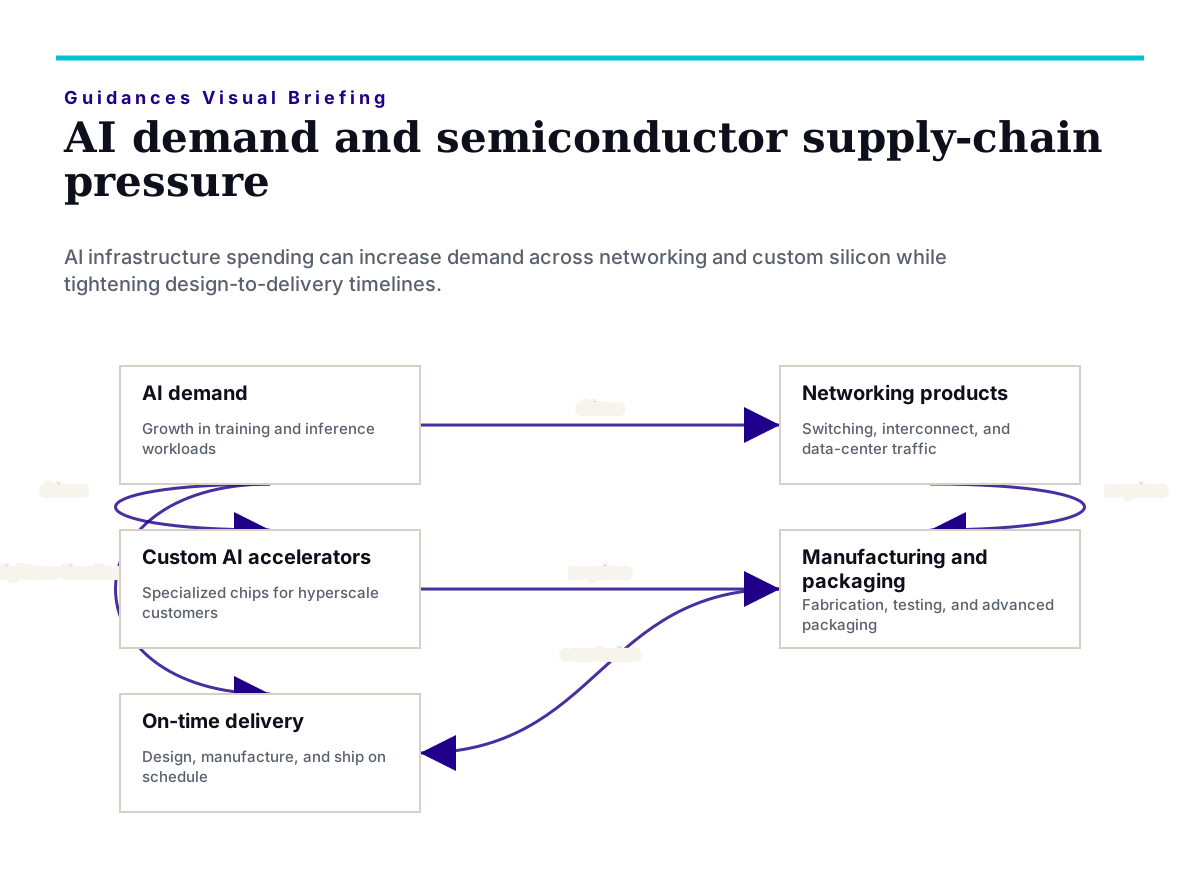
The filing suggests AI growth is not only boosting demand, but also increasing pressure on the semiconductor supply chain to deliver faster.
Corrections and safety
See a factual, privacy, rights, or safety issue? Review the corrections process or contact Guidances before relying on this article for important decisions.