What Happened
The European Commission's digital strategy portal designates the EU Artificial Intelligence Act as the bloc's primary legislative instrument for governing AI systems. The official source confirms that the Act covers generative AI through provisions addressing disclosure obligations, safeguards against legally prohibited outputs, and an explicit policy push toward technical watermarking and content-identification infrastructure. The source page carries no verified machine-readable publication date; this analysis therefore treats the AI Act as an active, phased regulatory framework rather than a newly issued document.
The Act's architecture is risk-tiered: different obligation categories activate on different schedules, with generative AI-specific requirements among the earlier-activating tiers. For operators building or distributing AI-generated content in European markets, the framework is not a future compliance horizon—it is a present operating constraint.
Why the Market Cares
The economic significance of the AI Act's synthetic-media provisions extends well beyond legal departments. Generative AI tools are now embedded throughout music production, advertising, gaming, short-form video, and journalism workflows. The Act's disclosure requirements apply across this entire production chain, meaning that compliance is not a one-time certification exercise but an ongoing operational discipline.
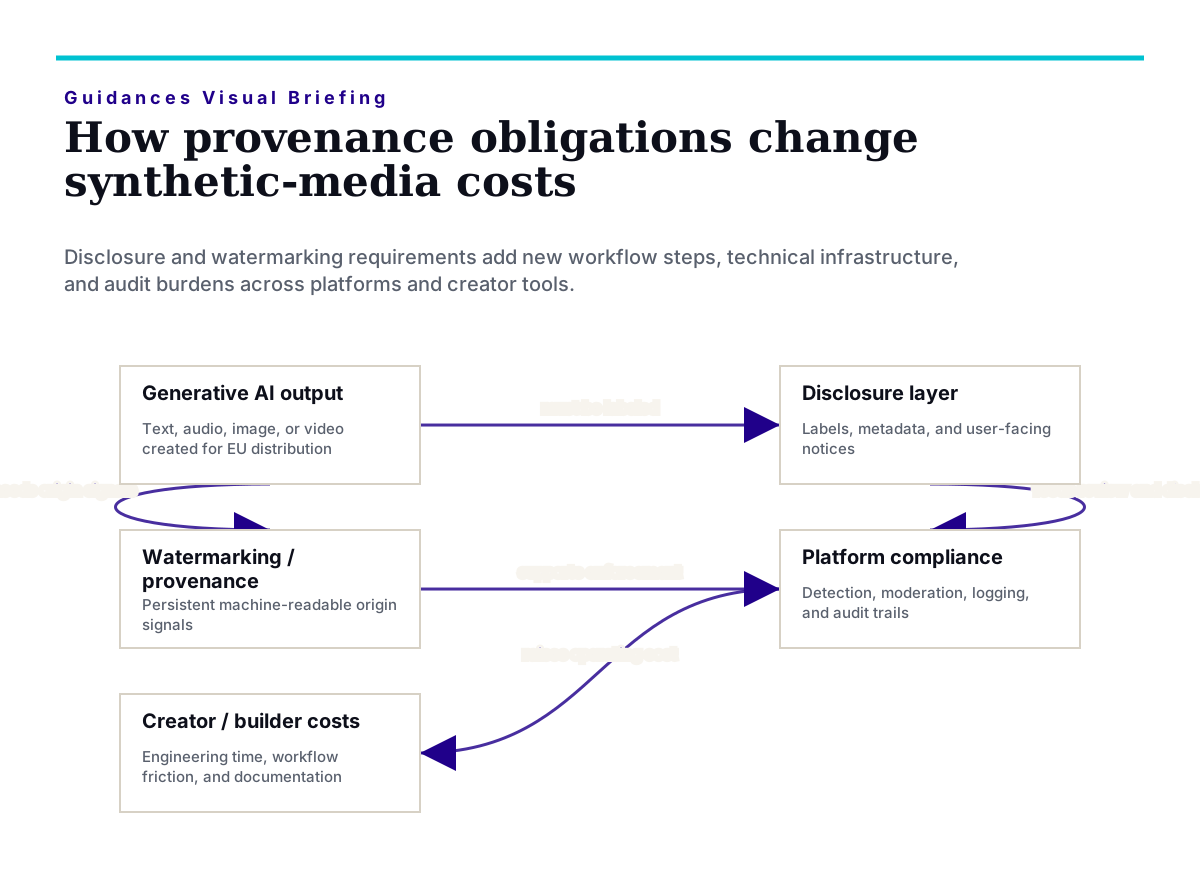
Consider the cost structure this creates. A platform hosting user-generated content must simultaneously manage disclosure for its own AI-assisted features and build detection or labeling infrastructure for third-party uploads. These are two distinct engineering problems with different data flows, different latency requirements, and different audit trails. Neither can be addressed with a simple policy update; both require architectural decisions that affect product roadmaps and engineering budgets.
For independent creators—musicians using AI voice synthesis, video producers using generative visual tools, game studios deploying AI-written dialogue—the compliance burden lands at the workflow level. Every output destined for EU distribution must carry appropriate labeling before it reaches consumers. This is not a hypothetical edge case. It describes the current production reality for a substantial portion of the creative technology sector, and the cost of retrofitting labeling into existing pipelines is materially higher than building it in from the start.
The Act's encouragement of technical watermarking solutions carries a distinct market-structure implication. By signaling that self-declaration alone is insufficient and that the industry should develop standardized detection infrastructure, the legislation effectively creates demand for a category of compliance technology that had no meaningful commercial scale before binding regulatory pressure emerged. Watermarking and content-provenance vendors now operate in a market shaped by legal necessity rather than discretionary enterprise demand.
Technology and Policy Linkage
The AI Act's approach to synthetic-media governance sits at the convergence of three distinct regulatory concerns, each with its own enforcement pathway.
The first is consumer-facing disclosure: audiences must be able to identify when content is machine-generated. This is a straightforward transparency obligation, but its implementation is technically non-trivial at scale. Labeling must be persistent, machine-readable, and resistant to stripping—requirements that point toward embedded metadata rather than surface-level annotations.
The second concern is intellectual property integrity. The Act's safeguard provisions require that generative AI systems include mechanisms to prevent outputs that reproduce protected works without authorization. This implicates training-data governance, output filtering, and content-moderation architecture—engineering layers that must be designed and documented before a product can legally serve EU users.
The third concern is platform accountability. The Act establishes that responsibility for AI-generated content does not dissolve at the point of upload. Platforms that host AI-generated material carry obligations that extend to the content circulating on their infrastructure, creating accountability structures that differ from the notice-and-takedown frameworks that governed earlier generations of content regulation.
The technical standards question remains partially open. Industry coalitions such as the Coalition for Content Provenance and Authenticity (C2PA) have developed cryptographic metadata specifications that embed origin and modification records directly into media files. The AI Act's direction aligns with this approach, but the legislation does not mandate C2PA or any equivalent standard by name. That gap means the European Commission may issue implementing acts or delegated regulations specifying acceptable technical methods—a decision that could materially advantage specific technology providers or open-source frameworks.
The fundamental rights dimension adds enforcement complexity. Because the Act frames AI governance partly around rights protection, enforcement is not confined to technical regulators. National data protection authorities, equality bodies, and civil courts can all engage with violations, creating a fragmented enforcement landscape even within a nominally unified regulatory structure. For platforms operating across multiple EU member states, this means compliance cannot be designed for a single enforcement counterpart.
Market Lens
Trigger: The EU AI Act's binding disclosure and watermarking obligations for generative AI systems, actively phasing into force across different obligation tiers.
Mechanism: Compliance requirements raise operating costs for AI tool developers and content platforms serving EU markets. The obligation to implement provenance infrastructure—rather than rely on self-declaration—generates direct demand for watermarking and content-authentication technology. Platforms that cannot demonstrate compliant labeling infrastructure face regulatory exposure that may constrain their ability to operate or form commercial partnerships within the EU.
Affected sectors (source-supported): Generative AI tool developers, synthetic-media platforms, music and video production technology companies, social-media platforms with AI content features, and emerging watermarking and content-provenance technology vendors. The creator economy broadly—independent musicians, video producers, and game studios using AI tools for EU-distributed content—faces workflow friction and incremental cost implications.
Time horizon: The Act's phased structure means obligations are activating progressively rather than simultaneously. Generative AI-specific requirements are among the earlier-activating tiers. Operators should treat the compliance window as current, not prospective.
Next check: European Commission publication of implementing acts or delegated regulations specifying technical watermarking standards; enforcement actions by national AI supervisory authorities establishing the practical penalty profile for non-compliance; major platform policy disclosures revealing how large content hosts are interpreting their labeling obligations; and standards-body publications from C2PA or equivalent bodies that may become regulatory reference points.
This analysis is market context only. It is not investment advice and does not constitute a recommendation to buy, sell, or hold any security or asset.
What to Watch Next
Four concrete checkpoints will determine how the AI Act's synthetic-media provisions translate into operating reality for builders and platforms.
First, the European Commission's publication of technical standards or implementing acts for watermarking will resolve the current ambiguity about which detection methods satisfy the legal requirement. This decision has direct procurement implications: operators cannot finalize their compliance architecture until they know which technical approaches are legally acceptable.
Second, enforcement actions by national competent authorities will establish the practical risk profile for non-compliance. The scale of penalties, the categories of violation that attract early regulatory attention, and the evidentiary standards applied will all shape how aggressively operators invest in compliance infrastructure.
Third, major platform disclosures—particularly from large social-media and content-hosting companies—will reveal how the industry is interpreting its obligations in practice. These disclosures will also indicate the scale of infrastructure investment being made, providing a reference point for smaller operators calibrating their own compliance budgets.
Fourth, the trajectory of C2PA adoption and competing provenance standards will indicate whether the market is converging on a single technical approach or fragmenting across incompatible systems. Fragmentation would increase compliance costs for operators who distribute content across multiple platforms with different technical requirements.
Uncertainty and Constraints
Several limitations apply to this analysis. The source is an official EU policy page without a verified machine-readable publication date, so the precise current status of specific implementing measures cannot be confirmed from this source alone. The Act's phased structure means that not all provisions are simultaneously active, and the applicable timeline for any specific operator depends on their risk classification and product category. The encouragement of watermarking solutions does not yet constitute a mandate for a specific technical standard, leaving compliance pathways partially undefined. Operators should consult the official EU AI Act text, relevant national authority guidance, and qualified legal counsel before making compliance decisions. This article is not legal advice.