What happened
FTSE Russell's Russell 2000 page is a formal description of a benchmark, not a breaking market development. According to the source, the index is designed to represent the smaller end of the U.S. listed equity universe and is used by managers and institutional allocators as a reference point for performance measurement and for products that track the segment passively. The page is therefore a reference document about market structure, not a news item about a sudden shift in fundamentals.
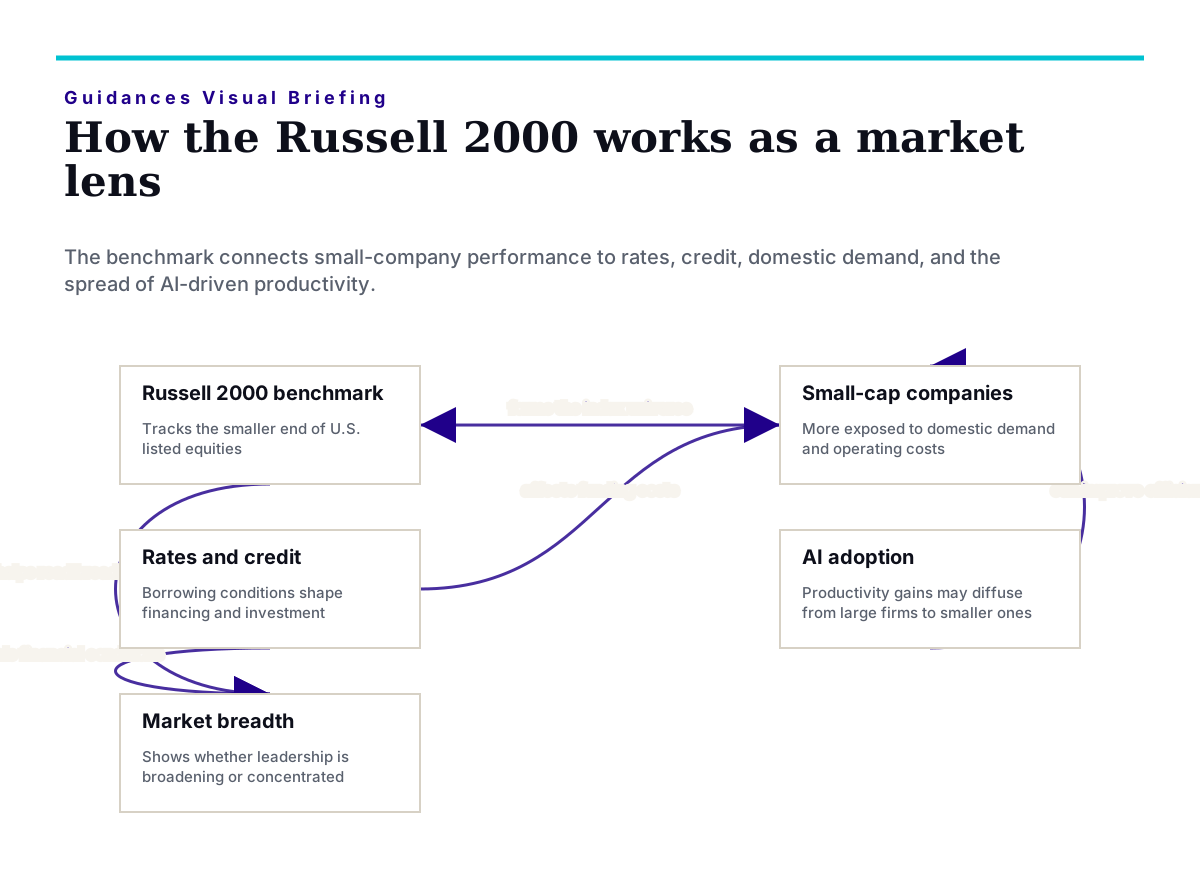
That distinction matters. In a market cycle dominated by large-cap technology, AI infrastructure spending, and a narrow set of companies that command most of the attention, a small-cap benchmark can appear mundane. Yet the Russell 2000 remains one of the clearest ways to observe how the broader domestic economy is being priced. It is useful precisely because it is not a story about one company or one quarter. It is a framework for reading breadth, financing conditions, and the spread of risk appetite across the public market.
The source page does not provide a verified publication date, so it should not be treated as newly published. The collection date is June 24, 2026. That undated status does not reduce its relevance. If anything, it reinforces the point that some market references matter because they are durable, not because they are fresh.
Why the market cares
Small-cap benchmarks sit at the intersection of portfolio construction and macro interpretation. The Russell 2000 is widely used because it gives investors a common language for the part of the market that is more exposed to domestic demand, bank lending, and operating leverage than the mega-cap tier.
That makes it useful in a period when public-market leadership is concentrated. If a handful of large technology names dominate index returns, the Russell 2000 offers a counterweight. It helps answer a simple but important question: is market strength broadening, or is it still confined to a narrow set of firms with exceptional access to capital and exceptional exposure to AI spending?
The answer matters for operators as much as for portfolio managers. Small companies usually have less room to absorb higher borrowing costs. They are more likely to rely on bank credit, revolving facilities, and shorter-duration financing. When policy rates stay elevated, or when lenders become more selective, the effect on small-cap balance sheets can be faster and more visible than on large multinational firms. That is one reason the Russell 2000 is often read as a proxy for domestic financial conditions.
The index also matters because it is embedded in products. Passive funds, ETFs, and benchmark-aware mandates all use it as a reference. That creates a feedback loop: the benchmark is not only a measurement tool but also a design input for capital allocation. In practical terms, that means the Russell 2000 influences how money is grouped, tracked, and compared, even when no directional market call is being made.
Tech and policy linkage
The source does not discuss AI directly, but the Russell 2000 still has a meaningful connection to the current technology cycle. The AI buildout has been concentrated in hyperscale cloud, semiconductors, networking, and a small number of enterprise software names. Those are mostly large-cap or mega-cap beneficiaries. The small-cap benchmark becomes relevant when analysts ask whether that investment wave is diffusing into the rest of the economy.
The mechanism is straightforward. If AI tools reduce administrative costs, improve customer support, streamline logistics, or automate routine workflows, smaller firms could eventually translate those gains into better margins or more room for investment. But that diffusion is not automatic. It depends on product packaging, implementation cost, integration burden, and the willingness of smaller buyers to spend in a tighter financing environment. The Russell 2000 is therefore a useful lens for judging whether AI is becoming a broad productivity story or remaining a concentrated capital expenditure story.
Policy also enters the picture. Interest-rate policy, credit availability, trade rules, and domestic industrial incentives all shape the operating environment for small-cap companies. A small manufacturer, regional bank, or local services business does not experience macro policy in the same way as a global platform company. For the former, borrowing costs and input prices can alter hiring, software adoption, and capital expenditure plans in a matter of quarters. That is why a small-cap benchmark can serve as a practical read on policy transmission.
Market Lens
Trigger: A formal index description from FTSE Russell highlights the role of the Russell 2000 as a benchmark for the smaller end of the U.S. equity market. The trigger is not a new event but a standing reference point that becomes more analytically important when market leadership is concentrated.
Mechanism: Small-cap companies are more sensitive to domestic rates, bank lending conditions, and operating costs. If AI-related gains remain concentrated in large-cap technology, the Russell 2000 may continue to diverge from broader headline narratives. If AI adoption spreads into smaller businesses, the index could become a better reflection of economy-wide productivity diffusion. Any market link beyond that structural framing is unverified unless supported by fresh data.
Affected assets and sectors: The Russell 2000 itself, ETFs that track it, and domestically oriented sectors such as financials, industrials, healthcare, and consumer discretionary are the most relevant exposures. Relative performance versus large-cap benchmarks is often used as a breadth check, but the source does not provide current performance data, so any live market reaction remains unverified.
Time horizon: Medium term. The relevant window is likely one to three years, because it depends on policy rates, credit conditions, and the pace at which AI tools move from large enterprise budgets into smaller operating environments.
Checkpoints: Watch Federal Reserve communications, small-cap earnings commentary on borrowing costs and capital expenditure, and FTSE Russell reconstitution or methodology updates. Those are the concrete reference points that can confirm whether the benchmark is merely a definitional tool or is also reflecting a changing operating backdrop.
This lens is explanatory benchmark context for risk framing only; it is not portfolio instruction.
Follow-up indicators
The first item to watch is whether financing conditions for smaller companies improve or remain tight. For Russell 2000 constituents, the cost of capital is often the most immediate macro variable. A change in policy rates matters, but so do bank lending standards, credit spreads, and management commentary on refinancing.
The second item is AI diffusion. The current market narrative is still dominated by large-scale infrastructure spending. What would make the Russell 2000 more informative is evidence that smaller firms are turning AI tools into measurable operating changes: lower support costs, faster workflows, better inventory management, or more efficient back-office processes. That evidence would likely appear first in earnings calls, product adoption updates, or management guidance rather than in broad market commentary.
The third item is index composition. Reconstitution can alter sector weights and change how the benchmark behaves. That is not a minor technicality. For a small-cap index, composition changes can affect how much exposure it has to rate-sensitive sectors, domestic cyclicals, and technology-adjacent names. Analysts should therefore be careful when comparing year-over-year performance without adjusting for membership changes.
Uncertainty and constraints
This article is intentionally narrow because the source is narrow. The FTSE Russell page provides a benchmark description, not a market event, a performance table, or a policy announcement. There is no verified publication date in the metadata, so the page is not framed as newly published. There are also no live market numbers in the source package, so this analysis avoids unsupported claims about current returns, flows, or relative performance.
That constraint is useful rather than limiting. It forces the right question: what does a small-cap benchmark actually tell operators and market readers? The answer is that it helps map the transmission of rates, credit, and technology adoption across the public market. It does not, by itself, prove that the economy is strong or weak. It is a lens, not a verdict.