What happened
SK Hynix said in its 4Q 2024 earnings release that it posted record quarterly revenue and operating profit. The company attributed the result to HBM and broader AI memory demand. In the same document, it outlined a plan to raise 2025 capital expenditure and to expand production capacity for both HBM3E and HBM4.
A caution on dating is necessary. The search provider attached January 23, 2025 to the document, but that date has not been verified against the source page itself. It should therefore be treated as a soft hint, not a confirmed publication date. The source is still an official company IR document. As of July 3, 2026, it is older material, but it remains relevant because it set a public benchmark for a dual-track HBM buildout. The question now is not whether the company saw demand; it is whether the planned investment translated into capacity, qualification progress, and shipment timing.
Why the market cares
This is not just a quarterly earnings note. SK Hynix carries a market capitalization of KRW 1588.71T in the market-data context provided for this article. At that scale, capital-allocation decisions matter beyond one company’s income statement. They can affect the memory supply chain, AI accelerator availability, advanced packaging demand, semiconductor equipment orders, and the procurement calendars of large cloud operators.
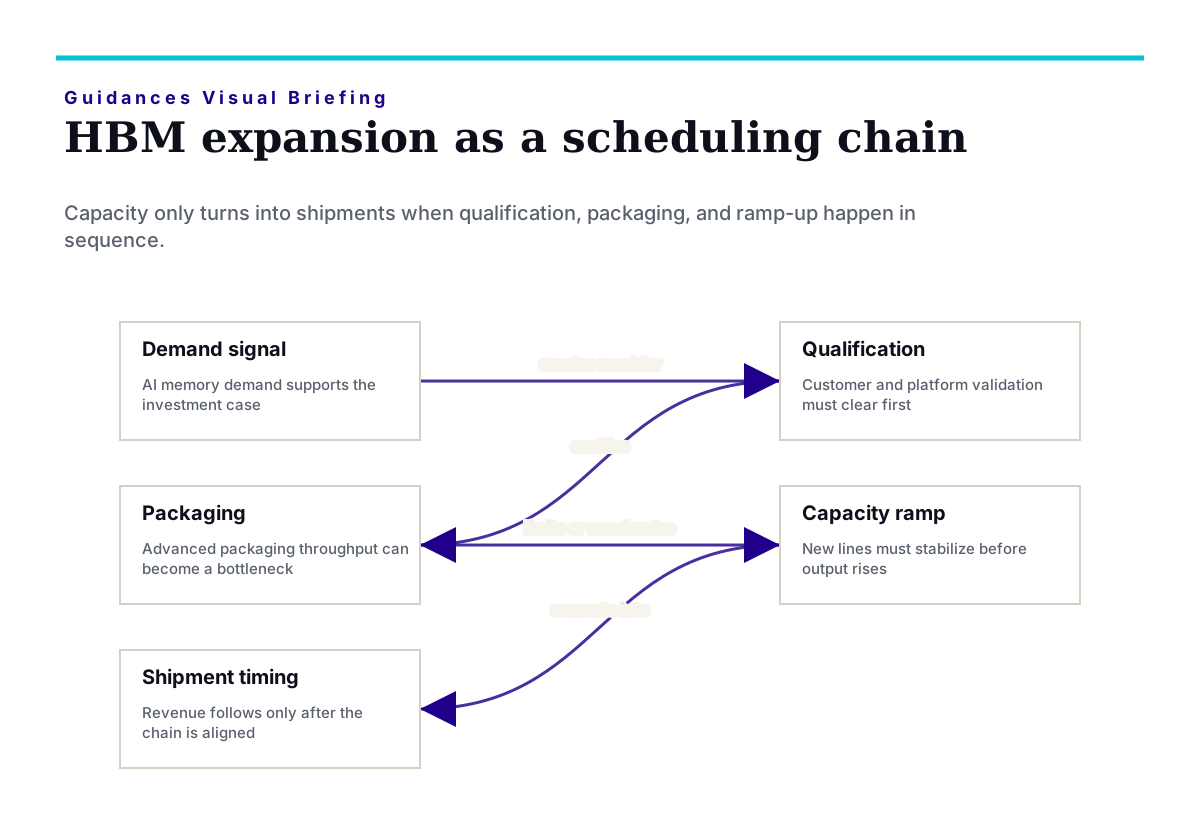
HBM is structurally different from standard DRAM. It depends on stacked architecture, advanced packaging, yield control, and platform-specific qualification. That means a plan to expand HBM3E and HBM4 capacity is not a simple volume story. It is a coordinated execution effort across manufacturing, packaging, and customer validation. Demand can exist without immediate shipment growth if the qualification chain is not ready.
For builders and operators planning AI infrastructure at scale, that distinction matters. A GPU module is only as available as the memory attached to it. If HBM certification slips, the delivery date of the finished accelerator can also move. In that sense, SK Hynix’s capex plan is part of the operating calendar for AI deployment, not just a semiconductor headline.
Tech / policy link
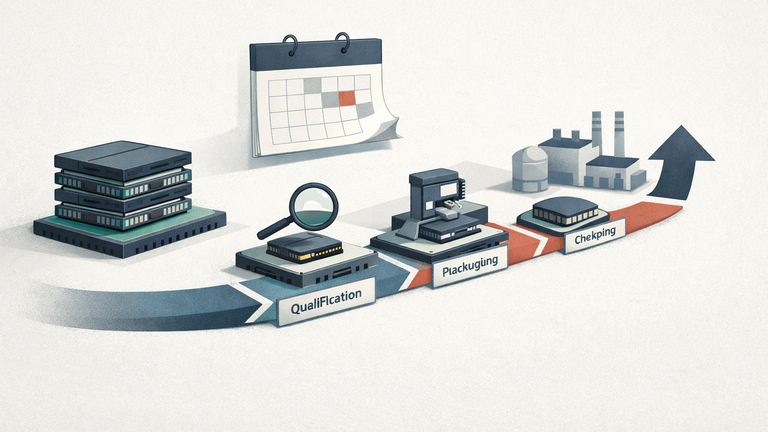
The technical center of gravity here is HBM4. Compared with HBM3E, it implies a more demanding packaging stack and a more complex validation path. No single party controls the timetable. Memory suppliers, accelerator designers, packaging partners, and end customers all have to move in sequence. That makes qualification timing the real gating factor, not the announcement of investment itself.
The company’s 2025 capex plan therefore has a conditional character. It only becomes commercially meaningful if the new capacity lines up with customer qualification milestones. If HBM4 validation takes longer than expected, the added spending may not convert into revenue on the original schedule. If validation proceeds smoothly, the same spending can help ease supply constraints and stabilize customer procurement.
Policy remains a relevant overlay. Advanced memory and the equipment used to produce it sit within a regulatory environment shaped by export controls and cross-border technology rules. This source does not establish any specific policy change, so any direct market link would be unverified. Even so, the broader point is clear: supply capacity is not determined by engineering alone. It is also shaped by what can be shipped, where, and under which rules.
Market Lens
Trigger: SK Hynix’s formal 4Q 2024 commitment to expand 2025 capex with a focus on HBM3E and HBM4 capacity.
Mechanism: If capex converts into usable production capacity, HBM supply rises. That can relieve a bottleneck in AI accelerator shipments and cloud procurement. The spending itself also supports demand for semiconductor equipment, advanced packaging, materials, and cleanroom buildout.
Affected assets / sectors: SK Hynix (000660.KS), advanced memory semiconductors, AI accelerator hardware, semiconductor equipment, and advanced packaging. The market-capitalization figure of KRW 1588.71T is scale context only; it is not investment advice.
Time horizon: The 2025 spending plan is now in mid-execution as of July 2026. The relevant horizon is therefore near to medium term, with quarterly disclosures as the main checkpoints.
Next check: The most useful verification points are SK Hynix’s later earnings releases and IR updates. Those documents should show whether capex was deployed as planned, whether HBM4 qualification advanced, and whether the revenue mix shifted from HBM3E toward HBM4. The market-data context lists February 25, 2027 as the next earnings date, but interim quarterly disclosures would be more informative before then.
This section is market context only, not investment advice.
What to watch next
First, watch the revenue mix. If HBM4 begins to take a larger share relative to HBM3E, that would suggest the transition is moving from intent to execution. If the mix changes slowly, the issue may be qualification timing or production conversion rather than a lack of demand.
Second, watch the lag between capex and capacity. In semiconductors, spending does not become output immediately. Equipment installation, process stabilization, packaging throughput, and customer validation all take time. The key question is whether the 2025 spending plan is showing up in later shipment and capacity disclosures.
Third, watch for multi-source qualification dynamics. SK Hynix is not the only HBM supplier. If other suppliers gain broader certification at major accelerator platforms, customer procurement patterns can change. That would affect supply flexibility and the balance of bargaining power across the chain. Any such read-through should be anchored in official disclosures, not inference.
Fourth, watch policy updates. Export controls, equipment rules, and regional customer access can all change the effective supply picture. This source does not establish a policy outcome, but it does make policy a relevant variable for the next round of verification.
Uncertainty and constraints
This analysis is based on a search snippet from an official company IR PDF and on market-data context. The snippet does not include the actual revenue figure, operating profit amount, capex size, or shipment volumes. That limits how far the analysis can go quantitatively. The publication date attached by the search provider is also unverified, so it should not be treated as the source publication date.
The document is older as of July 2026. That is precisely why it still matters: it provides a baseline against which later execution can be checked. The relevant question is no longer what SK Hynix intended to do in early 2025. It is what later official filings and earnings releases show about qualification, capacity conversion, and customer timing.
The market-data context for 000660.KS returned HTTP 402 errors for several deeper financial endpoints, so the only FMP-derived number used here is the market capitalization figure. No additional financial metrics are being inferred.
This is market context only, not investment advice.