What Happened
Oracle Corporation reported record financial results for both the fourth quarter and the full fiscal year 2026, driven by demand across cloud infrastructure, cloud applications, and artificial intelligence workloads. According to the company's official announcement, cloud revenues rose 47% in FY2026. Oracle also guided Q1 FY2027 total cloud revenue growth of 57% to 64%, with non-GAAP earnings per share expected in the range of $1.71 to $1.76. These figures indicate an acceleration from the FY2026 baseline.
To anchor the scale of this business: Oracle's annual revenue stands at $67.4B, with year-over-year revenue growth of +17.4%. The company carries a market capitalization of $530.1B, placing it among the largest enterprise software and infrastructure platforms globally.
Why the Market Cares
Oracle's results matter beyond the company itself for several interconnected reasons.
First, the magnitude of the forward guidance is notable. A 57–64% cloud revenue growth projection for a single quarter, issued by a company with Oracle's revenue base, is a figure that has drawn market attention. It suggests that enterprise customers are increasing cloud and AI infrastructure commitments at a pace that may be ahead of earlier analyst models.
Second, Oracle Cloud Infrastructure, or OCI, is viewed as one of the options in the cloud infrastructure market. The 47% full-year cloud revenue growth figure is consistent with OCI capturing demand, including AI training and inference workloads. This competitive dynamic informs how market participants think about choice and concentration risk in cloud procurement.
Third, the results are being read as evidence that AI adoption can be linked to large-enterprise infrastructure investment. Oracle's customer base includes large financial institutions, healthcare systems, government agencies, and global manufacturers, and those segments are often discussed in the context of infrastructure modernization and AI workloads.
Fourth, the non-GAAP EPS guidance of $1.71 to $1.76 for Q1 FY2027 provides a near-term profitability anchor. For a company generating $67.4B in annual revenue with a trailing operating margin of approximately 30.8%, the guidance suggests that revenue acceleration is being accompanied by continued profitability.
Technology and Policy Linkage
Oracle's results intersect with several structural technology and policy dynamics that operators and builders should track.
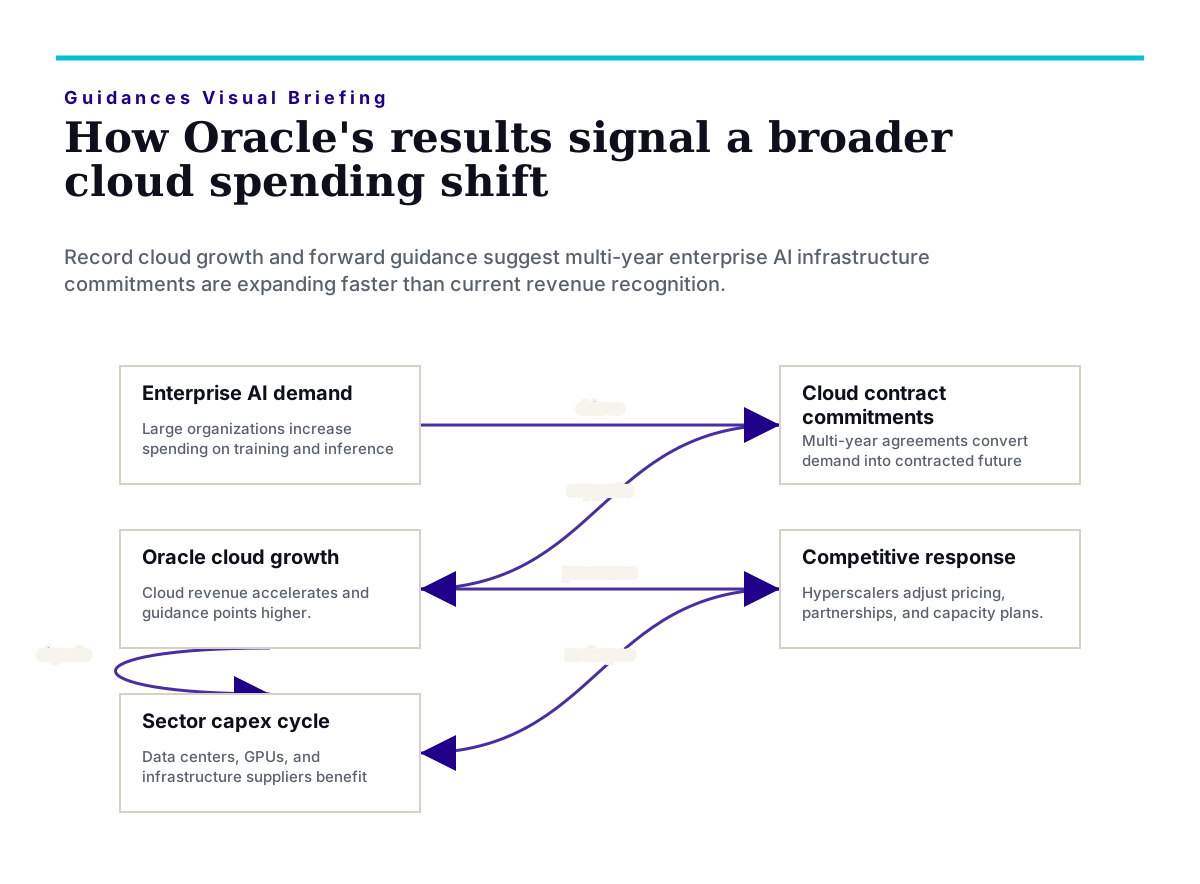
On the technology side, the company's AI-related growth reflects the infrastructure required to support large language model training, inference at scale, and enterprise AI application deployment. Oracle has invested in GPU-dense data center capacity, and it has announced partnerships with major AI model developers. The 47% cloud revenue growth figure is also connected to the semiconductor and data center capital expenditure cycle that has shaped technology infrastructure investment since 2023.
On the policy side, Oracle's cloud infrastructure expansion intersects with data sovereignty regulations, AI governance frameworks, and national cloud strategies across the European Union, Asia-Pacific, and the Middle East. Enterprises operating under strict data residency requirements often evaluate cloud providers that can offer in-country or in-region infrastructure. Oracle's multi-region buildout strategy aligns with that regulatory environment, and the growth figures suggest that the strategy is being reflected in revenue.
Additionally, Oracle's cloud applications business—which includes enterprise resource planning, human capital management, and supply chain software—connects with the ongoing modernization of government and regulated-industry IT infrastructure. As public-sector and regulated-enterprise customers migrate legacy on-premises systems to cloud environments, Oracle's installed base provides one possible migration path.
Market Lens
Trigger: Oracle's FY2026 record results and Q1 FY2027 guidance of 57–64% total cloud revenue growth, with non-GAAP EPS guidance of $1.71–$1.76.
Mechanism: Enterprise AI and cloud infrastructure commitments can translate into multi-year contracted revenue for Oracle, which may affect the revenue growth trajectory for the company's cloud segment. The guidance acceleration—from 47% full-year growth to a 57–64% forward projection—suggests that the order book and remaining performance obligations may be expanding faster than current-period revenue recognition.
Affected sectors and assets: Enterprise software, cloud infrastructure providers, GPU and data center hardware suppliers, and enterprise AI application vendors may all be contextually affected. Oracle's results serve as a reference point for the enterprise cloud spending environment, though individual company impacts vary by competitive positioning and customer overlap. This analysis is market context only, not investment advice.
Time horizon: The Q1 FY2027 guidance covers the quarter ending approximately August 2026, with results expected around September 8, 2026, per available forward calendar data. The AI infrastructure spending cycle that underpins Oracle's growth is a multi-year dynamic, not a single-quarter event.
Next check: Oracle's Q1 FY2027 earnings release (estimated September 8, 2026) will be the primary verification point for whether the 57–64% cloud revenue growth guidance is met or revised. Investors and operators should also monitor Oracle's remaining performance obligations disclosures, which provide direct visibility into contracted future revenue. Broader sector checks include AWS, Azure, and Google Cloud quarterly disclosures, as well as data center capex announcements from major hyperscalers.
Unverified links: Any direct causal connection between Oracle's results and specific semiconductor demand figures, hyperscaler market share shifts, or enterprise software peer valuations is not directly supported by the available source snippet and should be treated as contextual inference rather than established fact.
What to Watch Next
Several forward indicators merit attention in the weeks following this announcement.
Oracle's remaining performance obligations—the contracted but not yet recognized revenue on its balance sheet—will be a critical metric in the Q1 FY2027 filing. If RPO growth continues to outpace revenue recognition, it would indicate that the demand pipeline is expanding faster than the company can deliver.
The competitive response from hyperscalers is also worth monitoring. If Oracle continues to capture AI workloads at the rate implied by its growth figures, AWS, Azure, and Google Cloud may adjust pricing, expand partnership programs, or accelerate infrastructure buildout in regions where Oracle has been gaining share.
Finally, enterprise IT budget cycles for calendar year 2027 will begin to crystallize in Q3 and Q4 of calendar 2026. Oracle's ability to convert its current momentum into multi-year enterprise agreements during that budget cycle will help determine whether the 57–64% growth trajectory is a temporary acceleration or the beginning of a new baseline.
Uncertainty and Constraints
The available source metadata is a snippet from an official press release, which provides headline figures but not the full granularity of segment breakdowns, geographic revenue distribution, or balance sheet detail. Analysis of operating margin trajectory, capital expenditure commitments, and debt structure is constrained by the snippet-only collection mode. Readers should consult Oracle's full earnings release and SEC filings for complete financial detail before drawing operational or strategic conclusions.