What happened
NVIDIA’s official investor-relations disclosure is best read as a checkpoint on whether AI infrastructure demand is still converting into revenue at scale. The company said revenue for the quarter ended July 27, 2025 reached $30.1 billion. It also pointed to $32.5 billion in revenue for the following quarter. The immediate significance is not the headline number alone, but the fact that management is still describing demand for Blackwell-era accelerated computing and the surrounding infrastructure as strong enough to support another large step in the next period.
This analysis relies on the company’s primary release and the internal market data provided for context. A provider-supplied date appears in the metadata, but it is not verified as the source publication date and is therefore treated only as a soft timing hint. The market data context places NVIDIA at $215.9B in annual revenue, $4.85T in market capitalization, and +65.5% year-over-year revenue growth. Those figures are used here only to frame scale and market relevance, not as a valuation call.
Why the market cares
NVIDIA has become more than a semiconductor earnings event. For operators and market watchers, it now functions as a proxy for the pace at which AI capital expenditure is turning into deployed hardware. When a company of this size reports another very large quarter and guides to a similarly elevated next quarter, the market reads that as evidence that cloud providers, enterprise buyers, and public-sector AI programs are still placing orders rather than merely discussing plans.
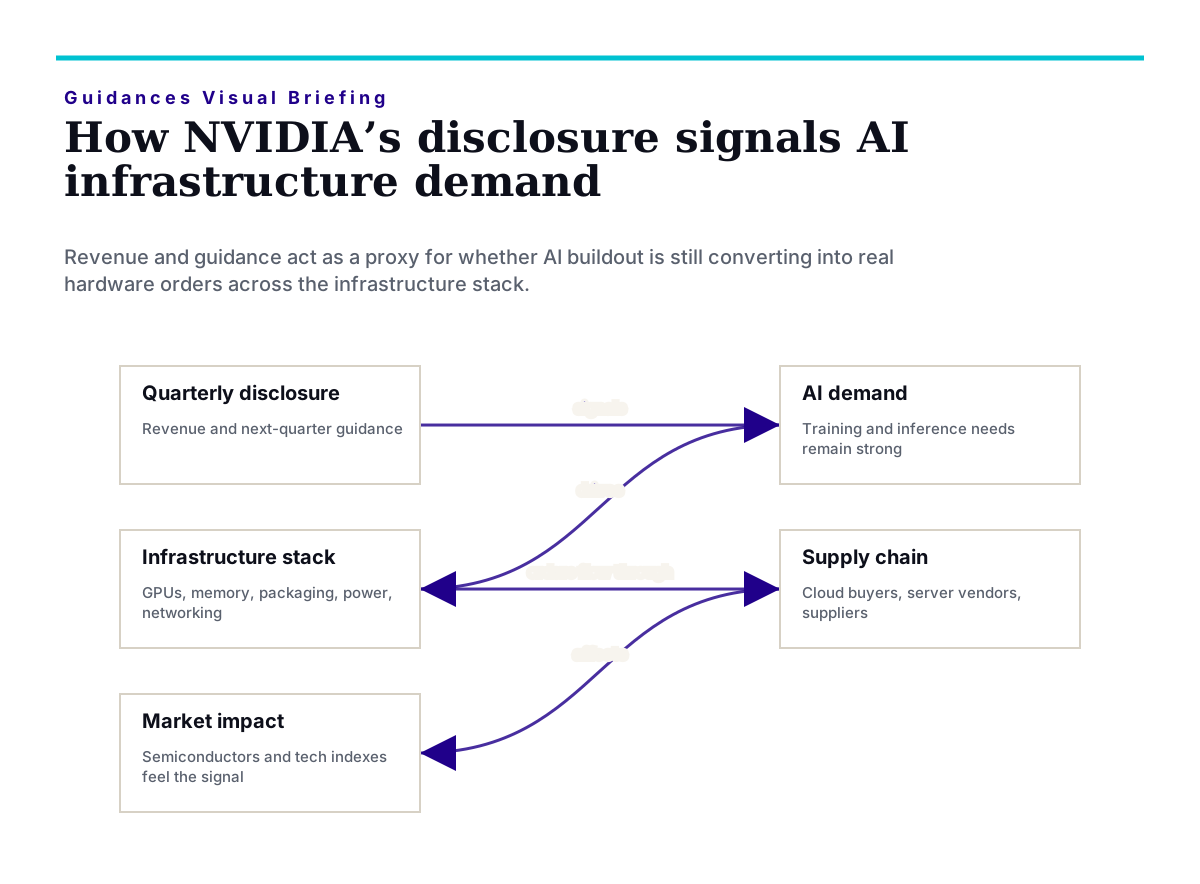
The mechanism matters. AI training and inference at frontier scale require not only GPUs, but also high-bandwidth memory, advanced packaging, networking, power delivery, and cooling. That means NVIDIA’s revenue is often a downstream reflection of a broader buildout. The internal data point of +65.5% year-over-year revenue growth on a $215.9B annual base suggests that this buildout is still translating into realized sales, not just pipeline optimism. That does not guarantee future growth, but it does show that the demand cycle has not yet rolled over in the available data.
The company’s $4.85T market capitalization also matters for index structure. A firm of that size can influence technology benchmarks, semiconductor ETFs, and large-cap growth portfolios simply through its weight. That is a market-structure fact, not a recommendation. It means the company’s disclosures can move sentiment well beyond the semiconductor group itself, even when the underlying event is a routine earnings release.
Tech / policy link
The technology story is centered on Blackwell, but the broader point is architectural. The current generation of AI systems is not just asking for more compute; it is changing the shape of the entire data-center stack. More compute means more memory bandwidth, more advanced packaging capacity, more power density, and more network throughput. In practical terms, NVIDIA’s disclosure is a signal about the health of the AI infrastructure layer, not only about one product family.
Policy remains part of the equation. Export controls on advanced chips, licensing rules, and procurement constraints can alter where and how AI hardware is sold. The source snippet does not provide enough detail to quantify policy impact, so any direct market link there would be unverified. Still, the broader policy risk is real: when a company’s product sits at the center of global AI buildout, regulatory changes can affect addressable demand, product configuration, and delivery timing. For founders and operators, that means supply planning cannot be separated from policy monitoring.
Market Lens
Trigger: NVIDIA disclosed $30.1 billion in revenue for the quarter ended July 27, 2025 and guided the next quarter to $32.5 billion.
Mechanism: The disclosure suggests that AI infrastructure demand is still being converted into actual hardware purchases. If Blackwell demand remains strong, the effect flows through GPUs, high-bandwidth memory, advanced packaging, data-center power systems, and networking gear. The internal market data of $215.9B annual revenue and +65.5% year-over-year growth reinforces the idea that this is a large, ongoing investment cycle rather than a one-off spike.
Affected sectors / assets: The most direct exposure is in semiconductors, AI accelerators, memory, advanced packaging, and data-center infrastructure. Secondary exposure extends to cloud providers, server supply chains, power equipment, cooling systems, and networking vendors. NVIDIA’s $4.85T market capitalization also means broad technology indexes and semiconductor ETFs can feel the impact through index weight alone. Any more specific price reaction is unverified from the source material and should not be inferred here.
Time horizon: The next official earnings release is the nearest hard checkpoint. In the meantime, hyperscaler capex commentary, TSMC monthly revenue, and memory-supply updates are the most useful intermediate signals. Policy changes can matter on a longer horizon, especially if export rules or procurement frameworks shift.
Next check: Watch NVIDIA’s next earnings disclosure, major cloud providers’ capex commentary, TSMC monthly revenue, and any official updates on supply-chain capacity or export policy. This is market context only, not investment advice.
What to watch next
The key question is whether the current demand pattern is durable or simply concentrated in a few large orders. The next NVIDIA report will help answer that, but it will not be the only useful signal. If hyperscalers continue to describe elevated AI spending, that would support the view that the buildout is still broad. If they soften their capex language, the market may begin to distinguish between near-term shipment strength and longer-term demand visibility.
Supply-side data matter just as much. TSMC’s monthly revenue releases can help confirm whether advanced packaging demand remains tight. Memory suppliers can indicate whether HBM capacity is still being expanded or whether the market is moving toward balance. For operators, these are not abstract data points; they are the practical constraints that determine whether AI products can be deployed on schedule and at acceptable cost.
Policy is the third variable. Export restrictions, procurement rules, and licensing changes can alter the geography of demand without changing the underlying appetite for AI compute. That is why the next check is not only another earnings report, but also the next official policy update and the next supply-chain disclosure.
Uncertainty and constraints
The available source is a snippet from NVIDIA’s official IR release, not the full document. That limits what can be said with confidence. The snippet supports only the quarter’s revenue, the next-quarter guidance, and the broad demand framing around Blackwell and AI infrastructure. It does not provide segment detail, regional mix, margin commentary, or a full discussion of supply constraints. Those omissions matter, because they prevent a more granular read on where the growth is coming from and how durable it may be.
The internal market data is useful for scale, but it is still enrichment, not the event source. The annual revenue figure of $215.9B, the market capitalization of $4.85T, and the +65.5% growth rate help explain why the company’s disclosures carry such weight. They do not, by themselves, prove future performance or future market reaction. That is why the analysis stays close to the official disclosure and avoids unsupported extrapolation.