What Happened
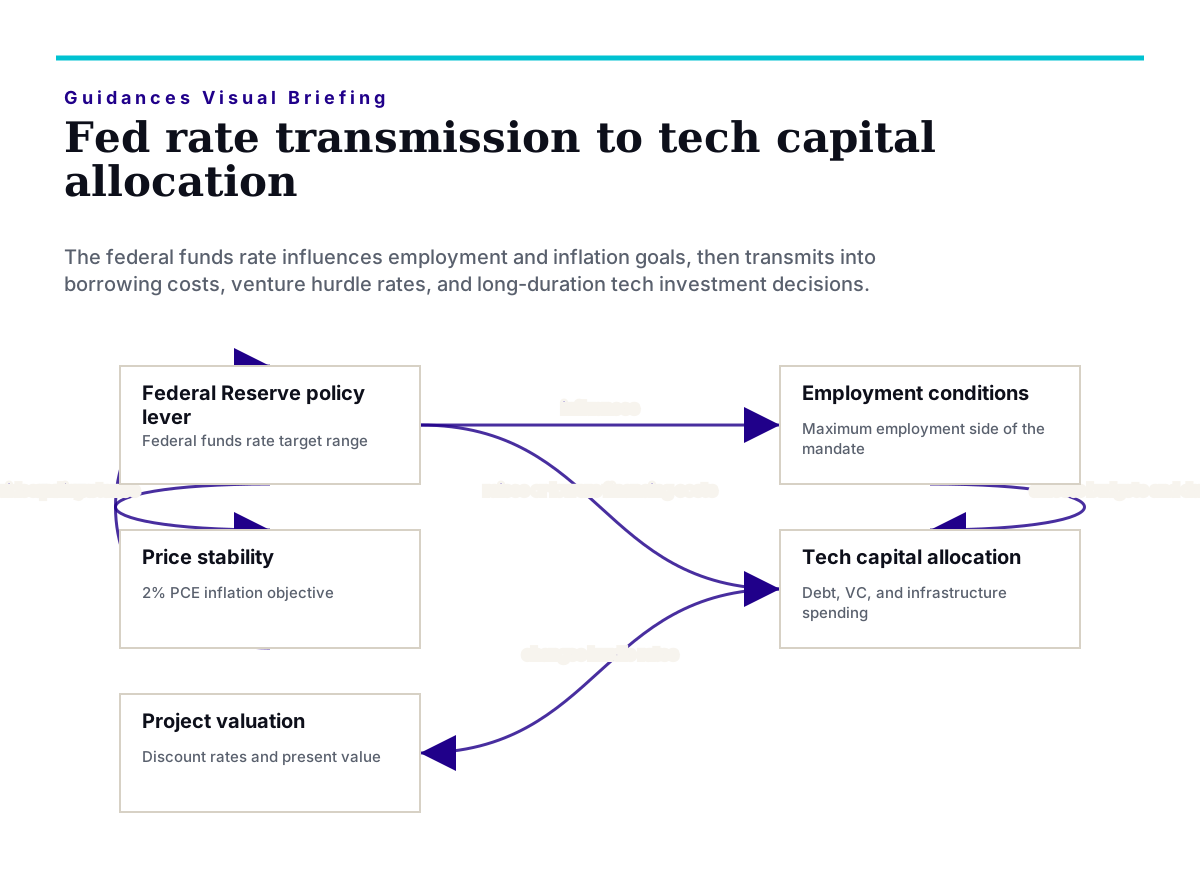
The Federal Reserve's official educational resource on monetary policy—hosted at federalreserve.gov—reaffirms the statutory framework that governs U.S. interest-rate decisions. The Federal Reserve Act charges the central bank with two co-equal objectives: promoting maximum employment and maintaining stable prices. The Federal Open Market Committee (FOMC) has operationalized the price-stability mandate as a 2% annual inflation target, measured by the Personal Consumption Expenditures (PCE) price index. The primary instrument for pursuing both goals is the target range for the federal funds rate, which sets the cost of overnight interbank lending and, by extension, anchors short-term credit conditions across the broader economy.
This source carries no verified machine-readable publication date; the retrieval date is June 26, 2026. The framework it describes, however, is the standing statutory and operational basis for every FOMC rate decision, making it a durable reference regardless of when the page was last updated.
Why the Market Cares
The federal funds rate is not merely a number that appears in central-bank press releases. It is the foundational input into virtually every asset-pricing model, corporate financing decision, and capital-allocation framework used by technology companies, venture funds, and infrastructure investors.
When the FOMC raises the target range, the cost of short-term credit rises immediately. That increase propagates through the yield curve—with varying lags and magnitudes—into corporate bond spreads, leveraged-loan pricing, and the risk-free rate used in discounted-cash-flow models. For technology companies with long payback horizons, even a modest shift in the discount rate can meaningfully compress the present value of projected cash flows. This is not a theoretical concern: the 2022–2023 rate-hiking cycle demonstrated how quickly high-multiple technology valuations can reprice when the risk-free rate moves from near-zero to above 5%.
Conversely, when the FOMC signals a pivot toward easing, capital tends to rotate back into growth assets. Venture capital deployment accelerates, debt financing becomes more accessible, and the implicit hurdle rate for large-scale infrastructure projects—including AI data centers—declines. The dual mandate creates a structural tension: if employment remains strong while inflation stays above 2% PCE, the FOMC has less room to cut rates, keeping financing costs elevated for capital-intensive technology buildouts.
Technology and Policy Linkage
The intersection of monetary policy and technology investment is particularly acute in the current AI infrastructure cycle. Hyperscale data center construction, GPU cluster procurement, and high-bandwidth memory supply chains all require multi-year capital commitments. The internal rate of return on those commitments is sensitive to the prevailing cost of capital, which the federal funds rate directly influences.
Several transmission channels are worth mapping explicitly for technology operators:
Channel 1 — Debt financing cost. Technology companies that fund infrastructure expansion through corporate bonds or revolving credit facilities face higher interest expense when the federal funds rate is elevated. This compresses free cash flow and can slow the pace of capacity additions, even when demand signals are strong.
Channel 2 — Venture and growth equity hurdle rates. Venture capital funds and growth-equity investors benchmark returns against risk-free alternatives. When Treasury yields are high, the minimum acceptable return on a startup investment rises, tightening the conditions under which early-stage AI companies can raise capital at favorable terms.
Channel 3 — Discount rate for long-duration assets. AI infrastructure—data centers, fiber networks, power generation capacity—has cash flows that extend a decade or more into the future. A higher discount rate, anchored by the federal funds rate, reduces the net present value of those cash flows and can delay or scale back investment decisions.
Channel 4 — Consumer and enterprise spending. The dual mandate's employment dimension matters too. If rate policy tips the labor market into contraction, enterprise technology budgets face pressure from customers managing their own cost structures. Demand-side softness can offset supply-side capacity additions, creating inventory or utilization risk for cloud and AI service providers.
The PCE inflation target is also directly relevant to technology sector economics. Persistent inflation above 2% keeps the FOMC in a restrictive posture, sustaining elevated financing costs. Disinflation that brings PCE toward target creates the conditions for rate normalization, which historically has been associated with multiple expansion in growth-oriented technology equities—though the relationship is not mechanical and depends on the growth and earnings trajectory of individual companies.
Market Lens
Trigger: The Federal Reserve Act's dual mandate—maximum employment and 2% PCE inflation—operationalized through the federal funds rate target.
Mechanism: The FOMC adjusts the federal funds rate target range to influence short-term credit costs. That rate propagates into corporate borrowing costs, venture capital hurdle rates, and the discount rates applied to long-duration technology and AI infrastructure investments. When the rate is elevated, capital-intensive technology buildouts face higher financing costs and compressed present values. When the rate declines toward neutral, those constraints ease.
Affected sectors (source-supported): Technology companies with significant debt or capital expenditure programs; venture-backed AI startups dependent on growth equity; hyperscale infrastructure operators whose project economics are sensitive to the cost of capital; enterprise software companies whose customers manage budgets in response to broader credit conditions.
Time horizon: The federal funds rate's effect on technology capital allocation operates on a medium-term horizon—typically one to three years from a rate-cycle inflection point to observable changes in capex commitments, startup funding rounds, and infrastructure deployment pace.
Next check: The FOMC's next scheduled rate decision and the accompanying statement and Summary of Economic Projections (SEP) are the concrete checkpoints. PCE inflation data releases—published monthly by the Bureau of Economic Analysis—are the primary data inputs the FOMC uses to assess progress toward the 2% target. Technology-sector capex guidance in quarterly earnings calls provides the demand-side read on how financing conditions are affecting investment decisions.
This analysis is market context only, not investment advice. No buy, sell, or hold recommendation is implied or intended.
What to Watch Next
Several observable signals will indicate how the dual mandate framework is translating into technology-sector outcomes in the near term:
-
PCE inflation prints: Monthly PCE data from the Bureau of Economic Analysis will show whether inflation is converging toward the 2% target. Sustained convergence increases the probability of rate normalization, which would ease financing conditions for technology infrastructure.
-
FOMC meeting outcomes and SEP revisions: The dot plot and median rate projections in the Summary of Economic Projections reveal the committee's collective view of the appropriate rate path. Shifts in the median projection are the most direct signal of where financing costs are headed.
-
Technology company capex guidance: Quarterly earnings calls from major cloud providers and AI infrastructure operators provide a real-time read on whether elevated financing costs are constraining investment plans or whether demand is strong enough to absorb higher capital costs.
-
Venture capital deployment data: Quarterly venture funding reports from industry data providers track whether startup financing conditions are tightening or loosening in response to the rate environment.
-
Employment data: The labor market component of the dual mandate—particularly nonfarm payrolls and the unemployment rate—shapes the FOMC's willingness to cut rates even when inflation is near target. A softening labor market increases the probability of earlier easing.
Uncertainty and Constraints
Several important uncertainties limit the precision of any analysis linking the federal funds rate to technology-sector outcomes. The transmission lag between rate changes and real economic activity is variable and difficult to predict. The relationship between the federal funds rate and longer-term Treasury yields—which more directly affect corporate borrowing costs—depends on term premium dynamics that the FOMC does not directly control. Additionally, the PCE inflation measure can diverge from other inflation gauges, and the FOMC's interpretation of incoming data involves significant judgment. Technology-sector capital allocation decisions also depend on factors beyond financing costs, including competitive dynamics, regulatory environment, and the pace of AI adoption by enterprise customers.
The source for this analysis is the Federal Reserve's official monetary policy explainer page. No verified publication date is available for that page; the framework it describes reflects the standing statutory mandate and FOMC operating procedures, which have been stable for an extended period.