What Happened
On October 1, 2024—628 days before this analysis was compiled—the U.S. Federal Trade Commission and the Department of Justice Antitrust Division joined competition authorities and senior policymakers from across the G7 for a summit focused on artificial intelligence. The related communiqué described concentrated market power and collusion risk as structural concerns in AI-related technology markets.
This source is older than the preferred 30-day news window. It remains relevant here because the summit has continued to serve as a reference point in competition-policy discussions and regulatory reviews. The 2024 meeting documented a shared way of talking about AI market structure among competition authorities in the United States, European Union, United Kingdom, Japan, and Canada.
The significance of the meeting was not limited to diplomacy. When major advanced economies’ competition authorities begin using a common analytical framework for AI market concentration, that can matter for technology operators, cloud providers, foundation-model developers, and enterprise software vendors. The summit did not create new law in any single jurisdiction, but it provided a framework that participating authorities can apply through existing powers.
Why the Market Cares
AI markets have consolidated quickly enough to attract sustained regulatory attention. A small number of large cloud providers supply much of the compute infrastructure used to train and deploy foundation models, and a limited set of companies holds important positions in the data, distribution, and application layers. The G7 communiqué’s explicit reference to market concentration suggests that regulators across multiple jurisdictions are working from a more detailed shared analytical lens.
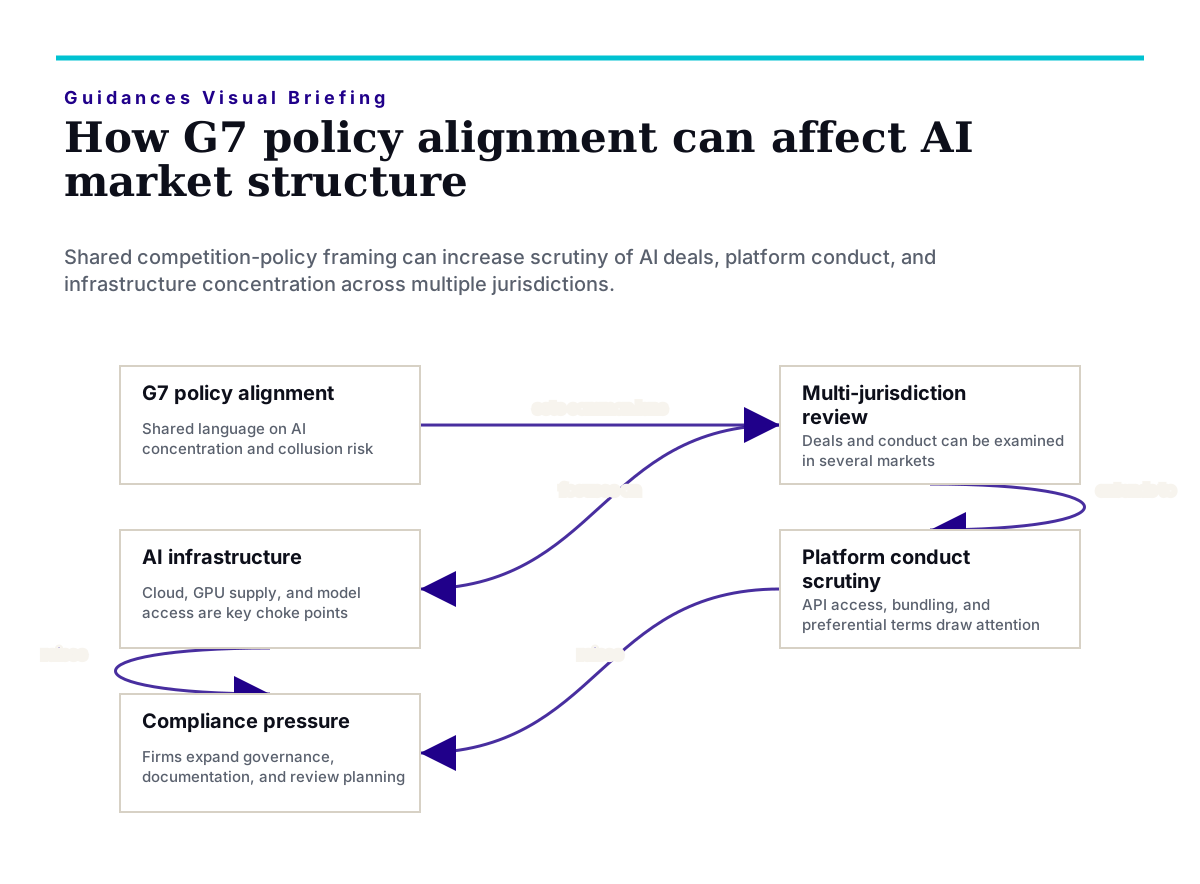
For technology operators and market participants, that has several implications. First, large AI-related transactions—such as acquisitions of model developers, data providers, or inference infrastructure companies—may be reviewed in multiple jurisdictions at the same time. Second, conduct reviews involving cloud-compute contracts, preferential API access, or bundled AI services may be discussed more often across jurisdictions. Third, the collusion-risk framing suggests that regulators may examine not only dominant-firm behavior but also industry consortia and standard-setting processes.
This analysis is market context only, not investment advice. Still, the policy environment shaped by the summit is a variable that technology operators and founders may want to include in strategic planning.
Technology and Policy Linkage
The G7 summit reflects a broader convergence in how advanced economies are approaching AI governance. The European Union’s AI Act, the United Kingdom Competition and Markets Authority’s tighter scrutiny of digital markets, and the United States’ dual-track approach—combining FTC market-study authority with DOJ merger-enforcement power—are all moving toward a common analytical vocabulary. That vocabulary centers on market concentration, interoperability barriers, and the structural advantages that can arise when a company controls both compute infrastructure and proprietary data.
For AI infrastructure specifically, cloud computing is the main linkage. Large cloud providers often supply GPU clusters, managed AI services, and model APIs together, making them central to enterprise AI deployment. Competition authorities in several G7 jurisdictions had already opened reviews of cloud-market dynamics before the 2024 summit, and the AI-specific framing at that meeting helped extend scrutiny to the model layer, the fine-tuning layer, and the application distribution layer.
The collusion-risk dimension also deserves attention. In markets where a small number of firms strongly influence benchmarks, safety-evaluation frameworks, or interoperability protocol design, the line between legitimate coordination and competition concerns can be contested. Regulators signaling interest in that boundary can affect the governance of industry consortia and standard-setting bodies.
The interaction between AI antitrust enforcement and national-security carve-outs adds another layer of complexity. Some G7 governments are pursuing competition-policy goals alongside industrial-policy measures such as support for domestic compute capacity, national foundation-model programs, and security reviews of certain cross-border AI transactions. The tension between those policy goals can create jurisdictional differences that companies operating across multiple markets need to manage.
Market Lens
Trigger: The October 2024 G7 communiqué set out a shared framework in which major-economy competition authorities treat AI market concentration and collusion risk as priority review topics. This is a documented policy position.
Mechanism: Policy alignment across multiple jurisdictions can increase the review burden for large AI-related transactions, raise compliance costs for dominant platform operators, and add uncertainty to industry coordination structures. Those effects can become more visible as authorities build shared investigative capacity and common standards.
Affected sectors: AI infrastructure—including cloud computing and GPU supply chains—foundation-model developers, enterprise AI software vendors, and data-licensing intermediaries may face direct effects. High-AI-adoption sectors such as financial services technology, healthcare technology, legal technology, and enterprise productivity software may face indirect effects.
Time horizon: The policy framework formed in 2024 is a medium-to-long-term variable. Individual reviews or investigations may appear at specific points in time, but the cumulative effect on AI market structure is likely to unfold over several years.
Next check: Watch for FTC or DOJ reviews of AI-related transactions, CMA or European Commission announcements on AI market investigations, and updates to the G7 competition authorities’ shared AI enforcement framework. Earnings calls from hyperscale cloud providers that mention regulatory risk may also be useful signals.
Unverified link: This analysis does not claim specific stock-price effects, sector-index moves, or named-company financial impacts. The source does not support those connections, so they have been excluded.
What to Watch Next
Several developments in 2025 and 2026 have increased the practical relevance of the 2024 G7 framework. Competition authorities in multiple jurisdictions have expanded AI-related investigative capacity, and AI safety bodies and standard-setting consortia are being discussed more frequently.
Founders and operators building on concentrated AI infrastructure may want to monitor whether any G7 authority moves from market-study phase to more formal enforcement steps. If that happens, the policy environment could change in a meaningful way.
The tension between industrial policy and competition policy is also worth tracking. If one jurisdiction allows a transaction on security or industrial-policy grounds while another applies a stricter competition standard, companies operating across those markets may face both strategic and compliance implications.
Uncertainty and Constraints
This analysis is based on a search-provider snippet from an official FTC press release dated October 1, 2024. The full text of the G7 communiqué and any later enforcement actions are not available in the source metadata. Claims about specific investigations, enforcement outcomes, or company-specific regulatory exposure are not supported by this source and have been excluded. The article describes the structural implications of a documented policy posture rather than confirmed enforcement events. Readers should consult primary regulatory sources and qualified legal counsel for jurisdiction-specific details.