What Happened
NVIDIA's official newsroom published an announcement—collected by Guidances on June 24, 2026, with a search-provider date of March 2025 that is unverified at the source-page level—describing a joint initiative with storage industry partners to position a new integrated hardware and software stack for AI workloads running against enterprise data repositories. The source-page publication date could not be confirmed; readers should verify current product and partner status directly through NVIDIA's official channels.
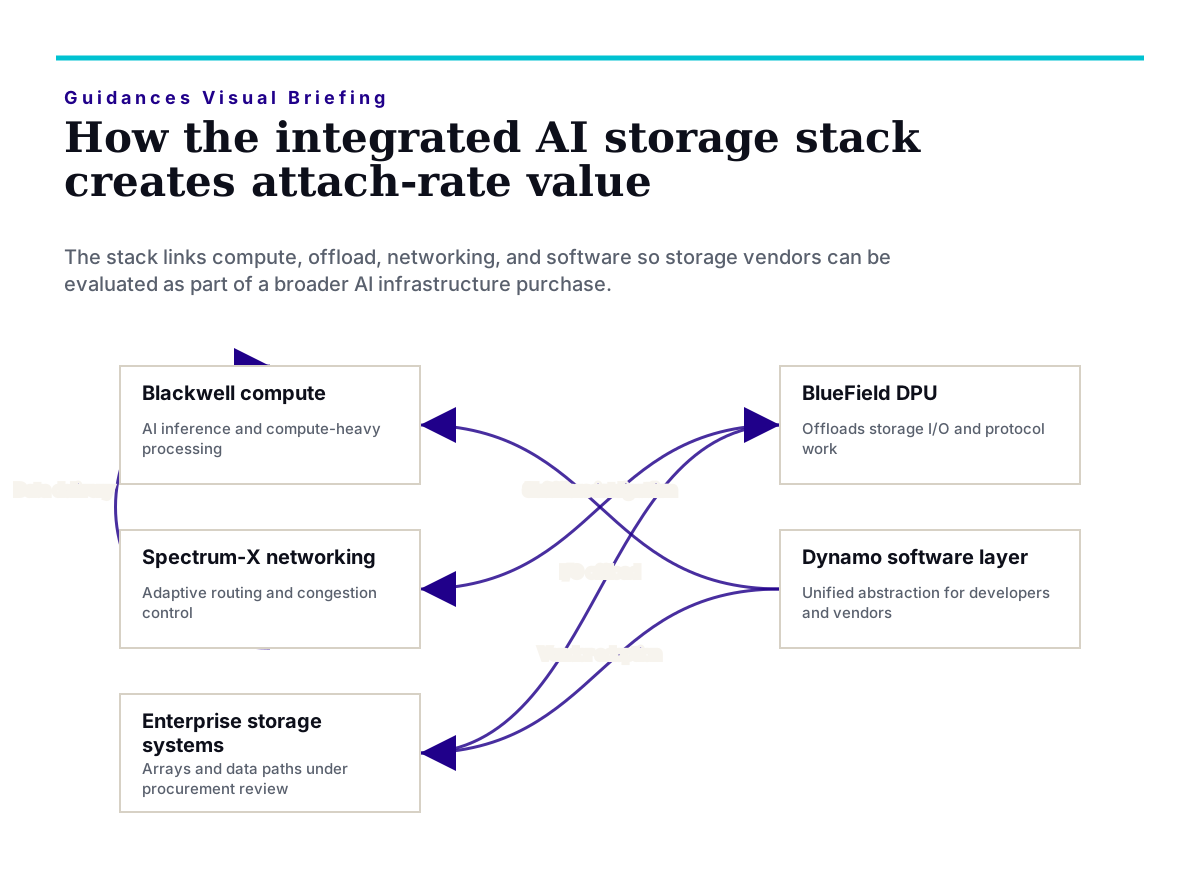
The architecture disclosed has four interlocking layers. Blackwell GPUs handle the compute-intensive inference work. BlueField data-processing units (DPUs) intercept storage I/O before it reaches the CPU, handling protocol processing and data movement in dedicated silicon. Spectrum-X networking governs the traffic path between storage arrays and compute nodes, applying adaptive routing and congestion control rather than relying on static Ethernet forwarding. The Dynamo open-source inference library provides the software abstraction that ties these hardware layers together and exposes a unified interface to application developers.
The performance figures disclosed are specific enough to anchor a procurement argument. Spectrum-X is claimed to accelerate AI storage traffic by up to 48 percent relative to conventional Ethernet, achieved through traffic-aware routing rather than raw link-speed increases. BlueField DPUs are said to deliver up to 1.6 times the storage throughput of CPU-based approaches while cutting power draw by up to 50 percent—a combination that compounds to more than three times higher performance per watt. These are presented as "up to" figures under benchmark conditions; real-world results in heterogeneous enterprise environments will vary, and no independent third-party validation is cited in the available source material.
Why the Market Cares
The strategic logic here is about attach rate as well as performance. Every Blackwell GPU rack that ships into an enterprise data center creates a potential attachment point for BlueField DPUs and Spectrum-X switches. If NVIDIA can establish its DPU and networking products as the qualified, reference-architecture choice for AI storage workloads, the revenue per deployed rack can expand beyond the GPU itself. This is the same platform-extension logic that drove the evolution of server networking from a commodity add-on to a differentiated infrastructure layer.
For storage vendors, the announcement creates an important qualification question. Enterprise IT buyers evaluating AI infrastructure proposals may ask whether a storage system is validated against NVIDIA's DPU and networking stack. Vendors that delay qualification could be viewed less favorably in competitive bids, even if their raw storage performance is competitive. The announcement effectively shifts the evaluation criteria from storage throughput alone to storage throughput within an AI inference pipeline.
The business scale behind this initiative is substantial. The market-data backdrop is large enough to make even adjacent infrastructure categories material: annual revenue was $215.9B, recent revenue growth was +65.5%, TTM operating margin was +64.0%, and market capitalization was $4.76T as of June 25, 2026. These figures reflect the pricing power and ecosystem leverage that NVIDIA brings to any new product category it enters. A storage-layer initiative backed by that scale of installed base and developer ecosystem is likely to draw attention from incumbent vendors.
For enterprise IT buyers, the reframing matters for budget allocation. A storage refresh that can be positioned as an AI infrastructure investment—rather than a routine capacity upgrade—competes for a different, typically larger, budget pool. This dynamic can affect procurement timelines and deal sizes, which is the outcome NVIDIA's go-to-market framing appears designed to support.
Technology and Policy Link
The Dynamo inference library deserves separate analysis from the hardware claims. Open-source distribution lowers the initial integration barrier: storage vendors and enterprise developers can begin building against Dynamo's abstractions without a licensing commitment. However, once a vendor's software stack is optimized around Dynamo's data-movement and scheduling interfaces, the cost of switching to a different inference runtime—or a different underlying hardware platform—can rise. This is a common platform-dependency pattern in infrastructure software.
The policy dimension is less visible in the announcement but materially relevant for international deployments. NVIDIA hardware components, including Blackwell GPUs and BlueField DPUs, may be subject to U.S. export licensing requirements in certain jurisdictions. Enterprise buyers in financial services, healthcare, and government sectors may face additional compliance review when deploying integrated AI infrastructure stacks that include controlled components. These constraints are not addressed in the available source material and remain an important variable for procurement timelines in regulated international markets.
Power efficiency is a third policy-adjacent variable. The claimed 50 percent reduction in power consumption from DPU offload is directly relevant to data-center operators navigating electricity capacity constraints, power purchase agreement limits, and mandatory carbon disclosure frameworks. In markets where grid capacity is tight or sustainability reporting obligations are tightening, a credible performance-per-watt improvement can influence procurement decisions independently of raw throughput benchmarks.
Market Lens
Trigger: NVIDIA's official disclosure of an integrated Blackwell-BlueField-Spectrum-X stack with specific performance-per-watt and throughput claims targeting enterprise AI storage workloads.
Mechanism: Storage vendor qualification of this stack can drive BlueField DPU and Spectrum-X attach rates alongside Blackwell GPU deployments, expanding NVIDIA's revenue per data-center rack. Dynamo adoption by storage software stacks can create switching-cost barriers over time. Incumbent Ethernet networking vendors may face competitive pressure in AI storage traffic paths if Spectrum-X gains qualified reference-architecture status.
Affected sectors: Enterprise storage hardware vendors, data-center networking suppliers, and hyperscale and enterprise cloud operators evaluating AI inference infrastructure refresh. NVIDIA is the primary named beneficiary