What Happened
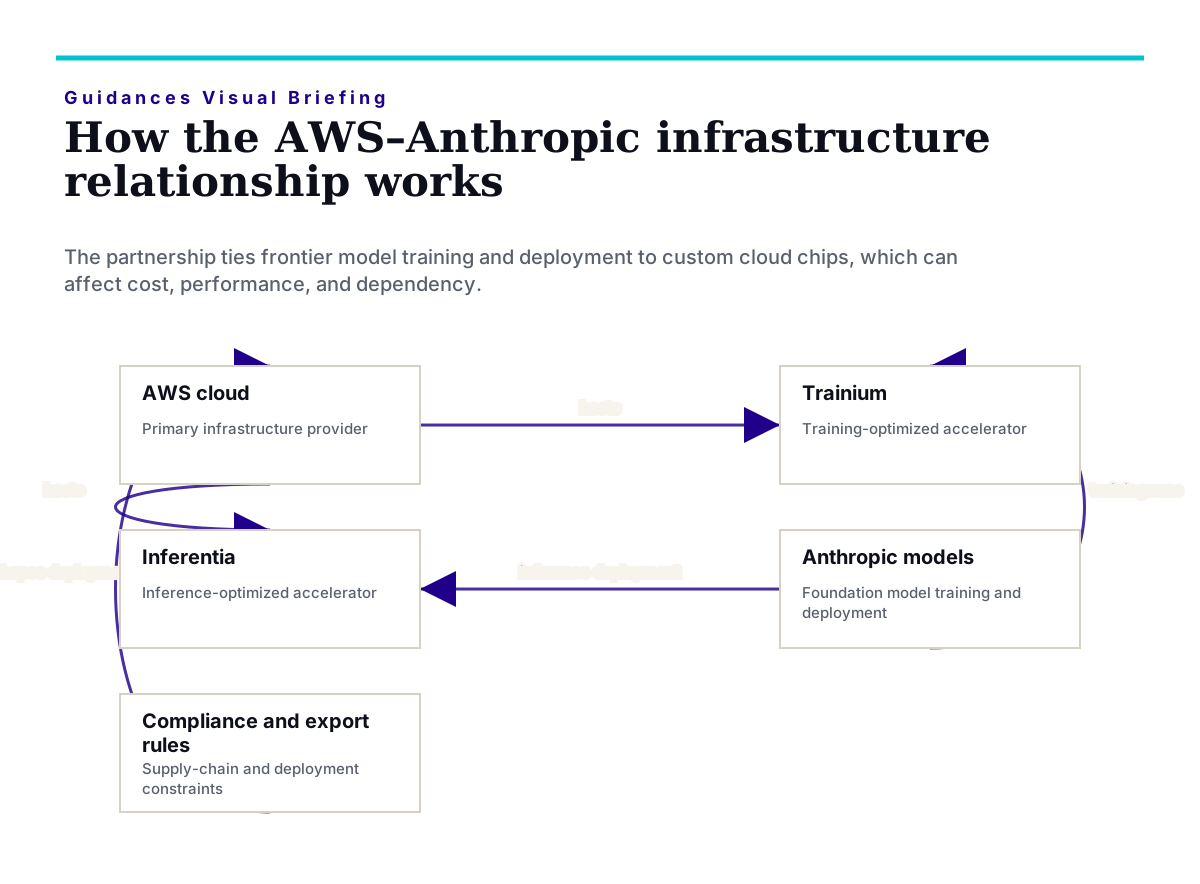
Amazon Web Services has announced that Anthropic—the AI safety company behind the Claude family of large language models—has designated AWS as its primary cloud provider. Under the arrangement, Anthropic will train and deploy its forthcoming foundation models on AWS's proprietary accelerator chips: Trainium, designed for large-scale model training workloads, and Inferentia, optimised for inference at scale. AWS states that its second-generation Inferentia chip delivers up to 50% more performance per watt and can reduce inference costs by up to 50% relative to comparable GPU-based instances. These figures, drawn from the AWS source snippet, are company claims and have not been independently verified.
The partnership is notable as a commercial agreement and as an example of AWS's custom-silicon strategy. A frontier AI developer has chosen to place core training and deployment infrastructure on a cloud provider's in-house silicon rather than on third-party GPU hardware.
Why the Market Cares
The Amazon–Anthropic relationship carries weight across several market dimensions.
First, it highlights AWS's multi-year investment in custom accelerator silicon. Amazon has developed Trainium and Inferentia as alternatives to Nvidia's GPU lineup. Anthropic's role as a major customer is a data point suggesting that proprietary silicon can be used for frontier AI workloads.
Second, the efficiency claims matter commercially. A 50% reduction in inference cost, if reproduced at production scale, could affect the cost structure of large-scale AI deployments. For AWS customers evaluating total cost of ownership, that figure becomes one input in comparing GPU-based and custom-silicon-based deployments. It also provides a comparison point for cloud providers that rely on third-party accelerators.
Third, the arrangement may deepen Amazon's position in the AI value chain. AWS is not simply a compute provider in this setup; it is an infrastructure partner to a frontier model developer. That relationship can create switching costs, data gravity, and potential for joint product development.
Amazon's operating scale provides context for how consequential the AWS AI infrastructure bet may be. The company reported annual revenue of $716.9B and carries a market capitalisation of approximately $2.63T. Year-over-year revenue growth stood at +12.4%, and AWS is an important business segment within that revenue base. The trajectory of AWS's AI chip adoption is therefore a variable to watch in Amazon's overall operating income profile. This is market context only, not investment advice.
Tech / Policy Link
The Trainium–Inferentia architecture reflects an industry shift toward purpose-built AI accelerators. Unlike general-purpose GPUs, these chips are designed around specific computational patterns—matrix multiplication at scale for training, low-latency token generation for inference.
From a policy standpoint, the partnership intersects with U.S. export-control frameworks governing advanced semiconductors. AWS's custom chips are designed and manufactured within supply chains subject to Commerce Department rules on AI chip exports. To the extent that Anthropic's models are deployed globally through AWS infrastructure, the geographic reach of that deployment may be affected by export-control compliance requirements. The source does not specify how Anthropic and AWS are handling those constraints, and that remains an open question.
There is also a concentration dynamic worth noting. As frontier AI developers increasingly commit to single primary cloud providers, the infrastructure layer of the AI stack may consolidate around a small number of hyperscalers. Regulatory bodies in the United States, European Union, and United Kingdom have begun examining whether such arrangements create competitive dependencies that warrant scrutiny. No regulatory action has been announced in connection with this specific partnership, but the structural pattern is being watched by market observers and policymakers.
Market Lens
Trigger: AWS secures Anthropic as a primary cloud customer committed to training and deploying foundation models on Trainium and Inferentia chips.
Mechanism: Custom-silicon adoption by a frontier AI developer may reduce AWS's dependence on third-party GPU procurement and could influence AWS segment costs and customer acquisition strategy. It also creates a reference case for AI-native customers. At the same time, it may create comparison pressure for cloud competitors whose AI infrastructure relies on Nvidia hardware.
Affected sectors and companies (source-supported): AWS and its parent Amazon (AMZN) are the direct parties named in the source. Alphabet/Google Cloud (GOOGL) and Microsoft Azure are comparable hyperscale competitors, though neither is named as affected in the source. The custom silicon segment of the semiconductor industry is also relevant. Nvidia is not named in the source, but it is often used as a comparison point because of its role in cloud AI workloads.
Time horizon: The commercial impact of Anthropic's training and deployment commitment may unfold over multiple quarters as model generations are released and inference volumes scale. Efficiency claims may be tested against production workloads over a medium-term horizon of one to three years.
Next check: AWS segment revenue and operating margin disclosures in Amazon's next earnings release; any Anthropic public statements on model deployment infrastructure; Nvidia earnings commentary on hyperscaler GPU demand; and U.S. export-control policy updates affecting AI chip supply chains.
This section is market context only, not investment advice. AMZN-related figures are used as scale context only.
What to Watch Next
Several developments will determine how significant this partnership proves to be in practice. The first is whether Anthropic's next major foundation model release explicitly credits Trainium-based training, which would serve as a public example of AWS silicon use. The second is whether other frontier AI developers—those currently training on Nvidia H100 or H200 clusters—begin evaluating or announcing similar primary-cloud commitments to AWS or its competitors. A pattern of such announcements would suggest a shift in how AI infrastructure procurement decisions are made.
The third variable is cost verification. AWS's claim of up to 50% cost reduction on inference is a headline figure that enterprise buyers may test against their own workloads. Independent benchmarks and customer case studies are likely to be more useful than vendor-published metrics in shaping procurement decisions at scale.
Finally, the regulatory environment around hyperscaler-AI developer partnerships deserves monitoring. Competition authorities have signalled interest in the structural dependencies that can arise when frontier AI companies rely on a single cloud provider for both compute and, in some cases, investment capital. The outcome of those reviews could affect the terms on which such partnerships are structured going forward.
Uncertainty and Constraints
The source for this analysis is an AWS-published snippet, which means the efficiency and cost figures cited are vendor claims rather than independently audited results. The financial terms of the Anthropic partnership are not disclosed. The publication date of the original AWS article is not machine-readable from the snippet metadata; the collected date is June 20, 2026, which is used as retrieval context only. Readers should treat performance claims as directional indicators subject to independent verification.