What Happened
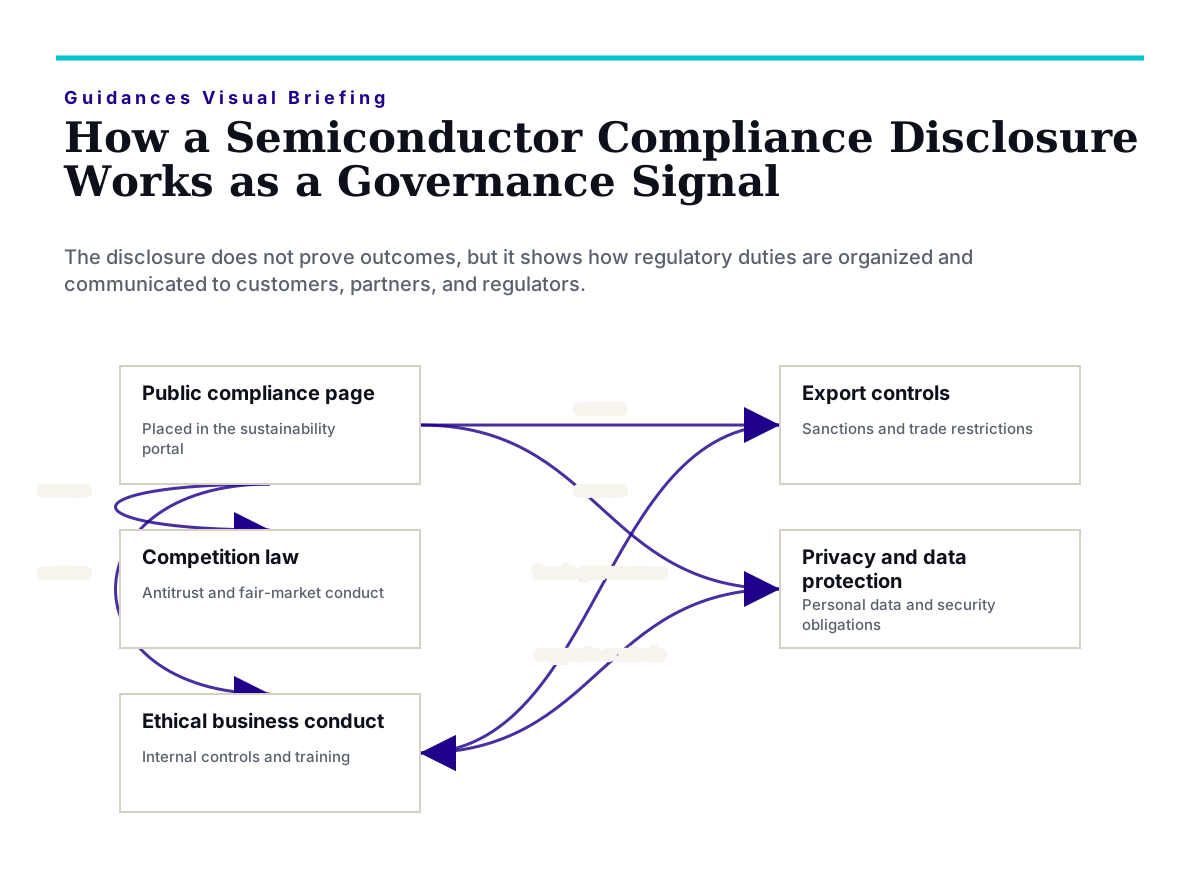
SK Hynix maintains a publicly accessible compliance page on its corporate sustainability portal. According to the provided material, the page covers four areas: export sanctions, antitrust law, data privacy, and ethical business conduct. It also describes a formal framework that includes structured training programs. Because the page sits within the sustainability section, it presents regulatory adherence as part of governance and responsible management rather than as a narrow legal function.
This disclosure is not a new policy announcement, and it is not an enforcement action. On the basis of the available source alone, it is not possible to determine operational effectiveness or external market reaction. The verifiable point is that SK Hynix is publicly organizing and describing its compliance posture across several regulatory domains.
Why the Market Cares
SK Hynix is one of the major suppliers in the DRAM and NAND flash memory markets. Its products are used in AI accelerators, data center servers, smartphones, and automotive electronics. In an industry with long supply chains and multiple regulatory layers, the way a company describes its compliance structure can matter to customers, partners, and other market participants as a governance signal.
That does not mean the disclosure itself proves a market outcome. It does mean that semiconductor companies operate in an environment where export controls, competition rules, privacy obligations, and internal conduct standards are all part of the operating context. A public compliance page can therefore be read as a statement about how the company is organizing its regulatory responsibilities.
SK Hynix's market capitalization is listed at KRW 1957.73T. This is scale context only. It shows that the company is large enough for its governance disclosures to attract attention, but it does not imply any price view or investment conclusion.
Technology and Policy Linkage
The disclosure sits within a broader policy environment that has become more active around semiconductors. The U.S. CHIPS and Science Act, the EU Chips Act, and Japan's semiconductor subsidy programs have all increased the policy focus on memory and logic chip production. In that setting, compliance is part of the operating framework that companies must manage alongside manufacturing and customer relationships.
Each of the four areas named in the disclosure connects to a different policy domain. Export sanctions relate to U.S. export control administration, including the Bureau of Industry and Security. Antitrust relates to competition-law enforcement in major jurisdictions. Privacy connects to data-protection rules such as GDPR and South Korea's Personal Information Protection Act. Ethical business conduct relates to internal controls used in multinational procurement, government contracting, and joint ventures.
The source supports these contextual links, but it does not support stronger claims about direct operating consequences or market effects. It confirms the existence of a structured framework; it does not provide audit results, enforcement history, or evidence of performance.
Market Lens
Trigger: SK Hynix publicly disclosed a multi-domain compliance framework through its sustainability portal.
Mechanism: In a regulated semiconductor market, a public compliance framework functions as a governance signal. It shows how the company is presenting its approach to sanctions, competition law, privacy, and conduct standards. For customers and supply-chain partners, that can be relevant in due diligence and procurement review. However, the disclosure alone does not establish any specific operational outcome.
Why it matters: Semiconductor supply chains are deeply interconnected. Companies that buy memory components often review supplier documentation as part of their own compliance and sourcing processes. A public framework may therefore be useful as reference material, but it should not be treated as proof of customer acceptance, regulatory clearance, or market impact.
Scope of exposure: The most direct context is the global semiconductor supply chain, including AI hardware, data center infrastructure, smartphone manufacturing, and automotive electronics. The disclosure may also be relevant to internal governance review. No source-supported causal market reaction is available from this disclosure alone.
Time horizon: Medium term. Compliance frameworks tend to matter when rules change, customer requirements become more formal, or additional disclosures appear. The available source does not justify a short-term market thesis.
What to Watch Next
First, watch for changes in export control rules. If U.S. export-control coverage changes, semiconductor companies may need to adjust classification, documentation, and verification processes. The current article does not assume any specific rule change.
Second, watch for customer due-diligence requirements. Large customers may ask suppliers for documentation on privacy, internal controls, and regulatory processes. A public compliance page can support that review, but it does not by itself show that all customer requirements are met.
Third, watch for domestic regulatory developments in South Korea. Competition and privacy enforcement trends can affect how companies structure internal controls and reporting. That is a general monitoring point, not a claim about this disclosure.
Fourth, watch for additional company disclosures. A more detailed report, audit summary, or governance update would provide a stronger basis for analysis than the current snippet.
Uncertainty and Constraints
The available source is a sustainability-portal snippet, not a detailed compliance report, enforcement filing, or earnings release. It confirms the existence of a structured framework and training program, but it does not provide completion rates, audit findings, enforcement history, or customer responses. Readers should treat it as a governance signal, not as a certification of compliance effectiveness.
The source is also not a market-data release. It does not support revenue estimates, price movement claims, valuation commentary, index eligibility arguments, or ESG score predictions. Those interpretations are outside the evidence provided here.
This article is market context only and does not constitute investment advice.