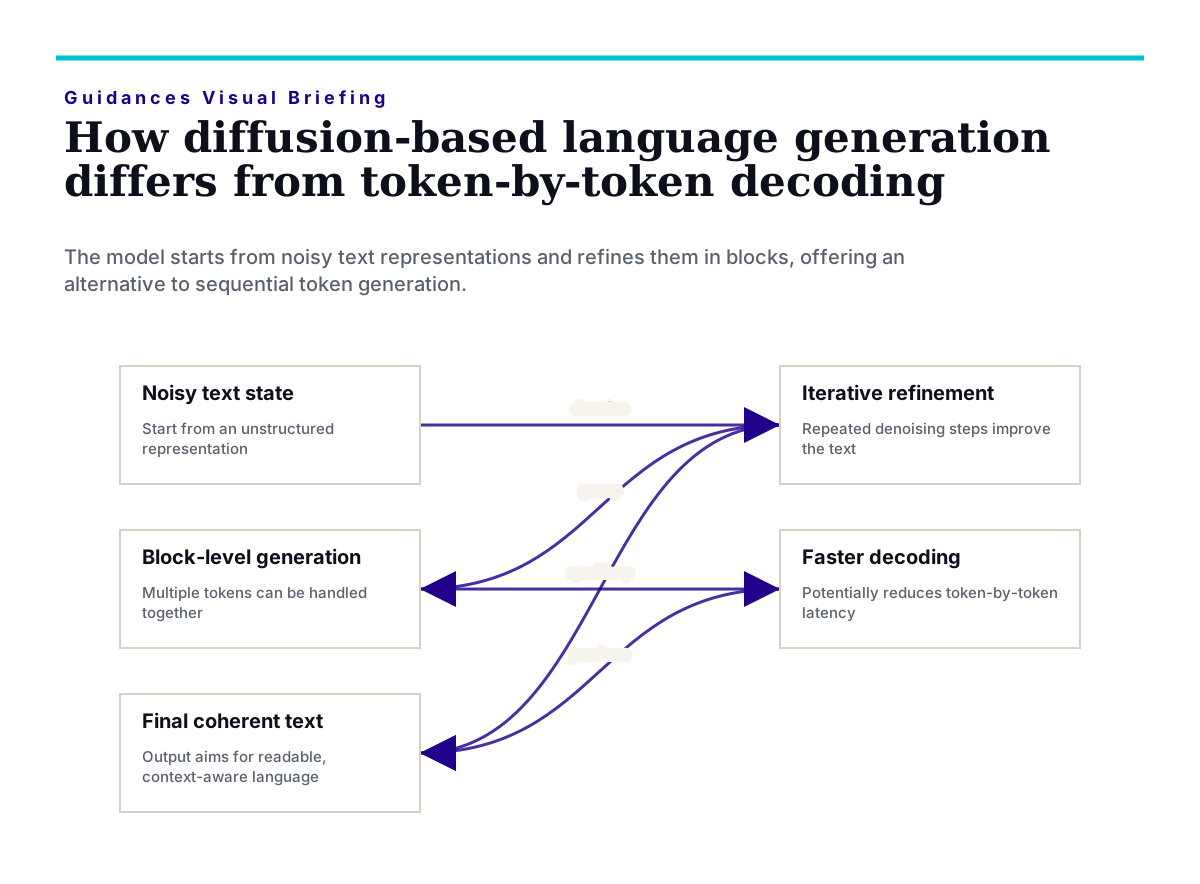
Google DeepMind has announced Gemini Diffusion, a diffusion-based approach for language generation. The announcement presents a new approach to how large language models can generate text.
Diffusion models are widely known in image generation. The method learns to progressively restore data from random noise and has been used in contexts where generation quality and diversity are important. Google DeepMind has extended this diffusion technique to text generation.
The core features of Gemini Diffusion are faster decoding speed and block-level generation capability. Traditional autoregressive models generate tokens one at a time in sequence, which can introduce latency when producing long texts. In contrast, diffusion-based approaches can offer a structure for generating multiple tokens at once or processing them in blocks.
Block generation is related to generating semantic units such as sentences or paragraphs in a single step. This is described as a design element that may affect contextual coherence and generation speed. Compared with models that predict tokens individually while maintaining overall context, block-level generation proposes a different way of composing text.
The application of diffusion models to language generation has been explored in academia. Prior research such as Diffusion-LM examined methods for applying continuous diffusion processes to discrete text data. However, these studies were largely experimental, and deployment in production environments has been limited.
Decoding speed is an important performance metric for AI application developers. Many current language model APIs use latency per token as a key measure, which affects user experience and operational costs. If Gemini Diffusion provides speed improvements in real-world use, it could affect response times and throughput in chatbots, content generation tools, and code assistants.
Challenges remain in applying diffusion models to language generation. Text has a discrete structure, unlike images, so additional techniques are needed to apply continuous noise-removal processes. Diffusion models also often involve multiple iterative refinement steps, which can increase computational cost. Evaluation of generated text quality and coherence includes several factors such as grammar, factual consistency, and context maintenance.
Google DeepMind has expanded its multimodal AI capabilities through the Gemini series. Gemini 1.0 and 1.5 demonstrated integrated processing of text, images, audio, and video, and Gemini Diffusion is presented as an additional direction in text generation. Google uses language models across product areas including search, advertising, and cloud services.
Publicly available information remains limited, so details such as model parameter scale, training datasets, and benchmark performance have not yet been confirmed. Google DeepMind's research page provides a technical overview, but does not appear to include detailed implementation specifics or open-source release plans. More information may be disclosed through future academic papers or API releases.
For language model developers, the announcement offers an opportunity to review new design directions. The training stability, sample quality, and controllability of diffusion models have been discussed in image generation, and whether those characteristics apply to text generation remains an open question. In particular, how diffusion models behave in fine-tuning and prompt engineering may be relevant for practical adoption.