What happened
ASML released its 2024 annual results, reporting total net sales of €28.3 billion. In the same disclosure, the company pointed to AI-linked logic chips and high-performance computing (HPC) demand as the primary backdrop for growth in EUV and High-NA EUV system sales in 2025. The source is an official company release. The collected metadata does not include a machine-readable publication date, so this article does not present the item as newly published news. It is best treated as a verified corporate disclosure tied to the 2024 fourth-quarter reporting cycle.
ASML holds a unique position as the world's sole supplier of extreme ultraviolet (EUV) lithography systems, which are indispensable for manufacturing advanced semiconductors at process nodes of 7 nanometers and below. These advanced nodes are critical for the development of cutting-edge AI accelerators, high-performance CPUs, and GPUs. Consequently, ASML's performance and outlook offer more than just insights into an equipment supplier's health; they serve as a crucial barometer for the global semiconductor industry's technological roadmap and the pace of capacity expansion.
As of a recent market data snapshot, ASML's current market capitalization stands at $703.9B. Its annual revenue is reported at $32.7B, reflecting a +15.6% year-over-year revenue growth, with a trailing operating margin of +34.8%. Those figures do not tell the whole story, but they do show that ASML sits in a rare position: it is not just a supplier of industrial tools, but a gatekeeper for the pace at which advanced semiconductor capacity can be added globally.
Why the market cares
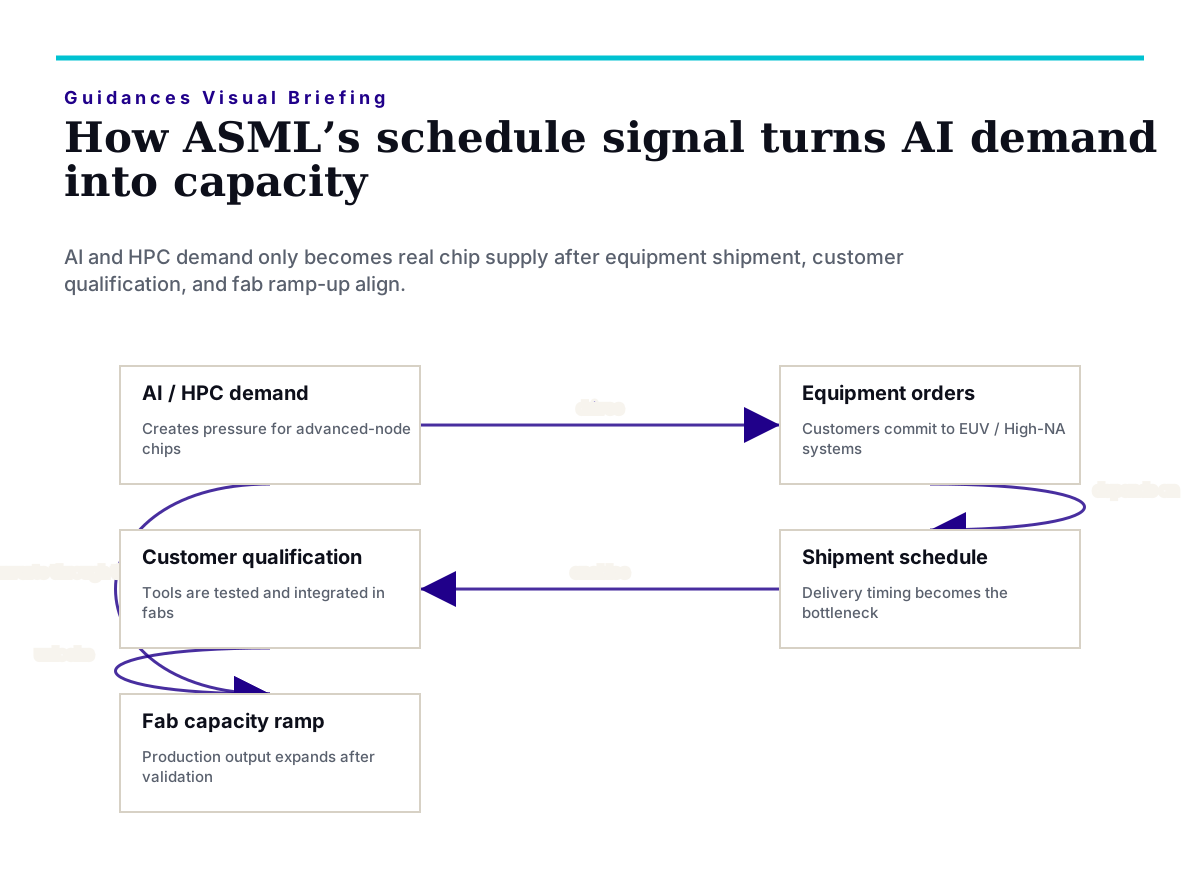
The key point is not simply that AI demand exists. It is that AI demand has to pass through a very specific industrial bottleneck before it translates into realized revenue, manufacturing capacity, or shipment volume. Advanced logic chips and AI accelerators require finer process nodes and tighter manufacturing tolerances, which are only achievable with EUV and High-NA EUV technologies. However, this technological transition is not solely driven by design intent. It critically depends on the supply of lithography equipment, customer qualification schedules, and the pace of capital expenditure by fab operators. ASML sits at the front of that intricate chain, making its disclosures highly influential.
That makes the disclosure useful as a schedule signal. When ASML states that growth in 2025 should be supported by AI-related logic and HPC demand, it is also implicitly communicating that customers are still willing to commit substantial capital to leading-edge manufacturing. However, the timing is paramount. A demand signal does not instantly become delivered systems. Customers must complete complex process validation, adjust mask layouts, and integrate new equipment into their production lines, a process that often spans years rather than quarters. In other words, the disclosure is less about a one-quarter sales story and more about the long-term cadence of advanced-node investment and the industrial cycle.
The margin profile matters for the same reason. A trailing operating margin of +34.8% suggests that ASML possesses significant pricing power, which is consistent with its supply-constrained and strategically critical position within the semiconductor stack. This indicates that ASML's technological leadership and limited supply capacity underpin its strong market standing. While this does not eliminate risk, it means that the company’s economics are tightly linked to how smoothly and quickly customers can absorb and deploy its highly specialized systems.
Tech / policy link
On the technology side, EUV remains central to advanced logic manufacturing, while High-NA EUV represents the next significant step in process architecture. High-NA is not merely a better machine; it requires customers to fundamentally rethink masks, process flows, and fab integration. This technology enables the creation of even smaller features and higher transistor densities, which are essential for the next generation of high-performance chips. Consequently, the qualification timeline for High-NA is measured in years rather than quarters, reflecting the immense investment and complex engineering required for its successful deployment. The equipment decision and the manufacturing transition are inextricably linked.
Policy is the other critical layer. Export controls on advanced semiconductor equipment remain a live variable, and they can significantly shape where ASML can sell, ship, and allocate its systems. For instance, restrictions on exporting advanced tools to specific countries can impede those regions' access to cutting-edge technology, potentially leading to a reconfiguration of global semiconductor supply chains. The practical market question is not whether policy matters in the abstract, but rather which customers can receive which tools, and on what specific schedule. Policy does not erase underlying demand; instead, it alters the path from demand to revenue and influences the geographical distribution of advanced manufacturing capabilities.
This still matters today because AI infrastructure spending continues to depend heavily on capital expenditure and the efficient execution of complex supply chains. ASML’s disclosure serves as a potent reminder that the AI buildout is not solely a software or model story. It is also fundamentally a manufacturing schedule story, and that schedule is constrained by the availability and deployment of advanced lithography capacity.
Market Lens
Trigger: ASML’s 2024 annual disclosure and its 2025 growth outlook for EUV and High-NA EUV systems.
Mechanism: AI-linked logic and HPC demand only becomes realized equipment revenue if foundry and memory customers continue to invest, validate new processes, and successfully move into production. ASML's equipment is at the core of this critical bottleneck. The disclosure therefore points to the pace at which lithography capacity can translate abstract AI demand into tangible advanced-node supply. This mechanism underscores that the advancement of AI technology is not solely a matter of software and algorithms but is heavily dependent on the physical limitations of manufacturing capabilities and the supply chain.
Affected assets and sectors: The direct exposure is the semiconductor equipment sector. ASML is the anchor, with etch, deposition, and metrology suppliers linked indirectly, as their demand is often correlated with ASML's system deployments. Downstream, advanced logic foundries (e.g., TSMC, Samsung Foundry, Intel Foundry) and AI accelerator supply chains (e.g., Nvidia, AMD) are significantly affected by the timing of system deployment. These companies must align their next-generation chip production plans with ASML's equipment availability. Any broader market link beyond these directly connected sectors is unverified from the source alone.
Time horizon: The near-term checkpoint is the 2025 system shipment cadence for EUV, which directly impacts the short-term expansion of AI-related chip production capacity. The medium-term layer involves High-NA qualification and ramp-up, which can extend into 2026 and beyond. The successful integration of High-NA EUV will determine the commercialization timeline for future generations of semiconductor technology. This is a multi-period industrial cycle, not a single-quarter event, reflecting the long lead times and complexity inherent in advanced semiconductor manufacturing.
Next check: The most useful follow-up items are ASML’s next official results release and quarterly order trends, which will indicate whether demand is translating into actual bookings and shipments. Additionally, TSMC's capital expenditure guidance, Intel Foundry’s High-NA progress, and any official export-control updates from Dutch or U.S. authorities are crucial. These four elements, when combined, will allow for a more robust verification of the schedule signal and a more accurate prediction of the actual pace of AI infrastructure expansion.
What to watch next
First, watch ASML’s order and shipment mix. The company’s AI-linked demand comment matters only if it shows up in bookings and system allocation. Specifically, monitoring the volume of High-NA EUV orders and its planned deployment will be a key indicator of the pace of next-generation technology adoption. Second, watch customer capital expenditure (capex) plans. If leading foundry customers maintain or increase their spending, ASML’s schedule signal remains intact. Annual capex guidance from major foundries provides critical clues for ASML's future performance. Third, watch policy. Export licensing changes can alter regional allocation and delay or redirect shipments, directly impacting the development of semiconductor industries in specific regions. For example, tightened export controls on advanced equipment to China could shift ASML's regional revenue distribution and influence global supply chain strategies.
There is an important constraint here: the source does not disclose customer-level orders, regional revenue, or unit shipment data. That means the article cannot definitively prove which specific customer drove the demand, how much High-NA volume is already committed, or how much of the 2025 outlook is already locked in. These are critical questions, but they remain open given the limitations of the current disclosure.
Uncertainty and constraints
This analysis is grounded in an official company source plus market-data context. The snippet is short, so the article stays conservative on specifics that are not visible in the collected material. It does not add analyst consensus, price reaction, or unsupported causal claims. Where the source does not support a market link, the link is left out. The euro-denominated company disclosure and the dollar-denominated market-data context are not directly comparable without allowing for timing and currency differences. That is a practical limitation, not a contradiction. This article is market context only, not investment advice.