What happened
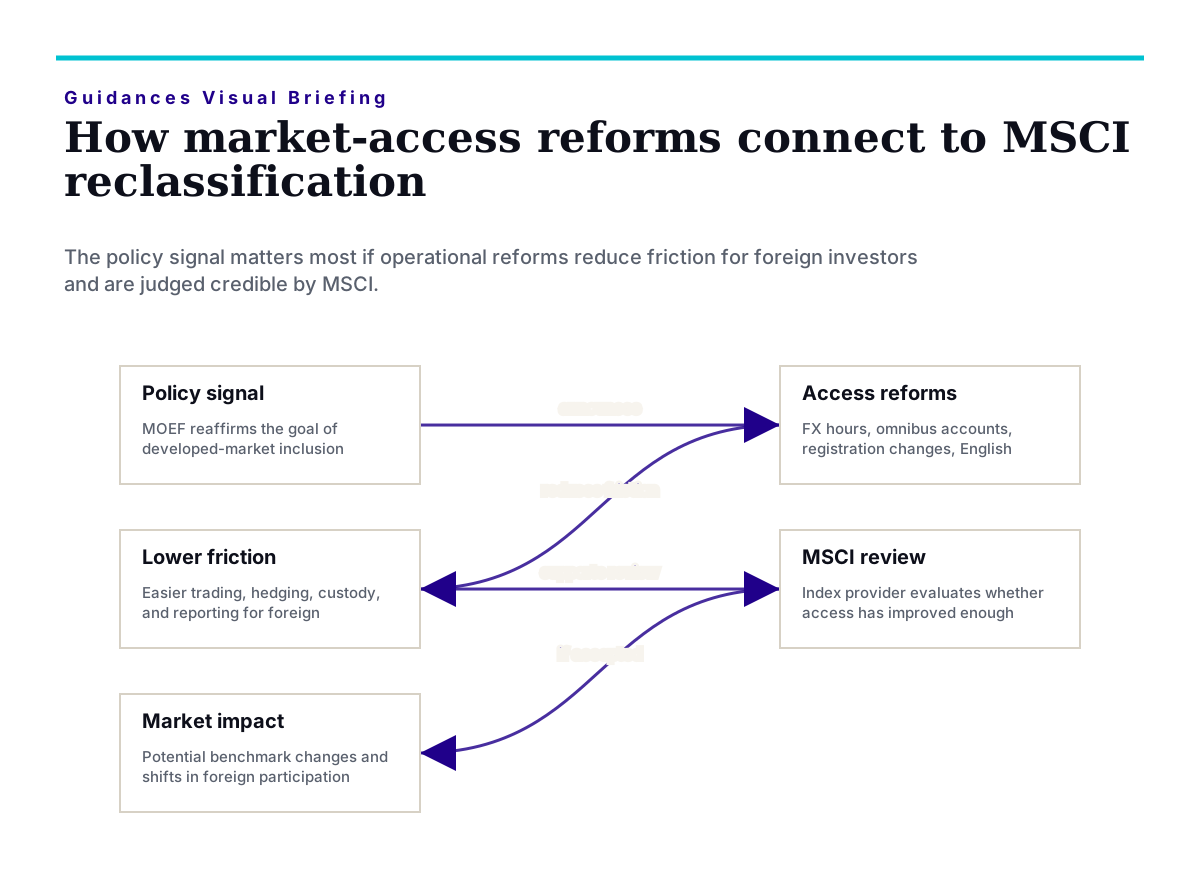
South Korea’s Ministry of Economy and Finance says it will work toward the country’s inclusion in MSCI’s developed-markets index. Based on the provided snippet, the ministry’s argument is straightforward: Korea already meets the benchmark on economic development, market size, and liquidity, but remains classified as an emerging market because of market-access constraints. The policy package cited in the snippet includes longer foreign-exchange trading hours, renewed direct participation by foreign financial institutions, the resumption of short selling, the abolition of foreign-investor registration, the introduction of omnibus accounts, and phased English disclosures.
That is a meaningful policy signal, but it is not the same as a completed market reform. The source material available here is limited to a press-release snippet, so the article should be read as a conservative analysis of direction rather than a claim that the reforms are already in force. For market participants, the distinction matters. Index classification is not changed by aspiration alone; it depends on implementation, operational detail, and the judgment of the index provider.
Why the market cares
MSCI classification matters because it sits inside the machinery of global portfolio allocation. A change in status can alter benchmark composition, the investable universe for some funds, and the operational burden faced by foreign investors. For Korea, the issue is not simply whether the country is “developed” in a broad economic sense. The practical question is whether the market is easy enough to access, trade, hedge, settle, and report on from the perspective of global institutions.
That is why the reforms named in the snippet are more important than the headline itself. Longer FX trading hours can reduce friction for overseas investors managing orders across time zones. Direct participation by foreign financial institutions can simplify market access. Omnibus accounts can reduce administrative overhead. English disclosures can narrow information gaps. Each measure addresses a different part of the same problem: the cost of participating in the market.
Still, the market should not assume a linear path from policy announcement to index reclassification. MSCI reviews are typically multi-step processes, and the market often prices expectations well before any formal change. If reforms are delayed, partial, or operationally narrow, the effect may remain more symbolic than structural. That is why execution, not rhetoric, is the key variable.
Tech / policy link
This is primarily a capital-markets and policy story, but it has a technology and infrastructure dimension. FX trading hours, foreign participation, and omnibus accounts all depend on market plumbing: trading systems, settlement rails, custody architecture, reporting workflows, and data distribution. English disclosures are also a digital-information issue, because they affect how quickly and reliably foreign investors can parse company information.
For technology operators, the relevant point is that market-access reform often creates downstream demand for better compliance tooling, multilingual disclosure systems, investor-relations software, and cross-border transaction infrastructure. The policy itself is not a software story, but it can change the requirements placed on software, data, and financial infrastructure providers.
There is also a policy-design question. Korea is trying to improve accessibility without undermining market integrity or supervisory control. The mention of short selling is notable in that context, but the snippet does not provide enough detail to determine the scope, timing, or safeguards attached to any change. That uncertainty should remain explicit. The source supports a policy direction, not a completed regulatory architecture.
Market Lens
Trigger: MOEF said it will work toward MSCI developed-market inclusion and outlined reforms aimed at foreign-investor access.
Mechanism: If implemented, the reforms could lower operational friction for global investors by improving FX access, simplifying account and custody procedures, and broadening disclosure usability. That can matter for benchmark-sensitive capital flows and for the perceived investability of Korean equities.
Affected assets / sectors: The most direct exposure is the Korean equity market as a whole, especially large-cap names that dominate index exposure and sectors with high foreign ownership. Secondary beneficiaries could include securities firms, market infrastructure providers, custody and settlement services, and disclosure/data platforms. Any specific ticker, ETF, or index-level move is unverified from the provided source alone.
Time horizon: Medium to long term. Index reclassification is usually a process, not a single event. The market will likely focus first on implementation milestones, then on any formal MSCI review, and only later on possible benchmark effects.
Next check: The next concrete check is not a price move but a policy document: implementation dates for FX trading changes, details on foreign financial institution participation, the legal or regulatory path for omnibus accounts and registration changes, and any formal MSCI commentary. Those are the points at which the market read-through becomes testable.
What to watch next
The first item to watch is whether the ministry publishes a detailed roadmap with dates, sequencing, and responsible agencies. The second is whether the FX market changes are operationally meaningful for overseas participants, rather than merely procedural. The third is whether English disclosure expansion is phased, mandatory, or limited to certain issuers. The fourth is whether MSCI acknowledges the reforms as sufficient progress in its own review framework.
It is also worth watching whether the reforms are coordinated across ministries and regulators. Market-access changes often fail when one part of the system moves faster than another. For example, a longer trading window is less useful if custody, settlement, or disclosure processes remain cumbersome. Likewise, an omnibus-account framework only matters if it is workable in practice for global institutions.
Uncertainty or constraints
The source material is thin and should be treated as such. It does not provide a timetable, a legislative package, or a quantified estimate of possible index effects. It also does not justify claims about immediate inflows, sector winners, or valuation changes. Those links would be speculative at this stage and are therefore left out.
This analysis is market context only, not investment advice. The policy signal is real, but the market consequences remain conditional on execution and external review.