What happened
The Federal Reserve's official monetary policy reference document articulates two statutory objectives: supporting maximum employment and maintaining stable prices. To pursue those goals, the central bank adjusts the target range for its benchmark overnight lending rate, which then ripples outward through short-term funding markets and into broader financial conditions. This is not a new policy announcement. The search metadata does not provide a machine-readable publication date, so the document should not be treated as breaking news. It is a standing policy explainer, and its value lies in the structural clarity it provides rather than in any immediate market signal.
That distinction is worth preserving carefully. In a rate environment where every data point is scrutinized for clues about the next policy move, understanding the transmission mechanism itself is foundational. Investors, corporate treasurers, and technology operators who understand how the policy rate connects to financial conditions are better positioned to interpret future announcements, earnings guidance, and capital allocation decisions. The document is relevant today not because it is new, but because the channel it describes continues to shape valuations, funding costs, and investment timing across the economy.
Why the market cares
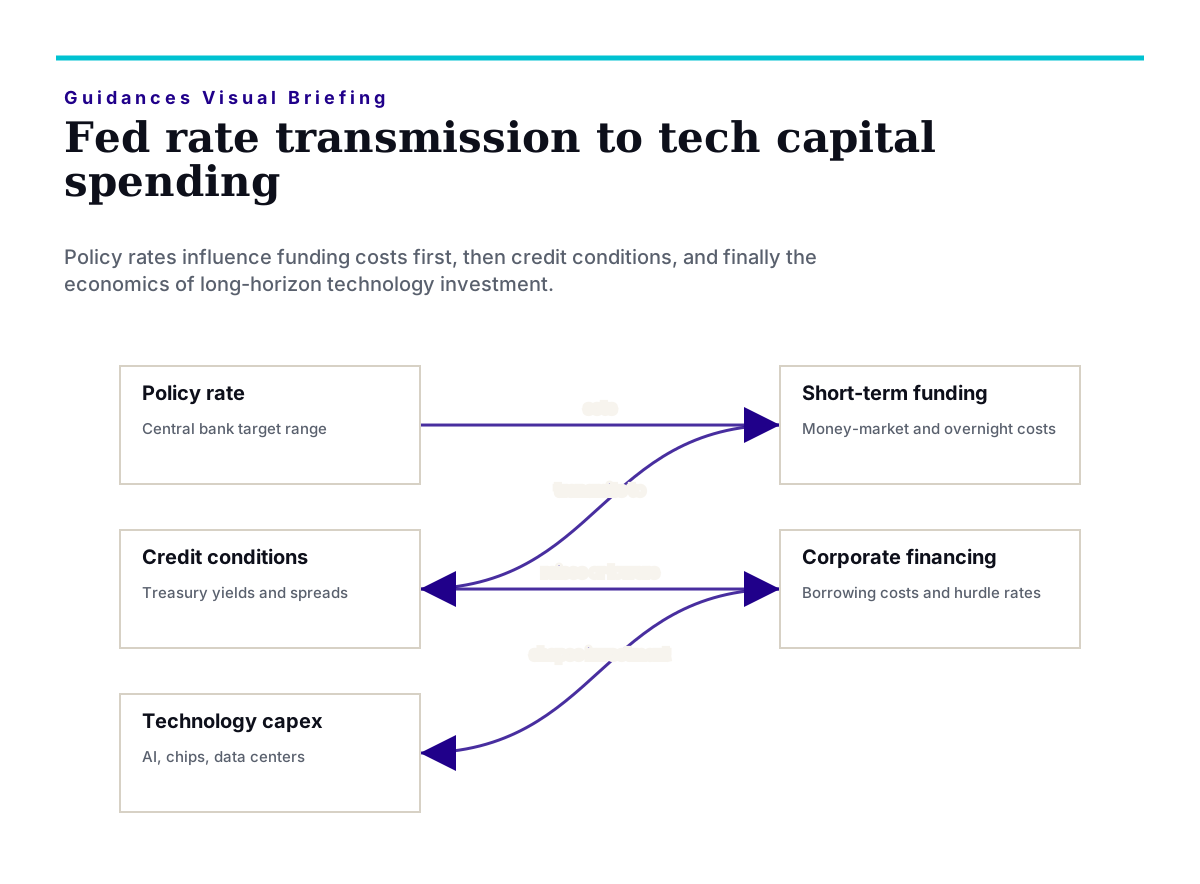
Monetary policy does not stop at the overnight rate. A shift in the policy rate target range moves short-term funding costs first, then propagates through Treasury yields, corporate bond spreads, bank lending standards, and ultimately the discount rates used in equity valuation. Each step in that chain affects a different set of economic actors: banks adjust lending terms, corporations recalibrate borrowing plans, and equity investors reprice future cash flows. The cumulative effect is what economists call a change in financial conditions, and it is the primary channel through which the Fed influences employment and inflation.
For market-aware readers, the relevance is especially pronounced in rate-sensitive parts of the economy. Growth equities, software platforms, semiconductor manufacturers, cloud infrastructure providers, data-center operators, and telecom equipment suppliers all carry significant exposure to the cost of capital. When the policy rate is elevated and expected to remain so, the present value of distant cash flows is compressed, financing becomes more selective, and marginal projects face higher hurdle rates. When conditions ease, the opposite dynamic can emerge, though the timing and magnitude depend on inflation data, labor-market readings, and the Fed's own forward guidance. This source does not support a specific market reaction, ticker move, or sector performance claim, so any such link would be unverified.
Tech / policy link
The connection between monetary policy and technology investment is indirect but structurally significant. AI infrastructure, semiconductor fabrication, large-scale cloud buildouts, and advanced networking deployments all require substantial upfront capital commitments that are typically financed over multi-year horizons. That makes them sensitive not only to demand conditions but also to the cost and availability of credit.
A lower policy rate can reduce the financing burden on long-duration projects and improve the economics of capital-intensive investment. A restrictive rate environment, by contrast, can push companies to stage projects more carefully, preserve liquidity, or defer marginal capacity additions. The same product roadmap can look materially different under different rate regimes, not because the technology changes, but because the financial conditions surrounding it do.
This is why a plain-language Fed policy explainer remains relevant to founders and operators. It helps define the environment in which capex decisions are made and evaluated. It also helps explain why corporate guidance on data-center spending, chip procurement, and infrastructure expansion often carries implicit assumptions about financing costs that are rarely made explicit. The source does not mention any specific company, ETF, or index, and it does not provide evidence of a direct operating impact on any named business. The policy link is therefore structural rather than event-specific.
Beyond the direct cost-of-capital channel, the Fed's balance-sheet operations also matter. How the central bank manages the reinvestment or runoff of its securities holdings affects longer-term yields and overall liquidity conditions in ways that complement or complicate the signal from the policy rate alone. That dimension is not addressed in the source snippet, but it is part of the broader financial-conditions picture that technology investors and operators should track.
Market Lens
Trigger: The trigger is the Fed's official articulation of how monetary policy is designed to function. The source is explanatory rather than event-driven, and no new policy decision is embedded in it.
Mechanism: The central bank adjusts its overnight rate target range to influence short-term funding costs. That adjustment propagates through the yield curve, credit spreads, bank lending behavior, and equity discount rates, ultimately affecting corporate investment, hiring, and pricing decisions.
Affected assets and sectors: The most structurally exposed areas include U.S. Treasuries, investment-grade and high-yield credit, bank equities, growth and technology equities, semiconductors, cloud and software names, AI infrastructure supply chains, data-center capital goods, and rate-sensitive real estate. Any direct link to a specific ETF or index is unverified because the source does not provide market data or a contemporaneous reaction.
Time horizon: The transmission from policy rate to economic outcomes is typically medium term. Markets may reprice immediately in response to Fed communication, but the effects on hiring, capital expenditure, and pricing power tend to unfold over quarters rather than days or weeks.
Next check: The most concrete follow-up indicators are FOMC statements and meeting minutes, the Fed Chair's public remarks, CPI and labor-market releases, movements in the two-year and ten-year Treasury yields, senior loan officer surveys, and corporate capex guidance in quarterly earnings calls. For technology operators specifically, the most practical signal is whether companies adjust their capital expenditure plans or financing assumptions in response to changing rate conditions.
What to watch next
The central question is not whether the Fed has a policy framework; it is how that framework is being applied to current inflation and employment dynamics. If inflation remains above target, financial conditions may stay restrictive for longer than markets currently expect. If labor-market softness becomes more pronounced, the policy path could shift toward easing. The source itself does not answer those questions, and the prudent reading is to treat it as a baseline for interpretation rather than a forecast.
For technology and industrial builders, the practical issue is the cost and availability of capital over the investment horizon. AI infrastructure, semiconductor supply chains, and data-center expansion all depend on large, multi-stage investment plans. Those plans are sensitive not only to demand forecasts but also to financing terms, procurement timing, and the willingness of lenders and capital markets to support long-duration projects. A change in financial conditions can affect deployment speed as much as a change in customer demand.
It is also worth watching how the Fed communicates about the balance between its two mandates. Periods in which employment and inflation objectives appear to be in tension tend to produce more volatile rate expectations, which in turn create more uncertainty for capital-intensive investment planning. That uncertainty has a direct cost: it raises the effective hurdle rate for projects that depend on stable financing assumptions.
Uncertainty and constraints
The source metadata does not provide a machine-readable publication date, so this analysis should not be framed as a response to newly published news. The document is an official policy explainer, not a live policy update, and it does not support claims about the next rate move, the timing of easing or tightening, or any specific asset's direction. Any market read-through should be treated as general structural context, not as a causal claim about a particular stock, ETF, or sector outcome.
This analysis is market context only and is not investment advice.