What happened
A Public First survey of more than 18,000 people across 15 countries, reported by Politico, suggests that respondents in key U.S.-allied countries are increasingly inclined to see China as the world’s leading artificial intelligence power. The same survey points to a softer American mood toward AI, with respondents expressing greater concern about the technology’s resource use, its ability to automate work, and its potential to weaken confidence in online information. The source material is limited to a snippet, so the findings should be treated as directional rather than exhaustive, but the headline itself is significant because it captures a shift in perception at a moment when AI is becoming a strategic industrial policy issue rather than a narrow software story.
The immediate event is not a product launch, a funding round, or a regulatory filing. It is a measurement of sentiment. Yet sentiment matters in AI more than in many other sectors because the industry depends on a dense web of public procurement, enterprise trust, cloud infrastructure, semiconductor supply, and policy permission. A company can have a strong model and still lose ground if customers, regulators, or governments believe the strategic center of gravity has moved elsewhere. That is why a poll can matter to markets even when it does not directly change revenue or earnings.
The survey also highlights a second, equally important trend: Americans themselves are becoming more cautious about AI. Concerns about energy consumption, labor displacement, and unreliable generated content are not merely cultural. They are the raw material of regulation, procurement standards, and product design constraints. In that sense, the poll is less a scoreboard than a signal that the AI sector is entering a more contested phase in which public legitimacy will be as important as technical capability.
Why the market cares
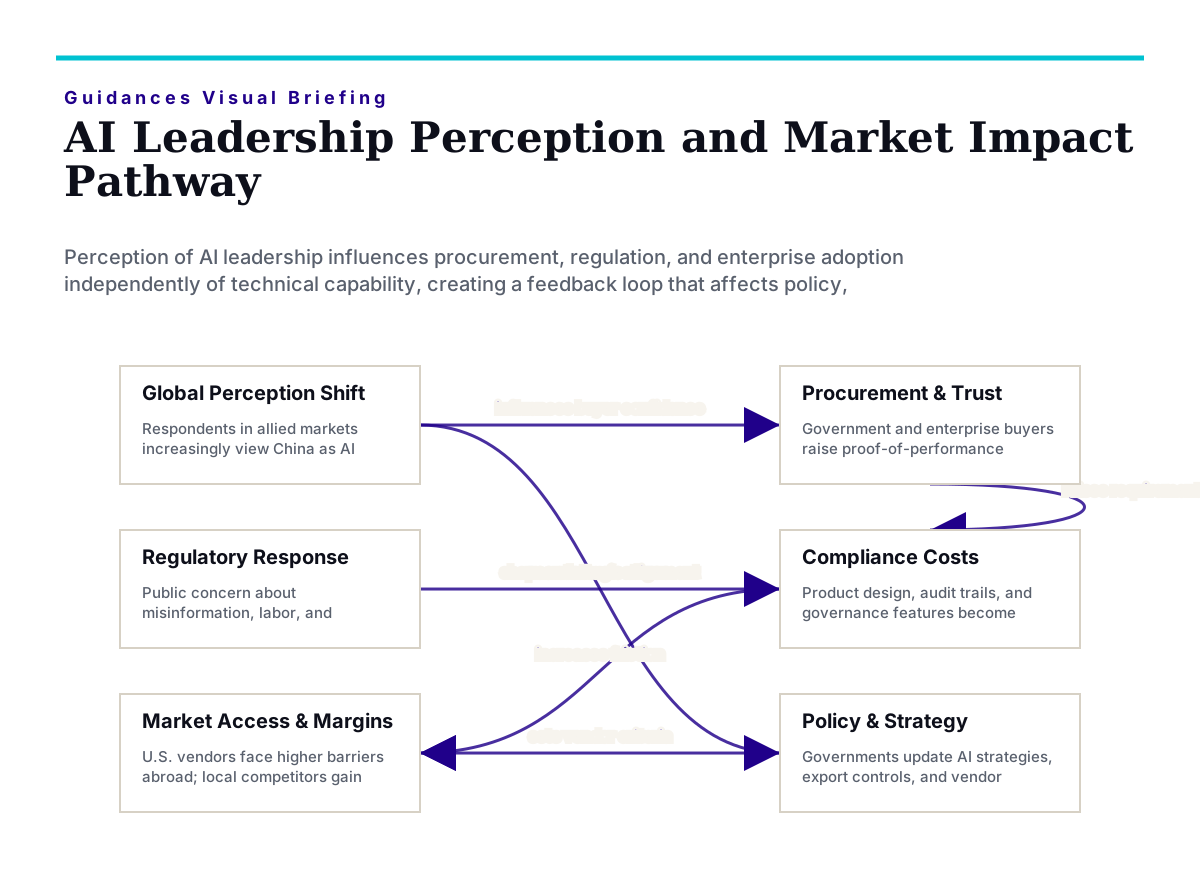
For investors and operators, the market relevance lies in the gap between technical leadership and perceived leadership. If allied-country respondents increasingly view China as the AI leader, U.S.-based AI firms may face a harder commercial environment abroad. That does not mean demand disappears. It means the burden of proof rises. Enterprise buyers, public agencies, and channel partners may ask more questions about model quality, data handling, local compliance, and long-term support before committing to a vendor.
This matters for several linked parts of the technology stack. Cloud providers that sell AI compute, model developers that rely on international enterprise adoption, and software vendors embedding generative tools into workflows all depend on trust as much as on performance. If the perception of leadership shifts, sales cycles can lengthen, procurement committees can become more cautious, and local competitors can gain room to argue that they are better aligned with domestic priorities.
The domestic U.S. mood matters as well. Public concern about AI’s resource consumption and labor effects can strengthen the case for oversight, disclosure rules, and sector-specific restrictions. That can raise compliance costs for operators and slow deployment in some use cases. For markets, the mechanism is straightforward: more scrutiny can mean more legal review, more product changes, more documentation, and more time before monetization scales. None of that is fatal to the sector, but it does affect margins, timing, and the pace of adoption.
There is also a capital-allocation angle. AI infrastructure remains one of the largest capex themes in technology, spanning data centers, networking, power, cooling, and advanced chips. If public and policy sentiment becomes less favorable, the sector may still spend heavily, but the justification for that spending will need to be clearer. That can influence how boards, customers, and governments evaluate the next wave of AI investment.
Tech / policy link
The policy link is direct. The United States has used export controls on advanced semiconductors and AI chips to slow China’s access to frontier compute. That strategy is built on the premise that hardware access is a meaningful lever in the AI race. The survey does not test that premise, but it does show that the narrative outcome is not guaranteed. A country can restrict chips and still fail to convince foreign publics that it is winning the broader contest.
That distinction matters because AI competition is now both industrial and diplomatic. Governments in South Korea, Japan, and Europe are not only buying technology; they are deciding which ecosystem to trust for public-sector use, research partnerships, and standards alignment. If a growing share of respondents in allied countries sees China as the AI leader, that perception can shape the political space available for procurement decisions and regulatory cooperation. It can also affect how U.S. firms position themselves in markets where provenance is no longer a sufficient selling point.
The American concern captured in the survey also links to policy in a second way. Worries about misinformation, automation, and resource use are the kinds of issues that can push lawmakers toward transparency requirements, watermarking debates, and disclosure obligations. For builders, that means product architecture may need to anticipate compliance from the outset rather than bolt it on later. For markets, it means the cost of scaling AI may increasingly include policy friction, not just compute expense.
Market Lens
Trigger: A multi-country survey indicates that respondents in key U.S.-allied markets increasingly view China as the world’s AI leader, while U.S. respondents are becoming more skeptical of AI.
Mechanism: Perception can influence procurement, regulation, and enterprise adoption. If customers and governments believe China leads, U.S. vendors may face a higher trust hurdle abroad. If American public concern deepens, regulators may impose more disclosure and governance requirements, raising operating costs and slowing some deployments.
Affected assets/sectors: U.S.-based AI model developers, cloud infrastructure providers, enterprise software vendors, semiconductor supply chains, and AI governance or compliance tooling. South Korean and Japanese technology groups may also be affected through procurement and partnership dynamics. Specific ticker, ETF, or index effects are not supported by the source and remain unverified.
Time horizon: Medium term. The survey is not a near-term earnings catalyst, but it can influence procurement cycles, policy drafts, and product road maps over the next several quarters to several years.
Next check: Watch for government AI strategy updates in South Korea and Japan, changes to U.S. export-control policy, EU and Asia-Pacific transparency rules, and management commentary from major cloud and AI companies on international demand and regulatory costs. The full Public First report, if published, would also help determine whether the perception shift is broad-based or concentrated in specific countries.
Note: The source is a search-provider snippet, not the full article or survey report. Country-level results, methodology, and exact wording are unavailable in the provided material. Any market linkage beyond the verified headline and snippet should be treated as analytical inference, not confirmed causation. This analysis is market context only and not investment advice.
What to watch next
The most useful follow-up is not another opinion poll, but evidence that the perception shift is entering policy and procurement. In South Korea and Japan, that means watching national AI plans, public-sector vendor lists, and any language that privileges local control, data residency, or trusted foreign partners. In the United States, it means tracking whether export-control policy is tightened, clarified, or paired with a broader industrial strategy that addresses not only hardware access but also international confidence.
A second check is regulatory. If concerns about AI-generated misinformation and labor displacement continue to rise, lawmakers may push for stronger disclosure rules, auditability requirements, or sector-specific obligations. That would matter most for companies whose products are embedded in customer-facing workflows, content generation, or decision support. The key question is whether compliance becomes a differentiator or a drag.
A third check is commercial. Major AI and cloud companies will likely provide the clearest evidence in earnings calls and investor presentations. Look for commentary on Asia-Pacific demand, public-sector adoption, competitive pressure from local vendors, and the cost of meeting regional policy requirements. If management teams begin to discuss trust, localization, and governance more prominently, that would suggest the survey is capturing a real shift in the operating environment.
Uncertainty and constraints
The available source material is thin. It does not provide the full survey instrument, the country-by-country results, or the margin of error. It also does not establish a causal link between perception and market outcomes. For that reason, the analysis should remain conservative. The safest conclusion is that AI leadership is now a contested narrative, and contested narratives can matter for markets when they influence procurement, regulation, and capital spending. Beyond that, the source does not support stronger claims.