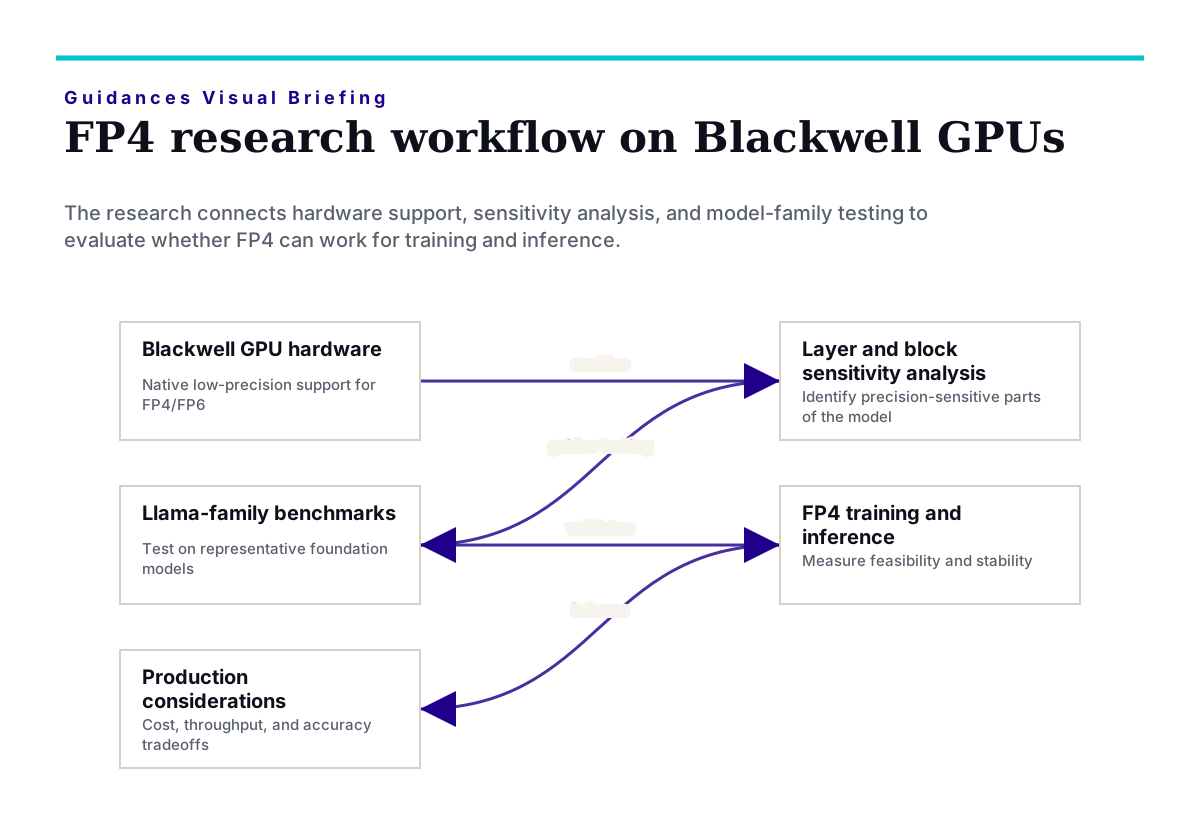
Nvidia's next-generation Blackwell architecture GPUs have been used to verify 4-bit floating-point (FP4) precision training results, according to a new research paper. The paper examines layer-wise and block-wise sensitivity analysis for FP4 inference and reports FP4 training results using Nvidia Blackwell GPUs. Foundational model families such as Llama 2 and Llama 3 are mentioned within the broader FP4 quantization context, suggesting that ultra-low-precision computation may become applicable to large-scale language model operations.
The Blackwell architecture is Nvidia's next-generation data center GPU platform, unveiled in 2024, and is designed to improve AI training and inference performance over the previous Hopper architecture. Blackwell is specifically designed to support low-precision operations such as FP4 and FP6 at the hardware level, and this research is presented as a case showing that these capabilities can be used in actual training workloads. FP4 can reduce memory usage and computational cost compared with FP16 or INT8, and may play a role in lowering deployment and inference costs for large-scale models.
Llama 2 and Llama 3 are open-weight large language models released by Meta, each containing tens to hundreds of billions of parameters. These models are frequently used as standard benchmarks for quantization research in academia and industry, and are well-suited for evaluating the impact of extreme precision reduction such as FP4 on model performance. The inclusion of the Llama families in the FP4 quantization context indicates that the research team sought to examine low-precision training and inference feasibility on model architectures widely used in production environments.
FP4 quantization is a technique that represents model weights and activation values in 4-bit floating-point format. Compared with FP16 or BF16, it can reduce memory bandwidth requirements by a factor of four, offering direct benefits in increasing inference throughput and batch size. However, precision loss can degrade model accuracy, making layer-wise and block-wise sensitivity analysis important. This research appears to present a methodology for diagnosing which layers are sensitive to FP4 quantization and which blocks are critical for maintaining precision.
The verification of FP4 training on Blackwell GPUs is a notable reference point for both hardware manufacturers and model developers. Nvidia has equipped the Blackwell architecture with dedicated tensor cores that accelerate low-precision operations, and this research shows that the hardware can perform FP4 computation in real training workloads. This provides a basis for cloud service providers and AI infrastructure operators to consider FP4 training and inference as an option when building Blackwell-based clusters.
FP4 quantization research on Llama model families is also expected to influence the open-weight ecosystem. Meta has released Llama models with open weights, encouraging research and commercial use, and if FP4 quantization is validated, community developers may be able to deploy large-scale models at lower cost. In particular, FP4 models open the possibility of running high-performance language models in on-device inference or edge environments with severe memory constraints.
However, challenges remain for the practical deployment of FP4 training and inference. Mixed-precision strategies to compensate for precision loss, layer-specific quantization policies, and optimization techniques to ensure training stability are still needed. Additionally, the throughput and energy efficiency that Blackwell GPUs' FP4 performance delivers in actual production environments must be confirmed through further benchmarks. While this research has shown that FP4 training is technically feasible, engineering work for commercial deployment will need to proceed separately.
Nvidia began supplying the Blackwell architecture to major cloud providers and enterprise customers in the second half of 2024, with full-scale production and deployment expected from 2025 onward. The timing of the FP4 training verification coincides with the early deployment phase of Blackwell, reflecting the simultaneous maturation of hardware performance and software optimization. Once Nvidia's CUDA libraries and TensorRT inference engine officially support FP4 operations, developers are expected to be able to deploy FP4 models without custom kernels.
The economic implications of low-precision computation directly affect cloud infrastructure cost structures. If FP4 inference reduces memory bandwidth to one-quarter that of FP16, the same hardware can handle more concurrent requests, increasing GPU utilization and lowering per-inference costs. In large language model services, inference costs account for a substantial portion of total operating expenses, so FP4 quantization can affect service provider cost structures. However, quantifying the impact of accuracy loss on user experience and balancing it with cost savings remains necessary.
In academia, FP4 quantization is seen as offering a new direction for model compression research. Traditional INT8 quantization relies on integer arithmetic and does not leverage the dynamic range of floating-point representation. FP4 includes both exponent and mantissa components, providing flexibility to represent extremely small or large values. This suggests that in layers where activation value distributions are wide, FP4 may maintain better accuracy than INT8. Future research is expected to focus on layer-wise performance comparisons between FP4 and INT8, mixed-precision strategies, and improvements in quantization-aware training techniques.
Blackwell GPU's FP4 support also marks an important turning point in Nvidia's hardware roadmap. While GPUs were historically optimized for FP32 and FP16 operations, the recognition that AI workloads can achieve sufficient performance at lower precision has shifted hardware design toward low-precision acceleration. Blackwell's tensor cores natively support FP4 operations, meaning hardware-level performance can be achieved without software emulation. This hardware support is a factor in transitioning FP4 quantization from an experimental technique to a production-deployable option.
This research is likely to serve as a reference point as academia and industry work to operationalize ultra-low-precision AI computation. The fact that FP4 quantization is applicable to major models such as the Llama families increases the likelihood that more foundational models will adopt low-precision training and inference as an option. Combined with hardware support from Blackwell GPUs, FP4 may become one of the core technologies of next-generation AI infrastructure. However, stability in actual deployment environments, accuracy maintenance strategies, and the maturity of the software ecosystem will determine the widespread adoption of FP4.