What Happened
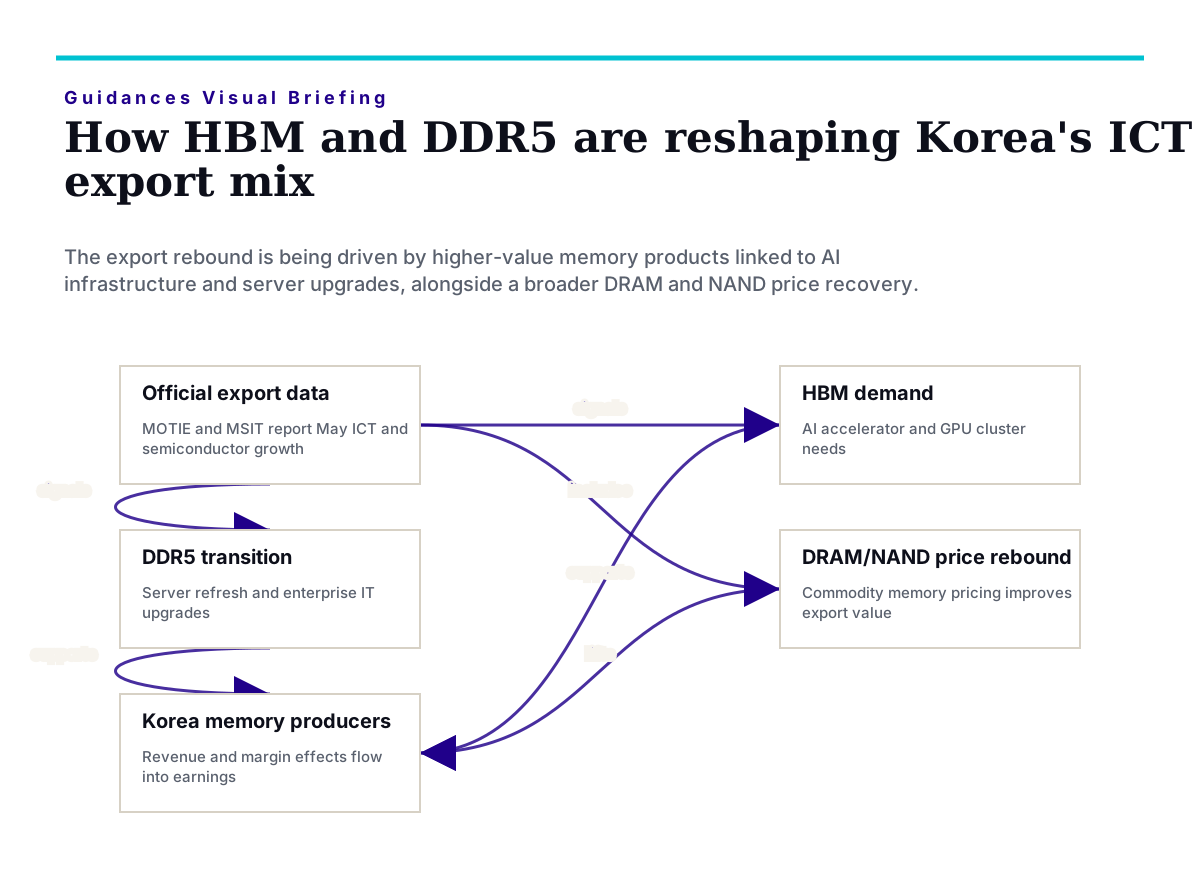
South Korea's Ministry of Trade, Industry and Energy (MOTIE) and the Ministry of Science and ICT (MSIT) jointly reported that the country's information and communications technology exports reached $20.9 billion in May 2025, a 9.6% increase compared with the same month a year earlier. Within that headline figure, semiconductor exports posted a 21.2% year-on-year increase. The official data attributes the acceleration to two concurrent forces: a price rebound in DRAM and NAND flash memory, and stronger demand for high-value-added products, specifically high-bandwidth memory (HBM) and DDR5 DRAM.
The figures come from primary government sources and provide a reference point for assessing Korea's technology export trends.
Why the Market Cares
Korea's semiconductor sector is a major export category, and its trajectory is often used as a reference point for global technology capital expenditure cycles. When Korean chip exports accelerate, the signal can move upstream to equipment makers, materials suppliers, and cloud infrastructure operators, and downstream to device assemblers and data-center operators that depend on memory pricing stability.
The May 2025 data matters for several reasons beyond the headline growth rate.
First, the composition of the gain is structurally significant. A 21.2% rise in semiconductor exports driven by HBM and DDR5 is different from a volume-led recovery in commodity DRAM. HBM is a product category with a smaller number of qualified suppliers, higher average selling prices, and direct linkage to AI accelerator demand—particularly from GPU clusters used in large-scale model training and inference. DDR5, while more broadly produced, represents a generational transition in server memory that correlates with data-center refresh cycles and enterprise IT investment.
Second, the DRAM and NAND price rebound, if sustained, could affect the revenue and margin profiles of Korea's major memory producers. Price recovery in commodity memory tends to flow relatively quickly into reported financials, while HBM pricing is typically negotiated on longer-term supply agreements, which can provide a more stable revenue base.
Third, the $20.9 billion monthly ICT export figure represents a meaningful share of Korea's goods export base. If sustained, growth at this pace could affect Korea's current account balance, the won's external support, and the policy room available for technology investment programs.
Technology and Policy Linkage
The HBM demand story is closely connected to the global AI infrastructure buildout. Major hyperscalers and AI-focused hardware companies have publicly outlined multi-year capital expenditure plans centered on GPU and accelerator procurement. High-end AI accelerators require HBM, and qualified HBM supply remains concentrated among a small number of manufacturers. Korea's producers sit at the center of that supply structure.
DDR5 adoption is tied to server platform transitions. As data centers upgrade to newer processor generations that natively support DDR5, the installed base of DDR4 systems is gradually being replaced. This transition can create a multi-year demand flow that is less volatile than short-term spot-market cycles.
On the policy side, MOTIE and MSIT have framed semiconductor competitiveness as a national strategic priority. Korea's government has introduced tax incentives and R&D support mechanisms aimed at sustaining domestic chip investment. The May export data offers one reference point for evaluating that policy direction alongside industry performance.
The geopolitical dimension also matters. Export control regimes in the United States and allied jurisdictions have created a complex compliance environment for memory producers shipping to certain markets. However, the official data does not provide destination-level detail, so the overall growth trend alone cannot support conclusions about specific regional demand.
Market Lens
Trigger: Official May 2025 ICT export data from MOTIE and MSIT showing 9.6% overall ICT growth and 21.2% semiconductor growth, with HBM, DDR5, and recovering DRAM/NAND prices cited.
Mechanism: Higher semiconductor export values reflect a combination of volume growth and price recovery. HBM demand is linked to AI accelerator procurement, DDR5 demand reflects server platform refresh cycles, and NAND price recovery affects storage-oriented product lines. Together, these dynamics can influence the revenue and gross-margin trajectories of Korea's major memory producers and their global supply-chain partners.
Affected Sectors: Memory semiconductor producers, AI accelerator manufacturers, data-center equipment suppliers, semiconductor capital equipment companies, and materials suppliers. ETFs and indexes with significant Korean technology or global semiconductor exposure may reflect these dynamics over time, though specific price movements are not supported by the available data and no investment conclusions should be drawn.
Time Horizon: The HBM demand cycle is tied to multi-year AI infrastructure capex commitments, suggesting a medium-term structural tailwind rather than a short-cycle event. DRAM and NAND price recovery is more cyclical and subject to reversal if supply additions outpace demand growth.
Next Check: The most concrete near-term verification points are the quarterly earnings disclosures from Korea's major memory producers, which will show whether export value growth is translating into reported revenue and margin improvement. Monthly trade data releases from MOTIE for June and subsequent months will indicate whether the May acceleration is a trend or a one-month event. Global AI capex guidance from major hyperscalers in their upcoming earnings calls will provide demand-side confirmation or caution.
This section is market context only and does not constitute investment advice.
What to Watch Next
Several variables will determine whether May's strong performance marks the beginning of a durable upcycle or a temporary peak.
HBM supply qualification timelines are important. If additional suppliers achieve qualification at major AI hardware customers, pricing pressure could emerge even as volumes grow. Conversely, if qualification barriers remain high, the current supply-demand balance may support sustained pricing.
NAND price recovery deserves separate scrutiny. NAND markets have historically been more volatile than DRAM, and the recovery noted in the May data may be fragile if enterprise SSD demand softens or if Chinese producers accelerate capacity additions.
The broader macroeconomic environment—particularly the trajectory of global IT spending, enterprise capital budgets, and consumer electronics demand—will shape the commodity memory portion of the export mix. A slowdown in PC or smartphone demand could offset gains in the AI-driven HBM segment.
Finally, currency dynamics matter. A significant appreciation of the Korean won against the dollar would mechanically reduce the won-denominated value of dollar-invoiced exports, even if volumes remain strong. Monitoring the Bank of Korea's policy stance and the won's exchange rate trajectory is therefore relevant context for interpreting future monthly data.
Uncertainty and Constraints
The available source is a government-released snippet without destination-level breakdown, product-level volume data, or forward guidance. The analysis above is grounded in the official headline figures and the product categories named in the official release. Readers should treat the structural interpretations as informed analysis rather than confirmed fact, and should verify against full official releases and company disclosures as they become available.