What Happened
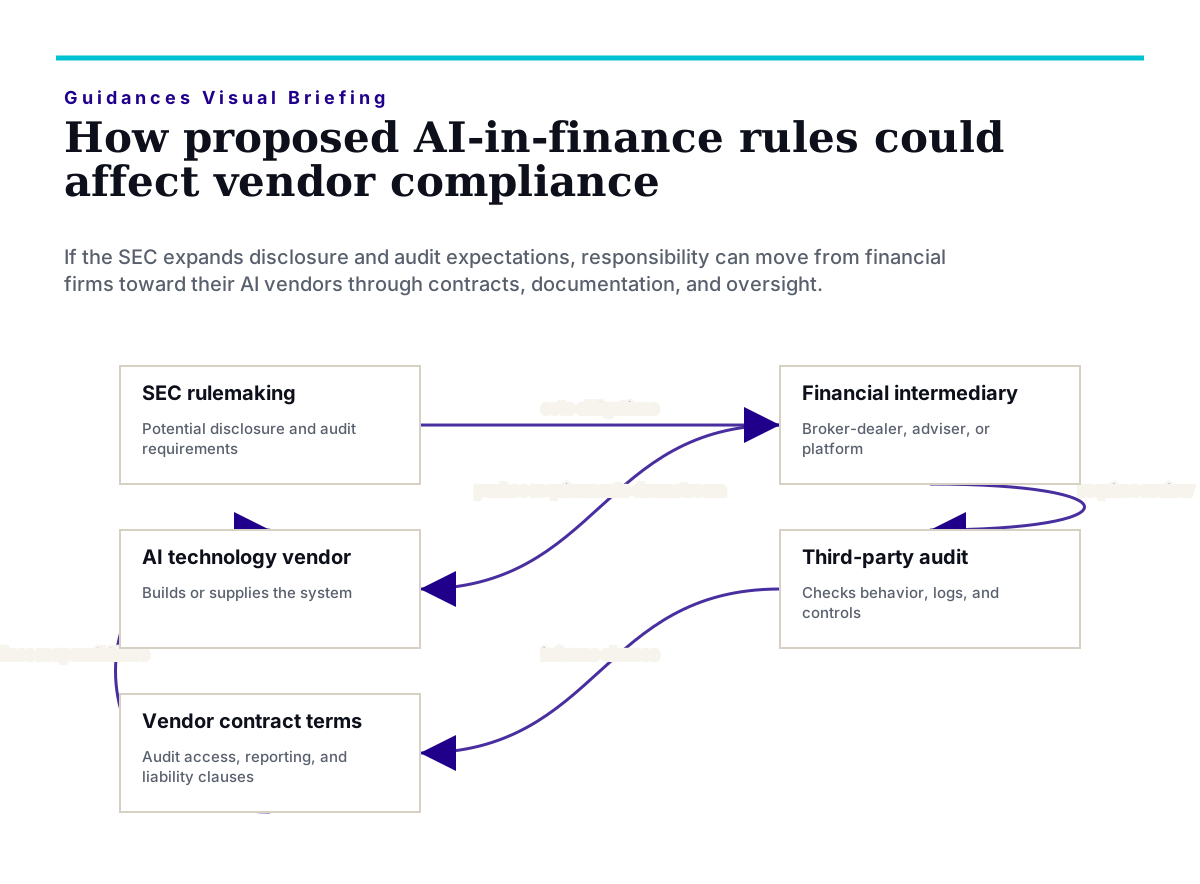
Public Citizen, a U.S. consumer and public-interest advocacy organization, submitted a formal comment letter to the Securities and Exchange Commission under rulemaking docket S7-12-23. The letter calls for three categories of regulatory action: mandatory disclosure obligations for AI systems that influence investment decisions, structured third-party auditing of those systems, and purpose-built rules for AI-powered investment products. It also raises the question of whether regulatory discussion could extend to the technology vendors supplying those systems when AI is linked to capital markets.
The source publication date for this filing is not machine-verified. The document was retrieved on June 21, 2026, and the analysis below is grounded in the headline, snippet, and SEC EDGAR filing context. The filing's specific arguments and evidence would require review of the full text.
Why the Market Cares
Docket S7-12-23 is the SEC's ongoing rulemaking on conflicts of interest arising from predictive data analytics and AI in broker-dealer and investment adviser contexts. Public Citizen's submission is one of several comment letters in that proceeding, and it reflects broader debate over how AI-related capital market risks should be addressed in the regulatory framework.
A common industry view has been that securities law governs the financial-services clients that use AI tools, rather than the companies that build and sell those tools. This filing presents a view of how that boundary could be discussed in the rulemaking record. Whether the commission ultimately adopts that view is uncertain, but the comment record can still shape the legal and political environment for future enforcement actions, congressional oversight, and judicial review of SEC authority.
For asset managers, broker-dealers, and robo-advisory platforms, the near-term concern is compliance cost. Disclosure and auditing requirements for AI systems that influence investment decisions could add operational obligations. For the technology sector, the longer-term question is how the rulemaking may describe the relationship between vendors and deploying institutions.
Technology and Policy Linkage
The intersection of AI and securities regulation is already operational, not theoretical. Algorithmic trading systems, AI-assisted portfolio construction tools, natural-language-processing applications that parse earnings disclosures, and generative AI systems used in client-facing financial advice all represent points at which AI directly touches capital allocation. The SEC's existing conflict-of-interest framework was designed for human advisers and rule-based algorithms; it was not built with foundation models or large language models in mind.
Public Citizen's three-part framework maps onto distinct regulatory mechanisms with different downstream effects. A disclosure requirement that names the AI system and its vendor creates a public record of which technology companies are embedded in regulated financial workflows. An auditing requirement can increase demand for model interpretability and explainability capabilities, and it may also support a professional services market for firms positioned to conduct those audits. A product-rule framework that treats AI-generated investment recommendations or automated portfolio strategies as regulated financial products could require technology vendors to participate more directly in registration, documentation, and suitability processes.
The international dimension adds policy relevance. The European Union's AI Act already classifies certain AI applications in financial services as high-risk, triggering conformity assessments and transparency obligations before deployment. If the SEC moves in a similar direction, AI companies operating across both jurisdictions may need to reconcile different compliance architectures.
The Financial Stability Oversight Council and the Office of Financial Research have both flagged AI-related systemic risk in recent annual reports. Coordination between those bodies and the SEC could influence the timeline for AI-specific financial regulation.
Market Lens
Trigger: A formal public-interest comment letter filed with the SEC recommends expanded AI oversight in financial services, including discussion of technology vendors whose AI systems interact with capital markets.
Mechanism: If the SEC incorporates these recommendations into a final rule or enforcement guidance, compliance obligations could flow from financial intermediaries to their AI technology suppliers through contractual indemnification clauses, vendor due-diligence requirements, and audit-access provisions. Technology companies that currently supply AI to financial services may face additional compliance requirements depending on the final regulatory approach.
Affected sectors (source-supported as potential, not confirmed): Financial technology platforms, AI infrastructure providers with material financial-services client revenue, robo-advisory and wealth-management technology vendors, and professional services firms positioned to offer AI auditing. The broader technology sector could be indirectly affected depending on how the rulemaking addresses upstream vendors.
Time horizon: Medium-term. SEC rulemaking under docket S7-12-23 has been in progress; comment periods, staff review, and final rule publication typically span one to three years from initial proposal. Enforcement action based on existing authority could occur on a shorter timeline, but a formal rule change is a multi-year process.
Next check: Monitor the SEC's final rule publication under docket S7-12-23; any SEC staff guidance on AI in investment advisory contexts; congressional hearings on AI and financial regulation in the Senate Banking Committee and House Financial Services Committee; and earnings commentary from major financial-technology and AI infrastructure companies on regulatory compliance costs and risk-factor disclosures in annual filings.
This section is market context only, not investment advice. No buy, sell, or hold recommendations are made or implied.
What to Watch Next
Several near-term indicators will clarify how Public Citizen's recommendations are treated within the SEC's formal process. The commission's final action on docket S7-12-23 is the most direct signal. If the final rule incorporates disclosure or auditing language that references AI systems by category rather than by specific firm, it would show that vendor-related issues are being reflected in the regulatory record.
Beyond the rulemaking itself, the political composition of the SEC commission matters. Rulemaking priorities shift with commission leadership, and the scope of any final rule on AI conflicts of interest will reflect the legal and policy judgments prevailing at the time of adoption. Congressional activity — particularly oversight hearings that invite testimony from both financial regulators and technology companies — may also influence the discussion.
For technology companies with significant financial-services revenue, the next set of annual reports and earnings calls will be an early indicator of whether management teams are beginning to characterize AI regulation as a material risk factor. A shift in risk-factor language in 10-K filings — from generic technology-regulation boilerplate to specific references to SEC rulemaking on AI — would suggest that legal and compliance teams are treating the issue as operationally important.
Uncertainty and Constraints
The source for this analysis is a search-provider snippet referencing an SEC EDGAR comment letter. The full text of the filing has not been reviewed, and the specific legal arguments, evidentiary basis, and precise regulatory recommendations made by Public Citizen are not fully available from the snippet alone. The analysis above is therefore grounded in headline and snippet metadata, with interpretation separated from direct source confirmation.
The SEC is not obligated to adopt any comment letter's recommendations. Advocacy organization submissions carry weight in the administrative record but do not bind the commission. The ultimate regulatory outcome depends on the commission's legal analysis, its political composition, and the full comment record, including submissions from financial industry participants and technology companies.
The absence of a machine-verified publication date for the filing means it cannot be characterized as newly published. It is treated here as a document retrieved in June 2026 that remains relevant to the ongoing S7-12-23 rulemaking process.