What Happened
NVIDIA's investor relations newsroom published financial results covering both the fourth quarter and the complete fiscal year 2026. The disclosed figures represent the company's most recently available official operating baseline. A provider-supplied date of February 26, 2026 accompanies the source, but that date has not been verified against the source page's own metadata and should be treated only as a soft ordering reference. This article was collected on June 23, 2026, and the figures remain the operative financial foundation for understanding NVIDIA's current trajectory.
The headline numbers are notable in scale. Fourth-quarter revenue reached $68.1 billion, advancing 20% sequentially and 73% compared with the same period a year earlier. The data center segment accounted for most of that result, generating $62.3 billion in Q4 alone—a 22% sequential gain and a 75% year-over-year increase. For the full fiscal year, NVIDIA reported annual revenue of $215.9B, a figure that places the company among a small group of technology enterprises operating at that revenue scale.
Profitability remained elevated. GAAP gross margin was reported at 75.0%, with the non-GAAP equivalent at 75.2%. GAAP earnings per share came in at $1.76, while the non-GAAP figure was $1.62. Management issued guidance for the subsequent quarter at $78.0 billion in revenue.
Readers seeking the complete income statement, balance sheet, cash flow statement, and management commentary should consult NVIDIA's official investor relations page directly, as the source available for this analysis is a structured snippet rather than the full earnings release.
Why the Market Cares
NVIDIA's results provide market context beyond the company's own financial statements. The data center segment accounted for most of Q4 revenue, which can be read as a reference point for demand flows tied to large cloud platforms, enterprise technology buyers, and government-sponsored AI programs. When a single semiconductor supplier reports $62.3 billion in data center revenue in one quarter, it offers a way to gauge the scale of related procurement activity.
The 65.5% year-over-year growth rate in annual revenue is notable because it was achieved against an already large prior-year base. Growth at that rate on a large base can be interpreted as evidence that AI compute procurement continues to expand at scale.
NVIDIA's market capitalization stood at $5.05T as of the market-data retrieval date. That figure reflects the degree to which public markets have already embedded future growth expectations into the current valuation. In that context, the $78.0B guidance and subsequent results may attract attention. This analysis is market context only and does not constitute investment advice.
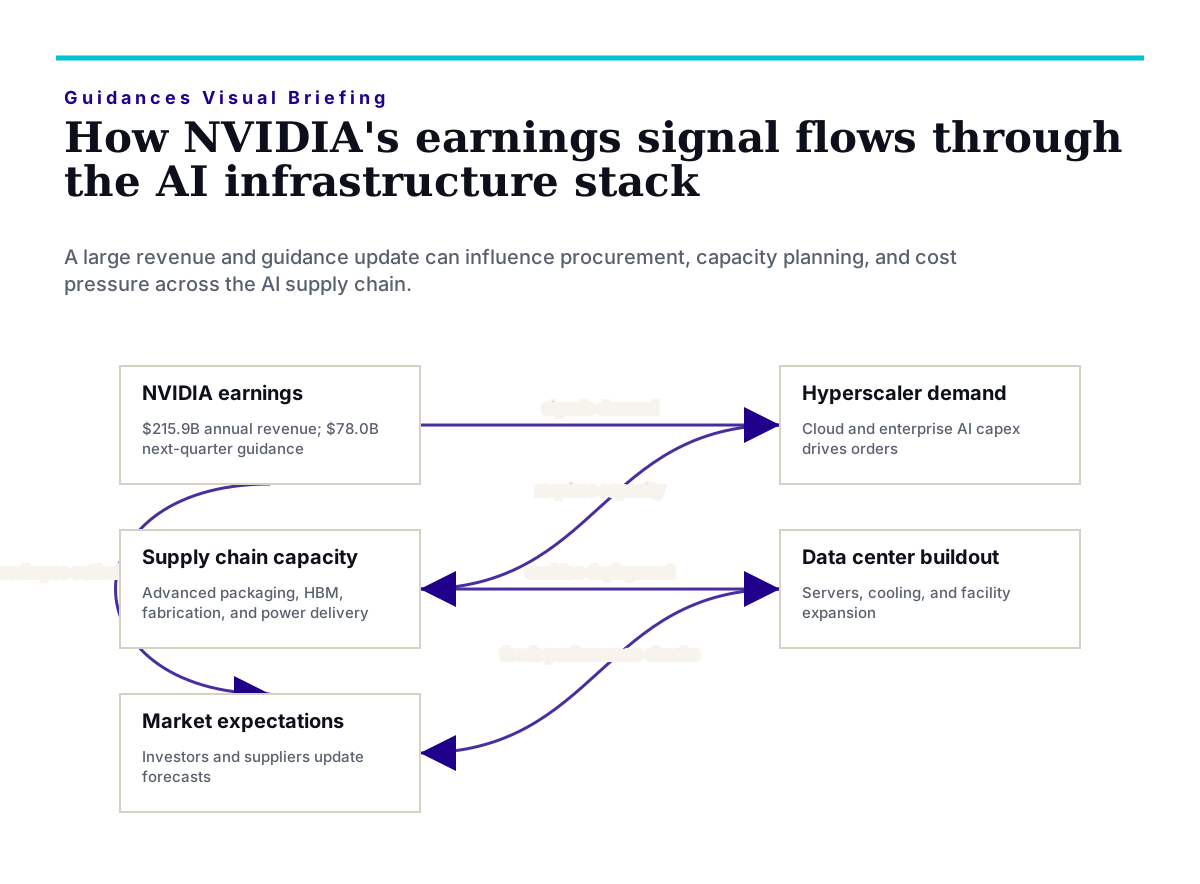
For adjacent sectors, the implications are concrete. Advanced packaging suppliers, high-bandwidth memory producers, power delivery infrastructure vendors, and data center construction firms may all use NVIDIA's demand signals as one input when planning capacity. A quarterly revenue run rate near $78.0B would require continued throughput from the upstream supply chain, making NVIDIA's guidance a useful demand reference for multiple industries.
Technology and Policy Linkage
The concentration of NVIDIA's revenue in the data center segment creates a link between the company's financial performance and the AI infrastructure spending plans of large customers. Major cloud platforms have publicly announced AI infrastructure investment programs measured in the tens of billions of dollars annually, and NVIDIA is one of the companies associated with GPU compute supply.
From a policy standpoint, U.S. export control regulations governing advanced semiconductor exports remain an important variable. Restrictions on shipments to certain geographies can affect NVIDIA's addressable market, and any change to those rules could influence revenue composition. The available source snippet does not break out the $78.0B guidance by geography, leaving policy-related exposure only partially visible.
The gross margin profile—stable above 75% at this revenue scale—reflects both pricing and cost structure. Sustaining those margins while growing toward $78.0B per quarter requires that input cost inflation in advanced packaging capacity, CoWoS interposer supply, and HBM memory procurement remain contained. Any meaningful cost pressure in those upstream inputs could affect future margins even if top-line growth continues.
For the broader AI infrastructure thesis, NVIDIA's results provide one empirical data point: the capex expansion trend discussed over the past two years remains active through the period covered by these disclosures. Whether it continues, moderates, or accelerates will become clearer in subsequent earnings cycles.
Market Lens
Trigger: NVIDIA's official disclosure of Q4 FY2026 and full-year FY2026 financial results, accompanied by forward guidance of $78.0B for the next quarter.
Mechanism: Annual revenue of $215.9B growing at 65.5% year over year suggests that hyperscaler AI capex is converting into procurement at scale. This can have second-order effects across the semiconductor supply chain: advanced packaging utilization at TSMC and its peers, HBM allocation from SK Hynix and Micron, power delivery infrastructure buildout, and data center construction activity. Each of those sectors may calibrate capacity investment partly in response to NVIDIA's disclosed demand trajectory.
Affected sectors (source-supported): Semiconductor equipment and materials, advanced packaging, high-bandwidth memory, data center infrastructure, and cloud computing platforms as the primary buyer cohort. Technology and semiconductor indexes may be associated with NVIDIA's operating trajectory, though the direction and magnitude of any resulting price movement are outside the scope of this analysis.
Time horizon: The $78.0B guidance covers the near-term quarter. The durability of the growth rate beyond that single quarter will depend on hyperscaler capex decisions that will be disclosed through their own earnings cycles in the second half of 2026.
Next check: Market data indicates NVIDIA's next earnings event is scheduled for August 26, 2026, with consensus revenue estimates in the vicinity of $91.7B. That disclosure will be the primary checkpoint for comparing the growth trajectory implied by the $78.0B guidance with subsequent results. Quarterly earnings from major cloud providers—which collectively represent a substantial share of NVIDIA's data center customer base—will provide demand-side corroboration or early caution signals in the interim.
Uncertainty: The source snippet does not disaggregate revenue by geography, individual customer, or product line within the data center segment. Customer concentration, export control exposure, and the timing of next-generation product transitions are all material variables that the disclosed aggregate figures alone do not resolve.
This section is market context only, not investment advice.
What to Watch Next
Several near-term checkpoints will help assess whether NVIDIA's growth trajectory remains durable.
The most immediate is the August 26, 2026 earnings disclosure, which will confirm whether the $78.0B guidance was achieved and provide the first look at whether sequential growth is continuing, moderating, or accelerating further. The consensus estimate of approximately $91.7B for that period—derived from market data—suggests that some observers expect growth to continue beyond the guided figure, though consensus estimates carry uncertainty.
Hyperscaler capex guidance from Amazon Web Services, Microsoft Azure, Google Cloud, and Meta's infrastructure division will serve as leading indicators for NVIDIA's order pipeline. The specific language these companies use around AI compute procurement timelines and infrastructure spending commitments can be informative alongside headline capex numbers.
U.S. export control policy remains an important variable. Any change to Commerce Department rules governing advanced chip exports could affect NVIDIA's addressable market in restricted geographies, and the policy environment has been revised with limited advance notice in the past.
Supply chain capacity signals from TSMC—particularly advanced packaging utilization rates and CoWoS capacity expansion timelines—and HBM allocation announcements from memory producers will indicate whether the upstream supply side can sustain the throughput implied by NVIDIA's guidance.
Finally, the gross margin trajectory will be a key indicator of pricing and cost discipline as revenue scales toward and potentially beyond $78.0B per quarter. Any compression from the current 75%+ level would suggest changes in pricing conditions