What happened
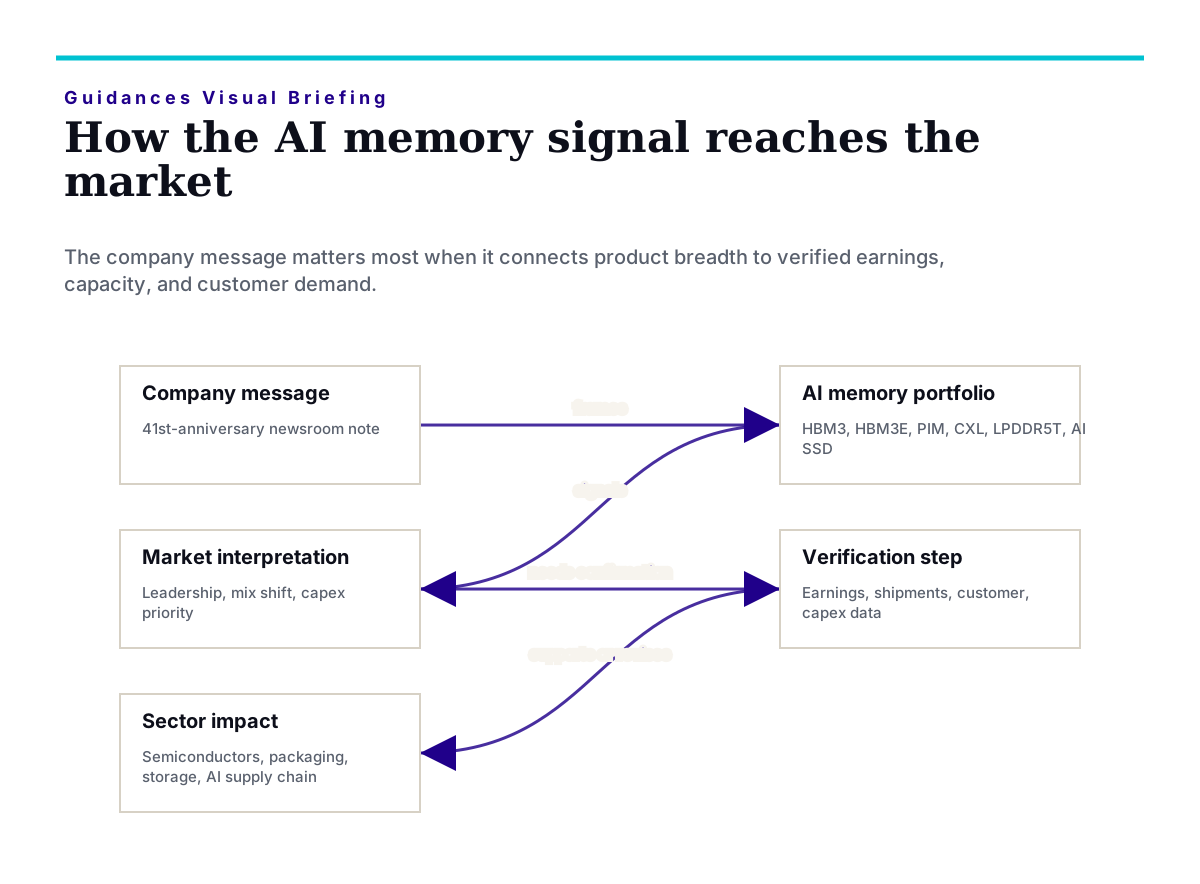
SK hynix marked its 41st anniversary with a company-newsroom message that placed AI memory at the center of its identity. Based on the provided snippet, the company said it has become a global leader in AI memory supply and highlighted two milestones: mass production of 12-layer HBM3 in 2023 and 12-layer HBM3E in 2024. It also pointed to a broader product set that includes PIM, CXL memory modules, LPDDR5T, and AI SSDs. Because the source is a company-owned newsroom item and the collection is snippet-only, the safest reading is that this is a self-described strategic update rather than a full operating disclosure.
The publication date was not machine-readable in the metadata, so it should not be treated as newly published beyond the retrieval context. Even so, the item still matters because it sits at the intersection of AI infrastructure demand, memory supply constraints, and the ongoing re-rating of semiconductor value chains. The source does not provide revenue, shipment volumes, customer names, margin data, or capex figures, so the analysis must remain anchored to the stated product and positioning claims.
Why the market cares
For equity and sector watchers, AI memory is not a branding exercise. It is one of the clearest ways to translate AI demand into semiconductor economics. HBM, in particular, sits close to the compute stack used in accelerators and high-end servers. When a memory supplier emphasizes HBM3 and HBM3E mass production, the market reads that as a sign that the company wants to be seen not merely as a cyclical DRAM vendor, but as a strategic supplier to AI build-outs.
That matters because AI infrastructure spending has changed the way investors think about memory. In a conventional cycle, DRAM and NAND are often discussed through inventory, pricing, and broad PC or handset demand. In the AI cycle, the relevant questions shift toward product mix, qualification status, packaging capacity, and the durability of demand from cloud and accelerator customers. A company that can credibly participate in HBM and adjacent memory architectures may have a different earnings sensitivity than one that remains concentrated in commodity memory.
Still, the source alone does not prove any specific financial outcome. It does not show whether the AI portfolio is already moving the income statement, whether supply is tight, or whether customers are locked in. That is why the market read-through is directional rather than conclusive.
Tech / policy link
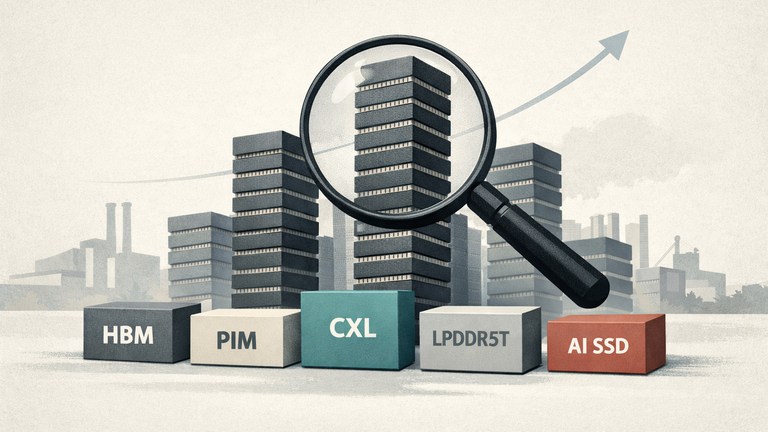
Technically, the snippet is notable because it does not stop at HBM. It also mentions PIM, CXL memory modules, LPDDR5T, and AI SSDs. That breadth matters. PIM points to attempts to reduce data movement costs by moving computation closer to memory. CXL memory modules speak to a server architecture in which memory can be pooled, expanded, or shared more flexibly. LPDDR5T reflects the continuing push for faster, lower-power memory in mobile and compact compute environments. AI SSDs suggest that storage is being repositioned as part of the AI data pipeline rather than a passive archive.
The policy link is indirect but real. AI memory is part of a broader industrial-policy conversation around advanced manufacturing, supply-chain resilience, and strategic technology capacity. Governments that care about AI competitiveness also care about semiconductor packaging, equipment access, power availability, and export controls. This source does not mention any policy program, subsidy, or regulatory deadline, so those links remain structural rather than event-specific.
Market Lens
Trigger: SK hynix used its anniversary message to emphasize AI memory leadership and to cite 12-layer HBM3 and HBM3E mass production, alongside PIM, CXL memory modules, LPDDR5T, and AI SSDs.
Mechanism: The market can interpret this as a signal that AI-related memory remains central to the company’s product mix and strategic positioning. If those products are gaining traction, they can influence mix, pricing power, and capex priorities. That said, the link from product announcement to earnings impact is unverified until official results, shipment data, or guidance confirm it.
Affected assets / sectors: The most relevant areas are Korean semiconductors, memory equipment, advanced packaging, server storage, and AI infrastructure supply chains. Using the provided market-data context, SK hynix carries a market capitalization of KRW 1957.73T, which underscores why product-mix shifts at the company can matter for sector sentiment and index-level technology exposure. The company’s next earnings revenue estimate in the provided context is KRW 47.5M, which should be treated only as a next-check marker, not as a forecast endorsement.
Time horizon: The immediate horizon is the next earnings release and any management commentary on capex, HBM capacity, and customer demand. The medium-term horizon is the pace of AI server deployment and the company’s ability to sustain qualification and production momentum.
Next check: Watch for official earnings materials, capex guidance, customer qualification updates, and any disclosure that clarifies how much of the AI memory story is already flowing into revenue and margins.
What to watch next
The most important follow-up is not another anniversary statement. It is whether the company’s next official disclosures quantify the AI memory contribution. Investors and operators should look for evidence on three fronts: product mix, production scale, and customer adoption. If HBM3E remains a central talking point, the key question is whether it is paired with capacity expansion or with evidence of stable demand. If PIM, CXL, and AI SSDs continue to appear in company materials, the question is whether they are strategic adjacencies or meaningful revenue lines.
A second point is competitive context. In memory, leadership claims are only durable if they are matched by execution in yield, packaging, and delivery. The source does not provide comparative data, so any claim of relative advantage should remain cautious. A third point is macro. AI infrastructure spending has been one of the strongest supports for semiconductor capex, but that support can be uneven across quarters. The next check should therefore include not only company-specific results but also broader cloud and AI spending signals.
Uncertainty and constraints
This source is useful, but it is thin. It is a company-authored anniversary note, not a filing, not an earnings release, and not a customer announcement. It contains strategic language but no hard operating metrics. That means the article can responsibly discuss positioning, product breadth, and market relevance, but it cannot infer shipment scale, profitability, or demand durability.
The publication date was not provided in machine-readable form, so the item should not be framed as breaking news. Its relevance comes from the underlying theme: AI memory remains a strategic battleground in semiconductors, and SK hynix is signaling that it wants to be read as a central participant.