What happened
TSMC reported consolidated revenue for October 2024 of NT$314.24 billion, with year-over-year growth of 29.2%. The official monthly revenue table does not break out AI or HPC demand; that demand context is an interpretation layered on top of the company-reported revenue datapoint. Because this is a monthly revenue report, it is not a full earnings release and it does not disclose the full operating bridge behind the number. It is still useful because it shows what kind of demand the company was seeing at that point in time.
The report is now older, with a verified source date in 2024, but it still deserves attention because TSMC remains one of the clearest public indicators of whether AI infrastructure spending is flowing through the semiconductor manufacturing stack. Monthly revenue is noisy, yet it can still reveal whether demand is reaching the factory floor, the packaging line, and the shipment stage. That makes it relevant well beyond the month in question.
What the report does not prove is just as important. It does not tell readers how much of the growth came from one customer, one product generation, or one geography. It does not show inventory behavior, order cancellations, or margin structure. It also does not establish that every part of the semiconductor chain is equally strong. The source supports a directional reading, not a complete diagnosis of the cycle.
Why the market cares
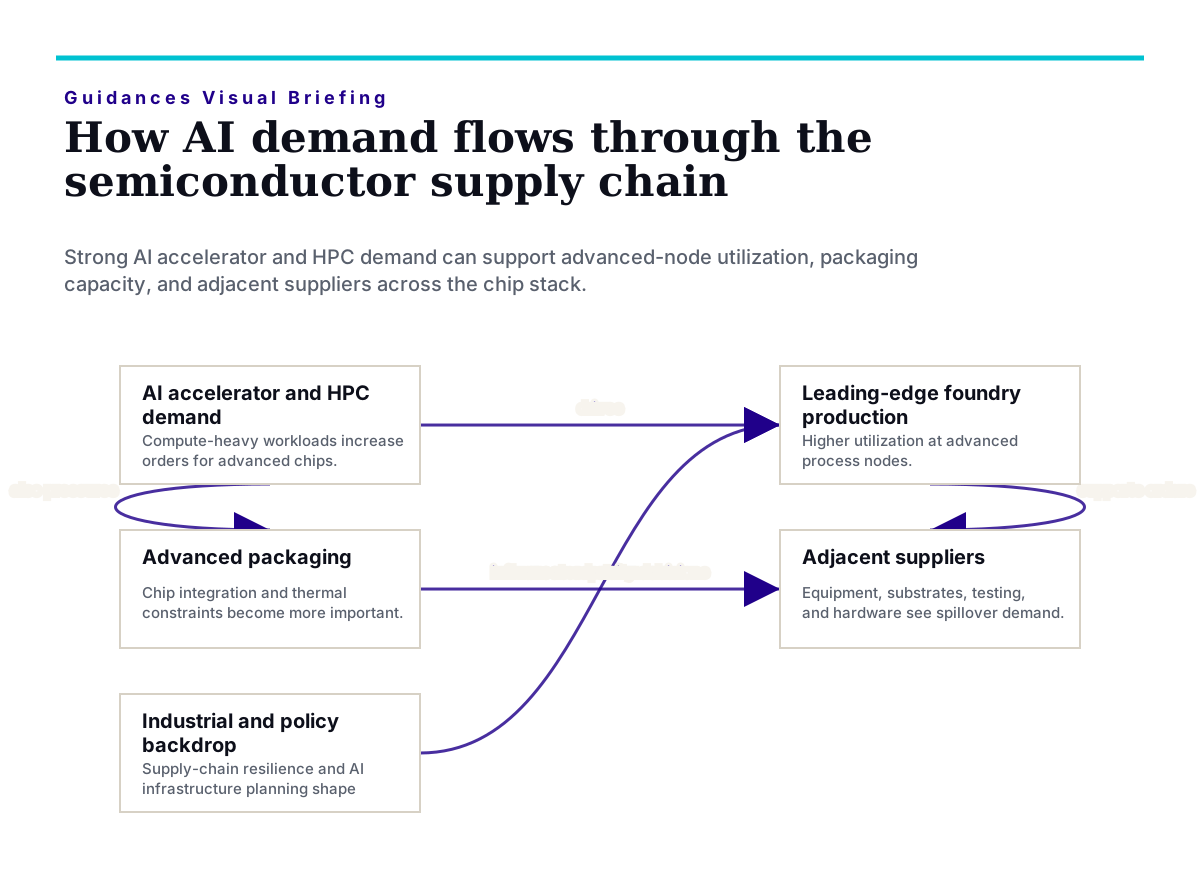
The market cares because TSMC is a bottleneck and a barometer. If AI accelerator demand remains firm, that tends to support utilization at advanced nodes, keep pressure on advanced packaging capacity, and sustain orders across adjacent suppliers such as equipment makers, substrate vendors, test services, and some data-center hardware providers. If demand weakens, the same chain can cool quickly. That is why a monthly revenue report can matter even when it is narrow.
For public markets, the mechanism is less about a single month and more about the signal it sends into the next reporting periods. Strong AI-related demand can support revenue visibility, which can in turn affect capex planning, capacity allocation, and the timing of expansion decisions across the ecosystem. The report therefore matters to operators who need to plan supply and to market participants who are trying to understand whether the AI build-out is still pulling through the manufacturing layer.
The internal market-data context adds scale. TSMC is associated here with a market capitalization of $2.29T, annual revenue of $3.85T, and year-over-year revenue growth of +33.0%. Those figures help frame the company’s operating footprint, but they do not change the basic interpretation of the source. This is a large, strategically important manufacturer reporting continued AI-linked demand, not a basis for trading advice.
Tech / policy link
Technically, the report reinforces a familiar but still important point: AI demand is increasingly a manufacturing and packaging story, not only a model or software story. AI accelerators and HPC workloads require leading-edge process technology, but they also depend on advanced packaging solutions that can integrate more performance, bandwidth, and thermal management into a single system. That makes packaging capacity and process reliability strategically important, not secondary.
Policy relevance is indirect but real. Semiconductor manufacturing sits inside a wider policy environment shaped by export controls, industrial policy, supply-chain resilience, and national AI infrastructure plans. A strong monthly revenue print tied to AI demand does not itself prove policy impact, but it does show why governments and large enterprises continue to treat semiconductor capacity as strategic infrastructure. In practical terms, that can influence capex incentives, localization efforts, and procurement priorities across multiple regions.
This is not a healthcare or medical systems story, and there is no clinical implication to draw from the source. The relevant bridge is industrial: AI compute demand, semiconductor manufacturing, and the capital intensity of the supply chain.
Market Lens
Trigger: TSMC’s October 2024 monthly revenue report and the company’s statement that AI accelerator and HPC demand continued to drive growth.
Mechanism: Sustained demand for AI accelerators and HPC products supports advanced-node utilization and advanced packaging activity. That can ripple into equipment, substrates, testing, and data-center hardware supply chains.
Affected assets/sectors: The direct read-through is TSMC’s operating momentum. Broader exposure extends to semiconductor foundries, advanced packaging, semiconductor equipment, substrate suppliers, test services, and AI infrastructure hardware. Any more specific link to individual stocks, ETFs, or index moves is unverified from the source alone.
Time horizon: Near term, the next monthly revenue update and the next quarterly earnings release are the most useful checks. Medium term, the key question is whether AI demand remains broad enough to support capacity expansion and packaging investment through the next several quarters.
Next check: Watch the next monthly revenue print, the next earnings call, and any commentary on advanced packaging capacity, capex allocation, and customer demand concentration. Those are the points where the current signal can be confirmed or revised.
What to watch next
The most important follow-up is whether the growth rate remains durable in the next monthly update. A second check is whether management continues to emphasize advanced packaging and leading-edge process demand, or whether the language becomes more cautious. A third is whether the company gives any indication that demand is broadening beyond a narrow set of AI customers or product generations.
It is also worth watching the supply side. If AI demand remains strong, the constraint may shift from demand to capacity, packaging throughput, or upstream component availability. That would matter for the timing of revenue recognition and for the cadence of capex across the semiconductor ecosystem. None of that is visible in a single monthly report, which is why the report should be treated as a directional indicator rather than a complete picture.