What Happened
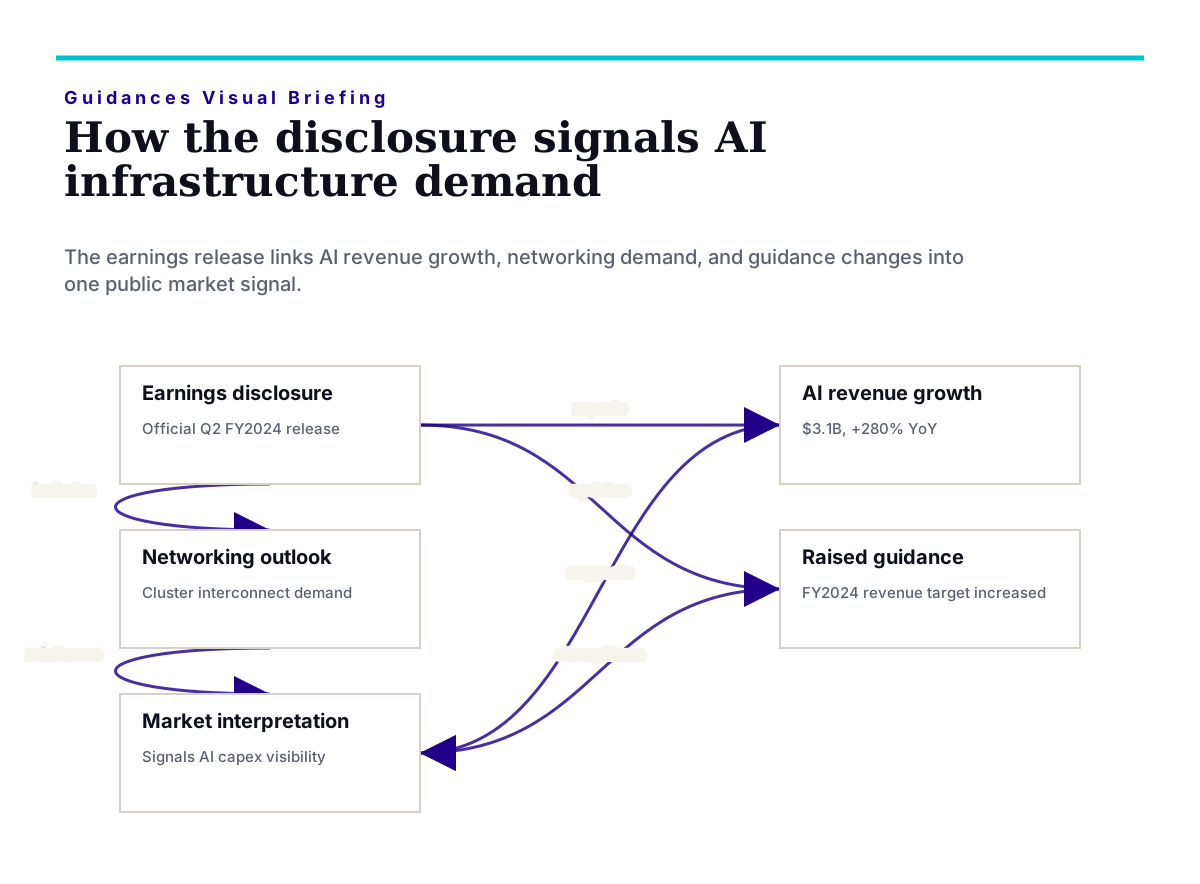
Broadcom Inc. (NASDAQ: AVGO) released its second-quarter fiscal year 2024 earnings through the company's official investor relations newsroom, covering operations through May 5, 2024. The headline figure was AI-segment revenue of $3.1 billion—a 280% increase against the comparable prior-year quarter. Management simultaneously revised its full-year fiscal 2024 revenue target upward to $51 billion and established an adjusted EBITDA margin objective of 61% of revenue. The networking segment, which serves AI cluster interconnect demand, was projected to expand 40% year-over-year to reach $15 billion for the full fiscal year.
A note on sourcing: the search provider associated this disclosure with a date of June 12, 2024, but that date has not been verified at the source-page level and should be treated only as a soft ordering reference. The disclosure originates from Broadcom's official IR newsroom at investors.broadcom.com, which is the authoritative location for precise release timing and complete financial detail. This article treats the disclosure as a company-primary source.
For operating-scale context, internal market-data enrichment indicates that Broadcom currently carries annual revenue of $63.9B, year-over-year revenue growth of +23.9%, and a market capitalization of approximately $1.87T. These figures reflect trailing data as of the enrichment date and are provided as scale context only—they are not investment advice and do not represent the metrics disclosed in the Q2 FY2024 release itself.
Why the Market Cares
A 280% year-over-year AI revenue figure from a company of Broadcom's scale can be read as a market signal about AI infrastructure demand. Custom AI accelerator programs often involve long lead times between design and revenue recognition, so quarterly results may reflect procurement and design decisions made in earlier periods.
That timing gap matters for how operators and market participants interpret the signal. The guidance raise visible in this disclosure can be understood as reflecting demand that was already visible at the time, rather than only short-term fluctuations. However, the disclosure alone does not establish the status of any individual customer commitment or contract.
The networking revenue projection adds a second demand-related signal. Broadcom participates in Ethernet-based switch silicon through its Tomahawk and Jericho product families. A 40% growth projection to $15 billion in networking revenue suggests that Ethernet-based interconnect was taking a meaningful share of AI cluster spending. Ethernet and InfiniBand represent different approaches to cluster networking, and the projection provides one public reference point for how hyperscalers were configuring deployments.
Taken together, the AI revenue figure and the networking projection offer a public data point for understanding AI infrastructure capital spending. For readers tracking the sector, the disclosure can be used as one input when assessing demand and supply-chain direction.
Technology and Policy Link
Broadcom's AI revenue trajectory intersects with at least three technology and policy dynamics that remain relevant beyond the original disclosure period.
Custom silicon as infrastructure architecture. The XPU model—where a hyperscaler co-designs an application-specific accelerator with a fabless partner like Broadcom—differs from merchant GPU procurement. Depending on workload characteristics, operators may evaluate tradeoffs in total cost of ownership and system design. The 280% revenue growth is a public indicator that this model had reached meaningful scale by mid-2024.
Export control environment. U.S. semiconductor export restrictions, which have been progressively tightened since late 2022, create different regulatory conditions for different chip categories. Custom XPUs designed for domestic hyperscalers and general-purpose AI accelerators may face different rules. This is a policy variable to consider when assessing Broadcom's custom silicon and networking businesses.
Multi-year infrastructure refresh cycles. AI cluster networking is not a one-time procurement event. As model architectures evolve and cluster sizes grow, switching and routing infrastructure requires periodic refresh. The 40% networking growth projection embedded in Broadcom's raised guidance can be read in the context of multi-year infrastructure investment.
Market Lens
Trigger: Broadcom's official Q2 FY2024 earnings disclosure, reporting $3.1 billion in AI revenue (+280% year-over-year) and raising full-year FY2024 revenue guidance to $51 billion, with networking revenue projected to grow 40% to $15 billion.
Mechanism: A guidance raise alongside networking growth projections can serve as a public signal of demand visibility across the AI infrastructure supply chain. It suggests that hyperscaler AI capex is being reflected over time in supplier results. The networking projection also helps frame the market position of Ethernet-based interconnect silicon relative to alternative cluster-networking approaches.
Affected sectors and context: The disclosure is relevant to the semiconductor sector, AI infrastructure-focused investment vehicles, and companies with revenue exposure to custom silicon design, high-speed networking, and hyperscaler capital expenditure. Broadcom's current annual revenue of $63.9B, year-over-year revenue growth of +23.9%, and market capitalization of approximately $1.87T provide operating-scale context for the disclosure. These figures are market-data context only and are not investment advice.
Time horizon: The guidance raise covered fiscal year 2024. Given the multi-quarter lead times common in custom silicon programs, the demand signals in this disclosure may remain relevant into later fiscal years. The networking refresh cycle extends the time horizon further.
Next check: Broadcom's next scheduled earnings disclosure is September 3, 2026, per available market-data context. Operators and market participants may also monitor hyperscaler capital expenditure guidance updates for corroborating or diverging signals on AI infrastructure spending commitments. Recent SEC filings available through EDGAR, including a filing dated June 18, 2026, may contain updated disclosures relevant to current operating conditions.
This section is market context only, not investment advice.
What to Watch Next
Several forward-looking questions emerge from this disclosure that operators, founders, and market participants may track over the coming quarters.
Customer concentration in custom silicon. Broadcom's AI revenue at the time of this disclosure appears to have been concentrated among a small number of hyperscale customers. Any strategic shift by a major customer could affect Broadcom's AI revenue trajectory. Hyperscaler earnings calls and infrastructure announcements are practical leading indicators to monitor.
Ethernet versus InfiniBand in next-generation clusters. The 40% networking growth projection assumes continued Ethernet adoption in AI cluster deployments. If InfiniBand-based architectures gain share in next-generation cluster designs, the networking revenue trajectory could differ from the guidance embedded in this disclosure.
Margin sustainability at scale. An adjusted EBITDA margin target of 61% of revenue is high for a company operating at this revenue scale. Sustaining that margin as AI revenue grows depends on product mix and cost structure. Changes in mix, higher R&D intensity, or pricing adjustments at volume could affect the margin profile.
Export control evolution. U.S. semiconductor export policy continues to be revised. Changes to entity lists, license requirements, or country-level restrictions could affect the addressable market for Broadcom's networking silicon in certain geographies.
Uncertainty and Constraints
This analysis is based on a snippet from Broadcom's official IR newsroom. The source publication date supplied by the search provider—June 12, 2024—has not been verified at the source-page level and is used only as a soft recency ordering reference. Readers requiring the precise disclosure date and complete financial detail should consult the original release at investors.broadcom.com directly. The current-scale financial figures cited in this article (market capitalization, annual revenue, revenue growth rate) are drawn from internal market-data enrichment and reflect trailing data as of the enrichment date, not the Q2 FY2024 disclosure period. No analyst consensus estimates, third-party projections, or external ratings have been incorporated. This article is market context only, not investment advice.