What Happened
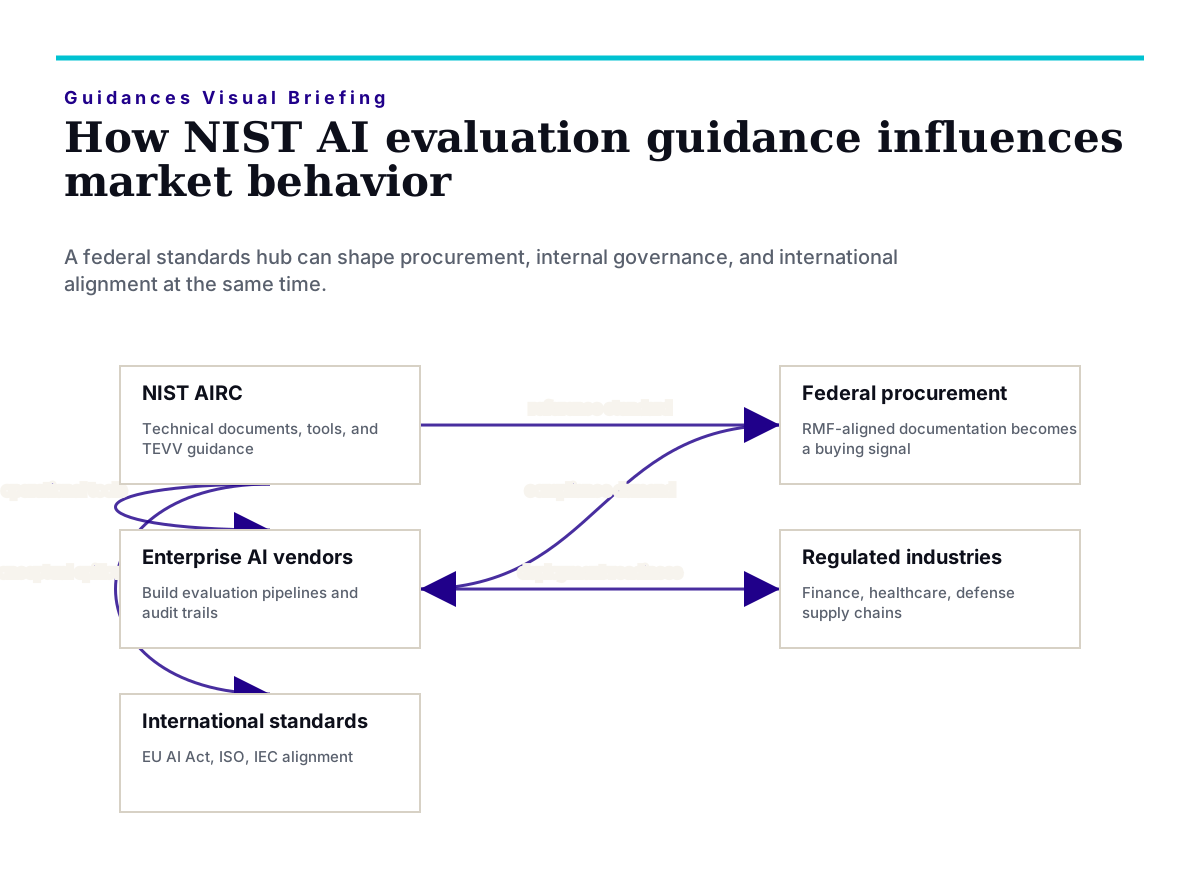
The National Institute of Standards and Technology's AI Resource Center—operating at airc.nist.gov—functions as a federal hub for helping translate the AI Risk Management Framework (AI RMF) into practice. According to the site's own description, the AIRC provides technical documents, software tools, and structured guidance oriented toward testing, evaluation, verification, and validation of AI systems, a cluster of activities the agency abbreviates as TEVV. The center also hosts materials related to the ARIA pilot—Assessing Risks and Impacts of AI—which is a structured federal effort to evaluate AI systems against risk criteria.
The search metadata for this source did not include a machine-readable publication date. The retrieval date was June 21, 2026. The analysis below treats the AIRC as an ongoing institutional resource rather than a newly published document, and all claims are grounded in the snippet and the publicly known scope of NIST's AI governance mandate.
Why the Market Cares
Federal AI evaluation infrastructure rarely generates headlines, but it can shape the operating environment for companies building, deploying, or procuring AI at scale. The AIRC's role is not advisory in the loose sense—it serves as a technical foundation for a compliance framework that is increasingly used as a reference point in U.S. government AI procurement.
The AI RMF, which the AIRC operationalizes, was released by NIST in January 2023 and has since been referenced in executive orders, agency guidance documents, and international standards discussions. The AIRC's TEVV materials translate that framework into testable and auditable procedures. For AI vendors, this matters because procurement officers at federal agencies may ask for RMF-aligned documentation as part of contract eligibility reviews. For enterprise buyers in regulated sectors—financial services, healthcare infrastructure, defense supply chains—the AIRC's outputs are becoming a reference architecture for internal AI governance programs.
The ARIA pilot evaluation materials are also notable. ARIA presents a structured methodology for assessing AI systems not just on technical performance metrics but on broader risk and societal impact dimensions. As AI systems move from experimental to operational status inside large organizations, the ability to demonstrate ARIA-style evaluation can become a factor in procurement discussions and regulatory reviews.
Technology and Policy Linkage
The AIRC sits at the intersection of three policy currents. First, the U.S. executive branch has repeatedly directed federal agencies to align AI procurement with NIST standards, creating demand for RMF-compatible documentation. Second, the European Union's AI Act—now in phased implementation—references risk-based evaluation frameworks that are structurally similar to the AI RMF, meaning that companies building NIST-aligned compliance programs may also gain partial readiness for EU regulatory requirements. Third, international standards bodies, including ISO and IEC, are developing AI governance standards that draw on NIST's conceptual architecture, extending the influence of what began as a domestic U.S. framework.
For technology operators, the practical implication is that TEVV is no longer a niche concern for government contractors. It is becoming a shared vocabulary of AI accountability across jurisdictions. Companies that invest early in TEVV-compatible evaluation pipelines—automated red-teaming, structured model cards, adversarial robustness testing, bias audits—are building infrastructure that can be reused across multiple regulatory regimes rather than custom-built for each one.
The AIRC's software tools dimension is also worth noting. NIST has historically produced reference implementations and open-source toolkits alongside its standards documents. If the AIRC follows that pattern, the tools it publishes could become embedded in enterprise AI development pipelines, potentially benefiting organizations that adopt early.
Market Lens
Trigger: The AIRC's ongoing operationalization of the AI RMF, including TEVV guidance and ARIA pilot materials, is raising the technical floor for AI compliance across federal procurement and regulated industries.
Mechanism: Federal procurement requirements that reference RMF alignment create a compliance demand signal. Enterprise AI vendors may need to invest in evaluation infrastructure to remain eligible for government and regulated-sector contracts. This can raise the cost of entry for smaller vendors and create differentiation opportunities for those with mature governance tooling.
Affected sectors: Enterprise AI software vendors, AI governance and compliance tooling providers, cloud hyperscalers with federal contract exposure, and regulated-sector AI deployers in financial services and healthcare infrastructure. AI safety and evaluation tooling is an emerging sub-sector that the AIRC's outputs directly support.
Time horizon: Medium-term. Procurement cycles for federal AI contracts typically run 12 to 36 months. The compliance infrastructure being built now may influence contract eligibility windows opening in 2027 and beyond. International regulatory alignment—particularly with the EU AI Act's phased obligations—adds a parallel timeline with its own deadlines.
Next check: Watch for NIST's publication of updated AI RMF profiles or sector-specific guidance documents, ARIA pilot evaluation results or methodology publications, and any executive branch directives that formally mandate RMF alignment in federal AI acquisition regulations. Congressional appropriations for NIST AI programs are also a leading indicator of how much support the federal government intends to provide this infrastructure.
This section is market context only and does not constitute investment advice.
What to Watch Next
Several near-term developments will affect how quickly AIRC outputs translate into binding compliance requirements. The Office of Management and Budget has periodically updated its AI guidance for federal agencies; any revision that explicitly references AIRC tools or TEVV procedures could accelerate adoption timelines. The ARIA pilot's eventual publication of evaluation results—methodology, criteria, and findings—would provide a clearer signal of what federal AI evaluation looks like in practice.
International alignment is the second major variable. If ISO or IEC formally incorporate NIST AI RMF concepts into published standards, the AIRC's outputs could gain broader use in jurisdictions that mandate ISO compliance in procurement. That would extend the compliance demand signal beyond the U.S. federal market.
Finally, litigation and regulatory enforcement in AI-adjacent domains—algorithmic accountability cases, model bias disputes, AI-generated content liability—may create case law that references evaluation standards. Companies that can demonstrate TEVV-aligned processes may be better positioned in those proceedings, adding a legal-risk dimension to the compliance discussion that goes beyond procurement eligibility.
Uncertainty and Constraints
The source metadata for this article is a search snippet from an official government site without a machine-readable publication date. The analysis above is grounded in the AIRC's described functions and the publicly known scope of NIST's AI governance mandate, not in any specific newly published document. Readers should verify current AIRC tool availability, ARIA pilot status, and any updated RMF guidance directly at airc.nist.gov. The pace at which federal procurement regulations formally reflect AIRC outputs remains uncertain and subject to administrative and legislative variables.