What Happened
FTSE Russell, the global index provider, maintains an official resource page dedicated to the annual reconstitution of its U.S. equity benchmarks, including the widely followed Russell 2000. The source page, collected on June 24, 2026, carries an unverified provider-supplied date and no confirmed machine-readable publication date. Accordingly, this article does not treat it as a breaking announcement. Instead, it uses the official source as an anchor to analyze a structural market event that recurs every year and carries real consequences for capital allocation, trading mechanics, and company-level investor access.
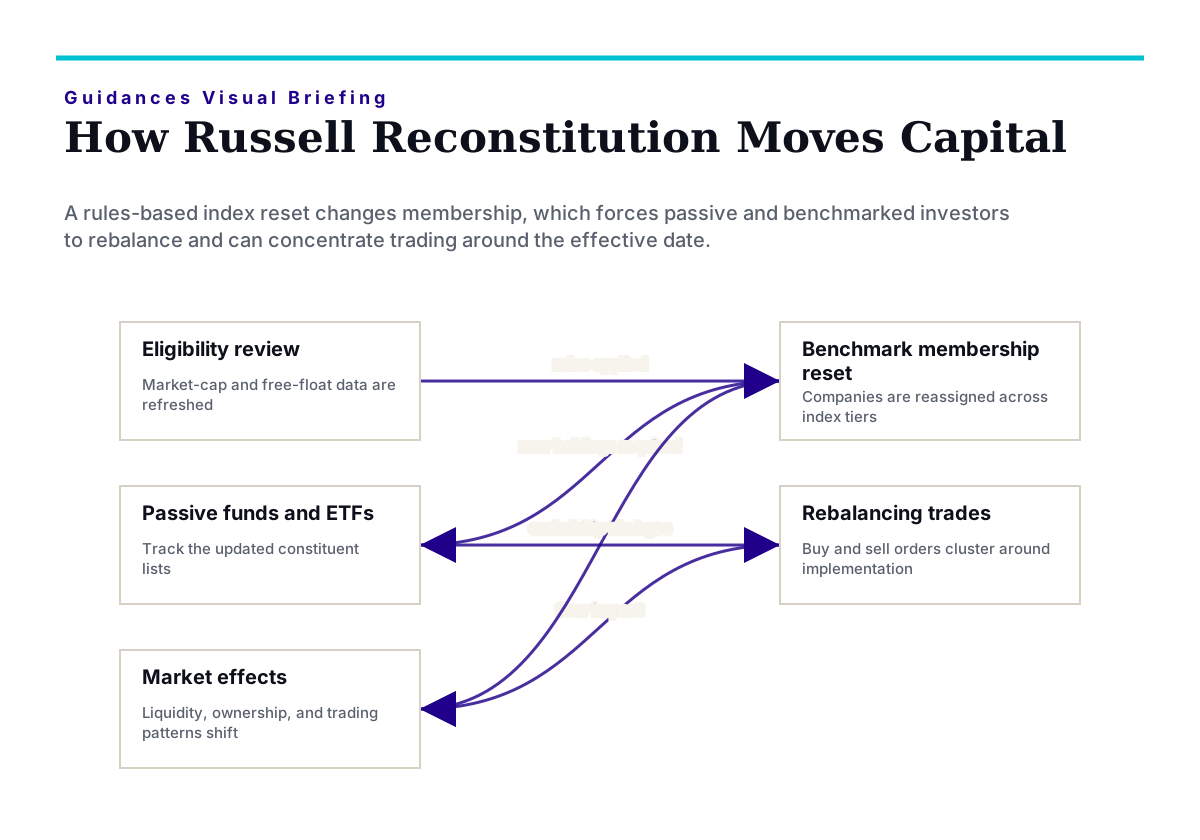
The reconstitution is best understood not as a data update but as a periodic recalibration of the U.S. equity classification system. Each cycle, FTSE Russell reassesses the full universe of eligible U.S.-listed companies and resets which names belong to which benchmark tier. The result is a revised map that passive funds, benchmarked institutions, and systematic strategies use to align their portfolios. The map changes; the capital follows.
Why the Market Cares
The Russell family of indexes occupies a specific and important role in U.S. equity markets. While the S&P 500 is the dominant large-cap benchmark, the Russell indexes—particularly the Russell 2000 for small-caps and the Russell 1000 for large-caps—are the primary reference points for a large portion of institutional mandates, ETF products, and derivatives contracts that target size-based exposure.
When the reconstitution resets membership, it does not merely update a list. It changes the routing of capital. Index funds and ETFs that track Russell benchmarks are contractually obligated to hold the constituents of their respective indexes. When a company enters or exits a benchmark, those funds must buy or sell accordingly. The same logic applies to benchmarked active managers who measure performance against a Russell index and to some quantitative strategies that use index membership as a signal or constraint.
The practical consequence is that reconstitution creates predictable, concentrated trading pressure. Volume in affected names often rises sharply around the effective date. Bid-ask spreads can widen or narrow depending on the direction and size of the flow. For companies near the boundary between tiers, even a modest shift in market capitalization or share count can trigger a reclassification that changes the investor base overnight.
This is not a theoretical concern. The scale of assets benchmarked to Russell indexes means that even a small percentage of assets under management moving in response to constituent changes can represent hundreds of millions of dollars in a single name. For smaller companies, that is a material event.
Tech and Policy Link
The Russell reconstitution is an index-operations event, but it intersects with technology and policy in several ways that matter to operators and founders.
First, technology companies—particularly those in AI infrastructure, semiconductors, cloud services, and software—tend to have market capitalizations that can move quickly relative to the broader market. A company that was comfortably in one size tier at the prior reconstitution may find itself near a boundary or in a different tier by the next cycle. That reclassification can change which funds are eligible to hold the stock, which benchmarks it appears in, and how it is screened by institutional allocators. For fast-growing technology companies, this is not a remote possibility; it is a recurring operational consideration.
Second, the growth of passive investing and ETF products is itself a policy and regulatory story. Regulators in the United States and internationally have paid increasing attention to the market-structure implications of index concentration, passive ownership, and the mechanics of benchmark-driven trading. The Russell reconstitution sits at the center of that discussion. It is a concrete example of how index design choices translate into capital-market outcomes.
Third, disclosure standards and free-float calculations—both of which feed into index eligibility—are shaped by securities regulation. Companies that change their capital structure, execute share buybacks, or issue new equity can inadvertently affect their index eligibility. That creates a feedback loop between corporate finance decisions and benchmark membership that founders and CFOs should understand.
Market Lens
Trigger: The annual FTSE Russell U.S. index reconstitution cycle, which resets benchmark composition across the Russell index family based on updated market-capitalization data and eligibility criteria.
Mechanism: Constituent changes obligate index-tracking funds and ETFs to rebalance their portfolios. Benchmarked institutional mandates and some systematic strategies follow the same logic. The result is concentrated buying and selling pressure around the reconstitution effective date, with the intensity proportional to the assets tracking the affected benchmarks. Any specific price move or fund-flow figure at the individual stock level is unverified from the available source and should not be inferred from this analysis alone.
Affected assets and sectors: The most direct exposure sits in Russell 2000 constituents and the ETFs and index products that track small-cap and mid-cap U.S. equities. The effect is not sector-specific by design; it can touch technology, healthcare, industrials, financials, and consumer names depending on where they fall in the size distribution. Which sectors or names experience the largest flows in any given cycle is unverified until the official constituent lists and post-reconstitution flow data are available.
Time horizon: The primary market-structure effect is concentrated in the weeks surrounding the announcement of preliminary lists, the finalization of constituents, and the implementation date. Liquidity effects often diminish after the rebalance is complete. However, the change in benchmark ownership can persist for a full year until the next reconstitution cycle, affecting how a company is screened, covered, and held by institutional investors.
Next check: The official FTSE Russell constituent announcement and implementation schedule are the primary checkpoints. Secondary checks include ETF and index-fund rebalancing disclosures, trading-volume data around the effective date, and any company-level filings that change the free-float or share-count picture. This analysis is market context only, not investment advice.
What to Watch Next
The most actionable near-term checkpoint is the release of the official preliminary and final constituent lists by FTSE Russell. Those documents convert the abstract methodology into a concrete trading map. Market participants typically begin positioning in advance of the effective date once the lists are public, which means the trading impact can begin before the official implementation.
A second area to monitor is the behavior of companies near the size-tier boundary. These names are most exposed to reclassification and can experience the largest relative flow effects. In the current environment, that group is likely to include a number of technology and AI-adjacent companies whose market capitalizations have moved significantly over the past year. The source does not identify any specific company, so any name-level inference would go beyond what the available evidence supports.
A third watch item is the broader passive-flow environment. The magnitude of reconstitution-driven trading is partly a function of how much capital is benchmarked to Russell indexes at the time of the event. If assets under management in Russell-tracking products have grown since the prior cycle, the mechanical trading pressure will be proportionally larger. ETF flow data and fund-size disclosures from major index-fund providers are the relevant inputs here.
Finally, observers should watch for any changes to FTSE Russell's eligibility methodology. The index provider periodically updates its rules around minimum market capitalization, liquidity thresholds, and free-float requirements. Any such change can alter which companies are eligible and how the reconstitution affects the broader market.
Uncertainty and Constraints
The available source is a short official-page snippet, not a full methodology document or a constituent announcement. That limits the specificity of this analysis. The structural mechanics described here are grounded in how Russell reconstitution works as a recurring market event, but the article cannot identify which companies will be added, removed, or reclassified in the current cycle without the official data. It also cannot assign a causal market reaction to any specific ticker or sector from this source alone.
The provider-supplied date associated with the source is unverified and should not be treated as the confirmed publication date. The analysis is framed around the recurring nature of the event rather than any specific cycle's outcomes.
This analysis is market context only, not investment advice.