AI
Developing · 0 updatesFact 9/10Cohere Releases North Mini Code, an Open-Source Agentic Coding Model
Cohere has launched North Mini Code, an open-source agentic coding model released under the Apache 2.0 license. The model employs a mixture-of-experts architecture with 30B total parameters and 3B active parameters, and is available through Hugging Face and Cohere's API.
Open article · no sign-in required
Sources and disclosure
Most key claims are directly supported by the provided context. The claim regarding availability on 'Model Vault and OpenCode platforms' is not explicitly mentioned in the provided search results.
Market lens
Agent runtime spending can spill into security, observability, and workflow infrastructure
The market signal is not another chatbot category; it is a possible budget shift toward the control layer around enterprise AI.
Impact path
Runtime spend → infra stack
Signals to watch
- Procurement language around audit logs and cost ceilings
- Security and observability vendors attaching agent controls
- Workflow platforms exposing approval and tool-call governance
Verification schedule
D+1 · Jun 15
Do buyers repeat audit/cost-control requirements?
D+3 · Jun 17
Do vendors publish runtime-control SKUs or partnerships?
D+7 · Jun 21
Do budgets move from pilots into operating infrastructure?
Informational context only — not investment, legal, tax, or financial advice.
Cohere has introduced North Mini Code, an open-source coding model for the developer community. The model is presented as the first release in Cohere's next-generation model lineup.
Model Architecture and Deployment
North Mini Code is built on a Mixture-of-Experts (MoE) architecture, with a total of 30 billion parameters and 3 billion active during inference. Cohere has released the model under the Apache 2.0 license. Developers can access it through Hugging Face for model downloads or through Cohere's API. Cohere also says the model is available through its Model Vault and OpenCode platforms.
Understanding Agentic Coding Models
Cohere describes North Mini Code as an "agentic coding model." In general, agentic systems break complex tasks into multiple steps, use tools, and decide next actions based on intermediate results. In coding workflows, this can support tasks such as writing code, debugging, generating tests, refactoring, and documentation.
The AI coding tools market has seen growing interest in agent-based systems that go beyond basic autocomplete. Tools such as GitHub Copilot, Cursor, and Replit Ghostwriter have added related features, and Cohere's release adds another open-source option in this segment.
Launch of a Next-Generation Model Series
Cohere has positioned North Mini Code as the first product in its next-generation model series. This suggests the company may release additional models with similar architectural or design characteristics.
Cohere has previously offered enterprise-focused language models including Command, Embed, and Rerank. The release of an open-source coding model expands its presence in developer tools. The Apache 2.0 license may broaden access for startups and individual developers.
Competitive Landscape in Open-Source Coding Models
The open-source coding model space includes Meta's Code Llama, Mistral AI's Codestral, DeepSeek's DeepSeek-Coder, and Salesforce's CodeGen. These models differ in parameter scale, licensing terms, and support for specific languages and task types.
North Mini Code's 30B/3B MoE structure is designed to balance efficiency and capability. The 3B active parameter count places it within a range that can be used in typical development environments, while the 30B total parameter count may provide capacity for more complex coding tasks. Its practical performance will depend on benchmark results and real-world use.
Deployment Infrastructure and Accessibility
Cohere offers multiple deployment channels. Direct download through Hugging Face supports teams that want on-premises deployment or customization. Cohere's API provides a managed service option for developers who prefer not to manage infrastructure. Model Vault and OpenCode are presented as tools for integrating and managing models within Cohere's ecosystem.
This deployment approach appears designed to accommodate different use cases and organization sizes. Startups can prototype through the API, while larger enterprises can deploy the model within their own infrastructure.
Public Information and Areas for Further Review
The information currently available does not include detailed performance metrics, training data composition, supported programming language coverage, or the specific implementation details of the agentic features. Cohere's official documentation and benchmark results will be needed to assess the model more fully.
MoE architectures are generally considered efficient, but practical use may require hardware-specific optimization. Execution stability and fine-tuning behavior across different deployment environments may affect adoption.
Builder Implications
- The Apache 2.0 license allows commercial use of the 30B/3B MoE coding model, with access through Hugging Face and Cohere's API.
- The agentic coding positioning suggests possible use in workflow automation, though the feature scope should be confirmed in official documentation.
- The MoE architecture may offer efficiency benefits in inference cost and latency, but hardware requirements and actual performance should be validated before production use.
Want follow-up alerts? Subscribe by email after reading the public article.
Market lens
Agent runtime spending can spill into security, observability, and workflow infrastructure
The market signal is not another chatbot category; it is a possible budget shift toward the control layer around enterprise AI.
Impact path
Runtime spend → infra stack
Signals to watch
- Procurement language around audit logs and cost ceilings
- Security and observability vendors attaching agent controls
- Workflow platforms exposing approval and tool-call governance
Verification schedule
D+1 · Jun 15
Do buyers repeat audit/cost-control requirements?
D+3 · Jun 17
Do vendors publish runtime-control SKUs or partnerships?
D+7 · Jun 21
Do budgets move from pilots into operating infrastructure?
Informational context only — not investment, legal, tax, or financial advice.
Visual Briefing
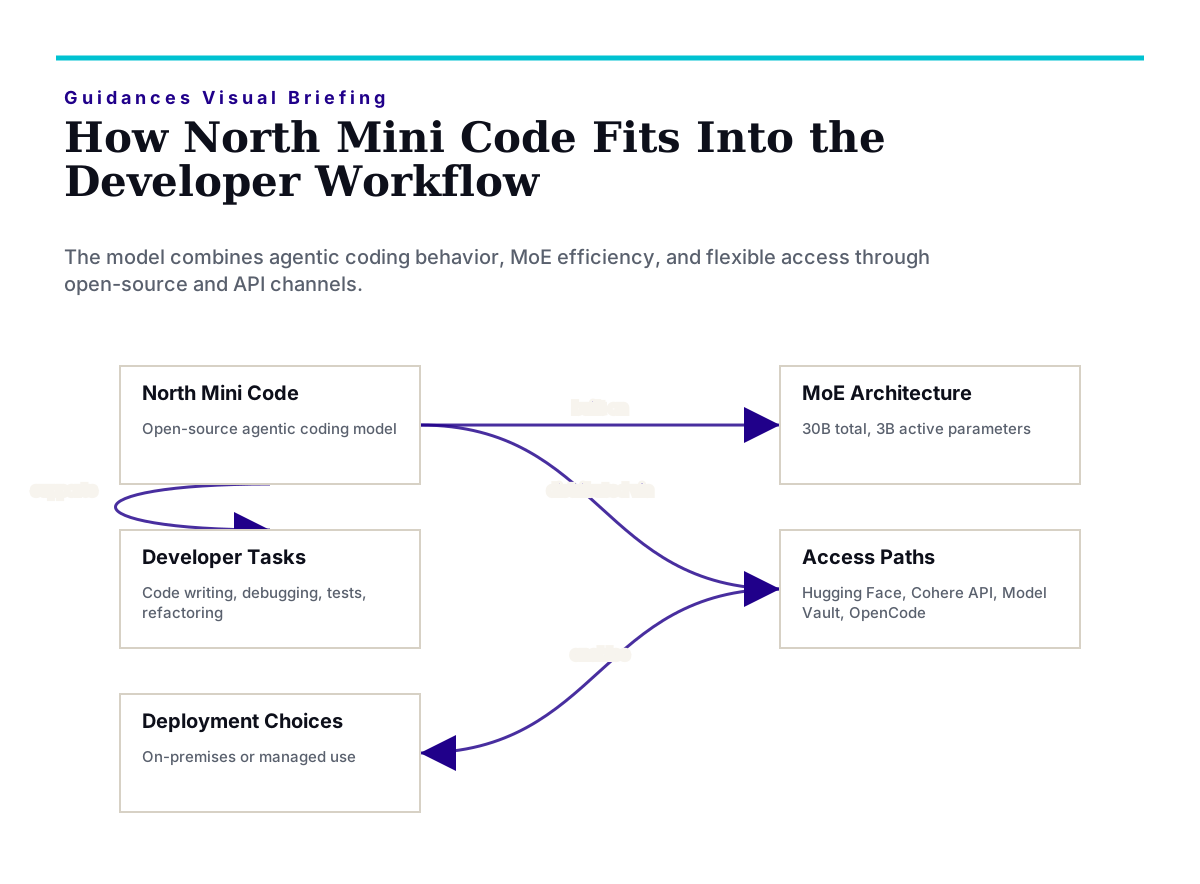
A simple workflow map showing the model’s architecture, use cases, and distribution options.
Corrections and safety
See a factual, privacy, rights, or safety issue? Review the corrections process or contact Guidances before relying on this article for important decisions.