AI
Developing · 1 updateFact 9/10Google Unveils Gemma 4 Model Lineup with Dense, MoE, and Multimodal Variants
Google has disclosed the composition of its Gemma 4 model family through developer documentation. The lineup includes dense architecture, mixture-of-experts (MoE) structures, and a unified multimodal model, with each variant designed for different performance and efficiency requirements.
Open article · no sign-in required
Sources and disclosure
The article accurately describes the composition of Google's Gemma 4 model family, including dense, Mixture-of-Experts (MoE), and unified multimodal variants. The claims are directly supported by the provided developer documentation and blog post contexts, which specify the existence and general characteristics of these models, along with their parameter counts (e.g., 31B dense, 26B MoE, 12B unified multimodal, e2b, e4b). The article maintains a neutral and informative tone, adhering to reputation safety guidelines.
Market lens
Agent runtime spending can spill into security, observability, and workflow infrastructure
The market signal is not another chatbot category; it is a possible budget shift toward the control layer around enterprise AI.
Impact path
Runtime spend → infra stack
Signals to watch
- Procurement language around audit logs and cost ceilings
- Security and observability vendors attaching agent controls
- Workflow platforms exposing approval and tool-call governance
Verification schedule
D+1 · Jun 15
Do buyers repeat audit/cost-control requirements?
D+3 · Jun 17
Do vendors publish runtime-control SKUs or partnerships?
D+7 · Jun 21
Do budgets move from pilots into operating infrastructure?
Informational context only — not investment, legal, tax, or financial advice.
Google has disclosed the detailed composition of its Gemma 4 model family through its AI developer documentation page. The announcement includes three main architectural variants: dense, mixture-of-experts (MoE), and unified multimodal models.
Architectural Variants
Dense models follow the traditional transformer structure, with all parameters activated during inference. This provides predictable latency and consistent throughput.
MoE architectures activate only a subset of expert subnetworks depending on the input, reducing the number of active parameters relative to the total parameter count. The routing mechanism selects expert combinations based on input tokens.
The unified multimodal model is designed to process text and images within a single architecture. It can support tasks such as visual question answering, document understanding, and multimodal retrieval.
Developer Ecosystem
The Gemma series has drawn attention in the open-weight model market, and the fourth-generation lineup expands the available options. Dense models are highly compatible with standard inference frameworks and are easier to integrate into existing pipelines.
MoE models require runtimes that support routing logic and expert load balancing. Multimodal variants place greater emphasis on input pipeline design, including image preprocessing, resolution adjustment, and text-image alignment.
Competitive Landscape
The open-weight model market includes Meta's Llama series, Mistral AI's model family, and Alibaba's Qwen lineup. Gemma 4's MoE variant may be compared with other MoE models, while the multimodal model may be evaluated alongside other multimodal offerings.
Licensing and Deployment
Gemma models are generally distributed under licenses that permit commercial use, but specific terms should be checked in the model cards and terms of service. MoE and multimodal variants may have higher inference memory requirements.
Google's official documentation is expected to include recommended hardware specifications, batch size settings, and inference optimization guides for each variant. The currently disclosed information confirms the existence of the model variants but does not specify parameter counts, benchmark performance, training data composition, or release schedules.
Want follow-up alerts? Subscribe by email after reading the public article.
Market lens
Agent runtime spending can spill into security, observability, and workflow infrastructure
The market signal is not another chatbot category; it is a possible budget shift toward the control layer around enterprise AI.
Impact path
Runtime spend → infra stack
Signals to watch
- Procurement language around audit logs and cost ceilings
- Security and observability vendors attaching agent controls
- Workflow platforms exposing approval and tool-call governance
Verification schedule
D+1 · Jun 15
Do buyers repeat audit/cost-control requirements?
D+3 · Jun 17
Do vendors publish runtime-control SKUs or partnerships?
D+7 · Jun 21
Do budgets move from pilots into operating infrastructure?
Informational context only — not investment, legal, tax, or financial advice.
Visual Briefing
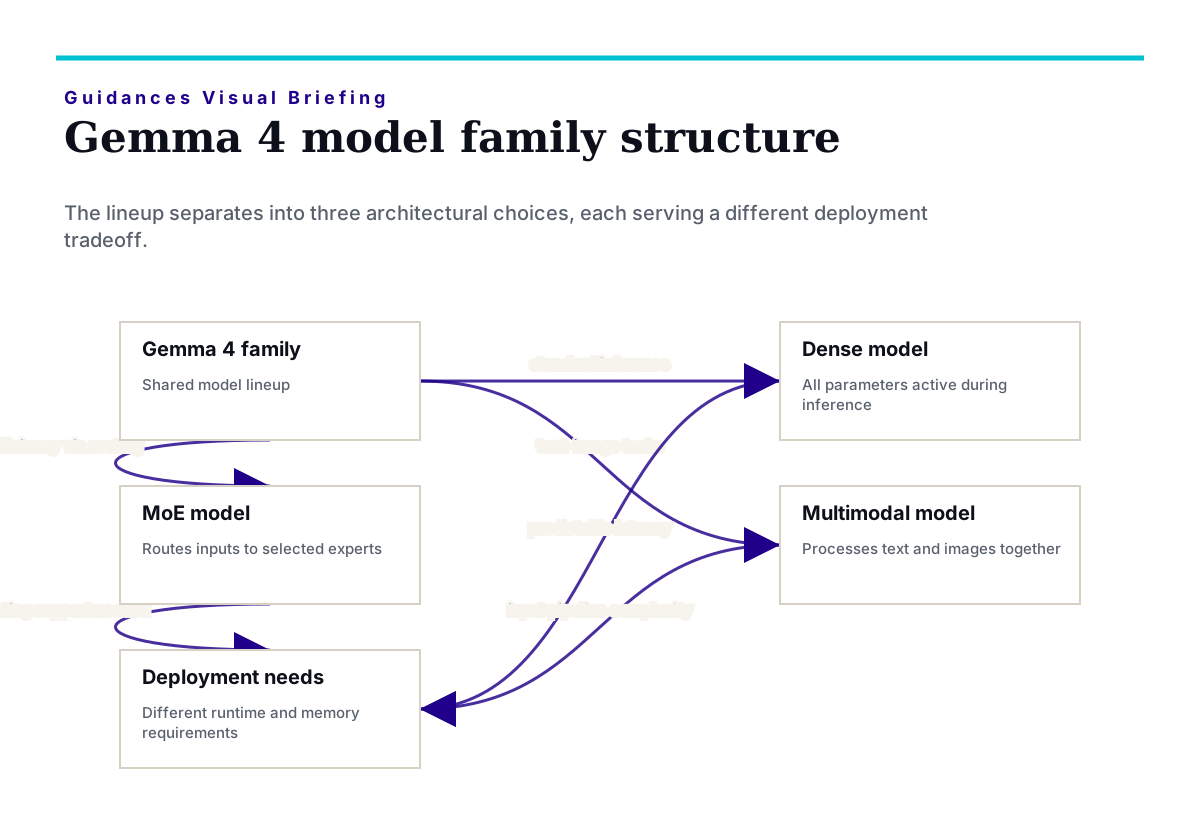
A simple map of the Gemma 4 lineup and the main operational tradeoffs for each variant.
Corrections and safety
See a factual, privacy, rights, or safety issue? Review the corrections process or contact Guidances before relying on this article for important decisions.