AI
Developing · 0 updatesFact 9/10Cohere Labs Unveils Speech Recognition Model Topping Open ASR Leaderboard
Hugging Face's Cohere Labs has released Cohere-transcribe, a speech recognition model that achieved first place on the Open ASR Leaderboard with an average word error rate of 5.42%. The model reportedly matches or exceeds existing open-source models across 13 additional languages.
Open article · no sign-in required
Sources and disclosure
All key factual claims are directly supported by the provided primary source, which is the official Hugging Face blog post. The article accurately reports the model's name, its affiliation with Hugging Face, its ranking and WER on the Open ASR Leaderboard, and its multilingual capabilities. The article also includes appropriate caveats regarding benchmark performance versus real-world application, maintaining a neutral and informative tone. The additional context from GitHub repositories further corroborates the existence and high ranking of the model.
Market lens
Agent runtime spending can spill into security, observability, and workflow infrastructure
The market signal is not another chatbot category; it is a possible budget shift toward the control layer around enterprise AI.
Impact path
Runtime spend → infra stack
Signals to watch
- Procurement language around audit logs and cost ceilings
- Security and observability vendors attaching agent controls
- Workflow platforms exposing approval and tool-call governance
Verification schedule
D+1 · Jun 15
Do buyers repeat audit/cost-control requirements?
D+3 · Jun 17
Do vendors publish runtime-control SKUs or partnerships?
D+7 · Jun 21
Do budgets move from pilots into operating infrastructure?
Informational context only — not investment, legal, tax, or financial advice.
Hugging Face's Cohere Labs has introduced a speech recognition model named Cohere-transcribe. The model reportedly achieved first place on the Open ASR Leaderboard with an average word error rate (WER) of 5.42%.
Word error rate is a core metric used to measure the accuracy of speech recognition systems, with lower values indicating higher performance. The Open ASR Leaderboard is used to compare the performance of publicly available speech recognition models.
Cohere Labs is the organization within Hugging Face focused on speech and language model development. The release is presented as an example of model performance in speech recognition technology.
Multilingual Performance and Technical Significance
Cohere-transcribe reportedly matches or exceeds existing open-source models across 13 languages beyond English. Multilingual support is an important factor in developing speech recognition applications for global markets.
The multilingual performance of speech recognition models can vary depending on the quantity and quality of training data, the complexity of each language's phonological system, and the model's generalization ability. Competitive results across 13 languages suggest training that takes diverse language environments into account.
The open-source speech recognition model market includes OpenAI's Whisper, Meta's SeamlessM4T, and models from various academic institutions. Cohere-transcribe's first-place ranking indicates strong benchmark performance. However, actual operational environments also require review of inference speed, memory usage, and accuracy in specific domains.
Meaning and Limitations of Benchmark Performance
The Open ASR Leaderboard evaluates models using standardized test datasets. Such benchmarks make model comparison possible, but they do not fully reflect the complexity of real-world environments. Acoustic characteristics of test data, speaker pronunciation patterns, and background noise levels may differ from actual use cases.
The average word error rate of 5.42% is a figure synthesized across multiple test sets. Individual test sets or specific languages may show higher or lower error rates, which can help characterize the model. However, the source metadata does not provide language-specific performance figures, so the exact level in each language requires additional verification.
The practicality of speech recognition models depends not only on word error rate but also on model size, inference speed, and resource usage. Large models can show high accuracy but may be difficult to deploy in environments with limited computing resources. In addition, recognition of specialized terminology or proper nouns may not be fully reflected in general benchmarks.
Impact on the Open-Source Ecosystem
Hugging Face has played an important role in the open-source community as an AI model sharing platform. Cohere Labs' release of a speech recognition model as an internal Hugging Face organization is an example of expanding the platform's technical scope.
The release of open-source models affects the development ecosystem in several ways. Researchers and developers can use recent technology, and when model architecture and training methods are made public, the community can improve them or adapt them for specific uses. It can also help reduce dependence on commercial services and support cost-efficient solution building.
When using open-source models, it is also important to review license terms, the origin and composition of training data, and maintenance plans. These factors can affect commercial use eligibility and long-term product strategy.
Current Position of Speech Recognition Technology
Speech recognition technology has advanced rapidly in recent years through transformer architectures and large-scale pre-training techniques. Systems that previously showed word error rates above 10% now show performance around 5%, reaching practical levels. This enables applications such as call center automation, real-time caption generation, and voice-based interfaces.
However, speech recognition technology still faces challenges. Performance can vary in environments with heavy background noise, strong accents or dialects, domains with extensive specialized terminology, and situations where multiple speakers talk at once. Support for low-resource languages and minimizing latency for real-time processing remain important technical challenges.
The advancement of speech recognition models includes not only accuracy improvements but also efficiency gains. The ability to achieve the same performance with fewer computing resources is an important research direction, and edge-device execution, low latency, and on-device processing are especially important in mobile and IoT environments.
Considerations for Practical Application
The release of Cohere-transcribe is presented as an example of the open-source sector offering technology that can be compared with commercial services. This may improve access to speech recognition technology and help more developers and enterprises build voice-based applications.
When introducing speech recognition models in practical environments, multiple stages of verification are needed. First, the acoustic and linguistic characteristics of the target use case should be analyzed to assess similarity with the benchmark environment. Next, accuracy, processing speed, and resource usage should be measured through pilot testing using real data. Finally, user feedback should be collected to evaluate experience quality and make necessary adjustments.
Model fine-tuning capability is also an important consideration. It should be determined whether additional training can be performed to improve performance for specific domains or accents, and how much data and computing resources would be required. One advantage of open-source models is that customization is possible, but practical implementation requires technical expertise and resources.
Deployment Architecture Considerations
When deploying speech recognition models in production environments, infrastructure decisions significantly affect both performance and cost. Cloud-based deployment offers scalability and avoids hardware management overhead, but it introduces network latency and ongoing API costs. Self-hosted deployment provides greater control over data privacy and can reduce long-term operational costs, but it requires expertise in model serving infrastructure and capacity planning.
The choice between batch processing and real-time streaming affects system architecture. Batch processing of recorded audio allows optimization of throughput and resource utilization but cannot support interactive applications. Real-time streaming requires careful management of latency budgets, with each processing stage—audio capture, network transmission, model inference, and result delivery—contributing to total delay. Applications such as live captioning or voice assistants typically require low end-to-end latency to maintain acceptable user experience.
Model quantization and optimization techniques can improve inference performance. Reducing model precision from 32-bit floating point to 16-bit or 8-bit representations often yields minimal accuracy loss while decreasing memory footprint and accelerating computation. Hardware-specific optimizations, such as using GPU tensor cores or specialized AI accelerators, can further improve throughput. These optimizations require validation to ensure accuracy remains within acceptable bounds for the target application.
Integration Patterns and Error Handling
Integrating speech recognition into application workflows requires careful consideration of error handling and user experience. Confidence scores accompanying transcription results can help applications identify uncertain segments and request user confirmation or trigger alternative processing paths. Fallback mechanisms, such as switching to alternative models or human review queues when confidence falls below thresholds, can improve overall system reliability.
Domain adaptation is a critical factor for specialized applications. General-purpose speech recognition models may struggle with industry-specific terminology, product names, or technical jargon. Fine-tuning on domain-specific data, implementing custom vocabulary lists, or using language model fusion techniques can improve accuracy in specialized contexts. The availability of model weights and training code in open-source releases enables such customization, though it requires machine learning expertise and representative training data.
Monitoring and observability infrastructure should track multiple dimensions of system health. Beyond basic metrics such as request volume and latency, speech recognition systems benefit from tracking accuracy indicators, audio quality metrics, and error patterns. Analyzing transcription errors by category—such as substitutions, deletions, or insertions—helps identify systematic issues and guide improvement efforts. User feedback mechanisms, including correction interfaces, provide useful signals for ongoing model refinement.
Builder Implications
- Implementing speech recognition functionality using a top-ranked Open ASR Leaderboard model can reduce commercial API dependence and support cost-efficient solution building. However, performance in specific domains or acoustic environments requires separate validation, and inference speed and memory usage must be measured in actual operational environments to determine deployment feasibility.
- Support for 13 languages presents the possibility of integrating multilingual speech recognition functionality into a single model when developing products for global markets. Language-specific performance differences and license terms should be confirmed in advance, and sufficient accuracy in the primary languages of target markets should be verified.
- Considering the gap between benchmark performance and actual operational performance, conducting pilot testing to measure accuracy, processing speed, and resource usage in your specific use case before deciding on adoption is recommended. Particularly when real-time processing is required, latency and concurrent processing capacity should be carefully evaluated.
Want follow-up alerts? Subscribe by email after reading the public article.
Market lens
Agent runtime spending can spill into security, observability, and workflow infrastructure
The market signal is not another chatbot category; it is a possible budget shift toward the control layer around enterprise AI.
Impact path
Runtime spend → infra stack
Signals to watch
- Procurement language around audit logs and cost ceilings
- Security and observability vendors attaching agent controls
- Workflow platforms exposing approval and tool-call governance
Verification schedule
D+1 · Jun 15
Do buyers repeat audit/cost-control requirements?
D+3 · Jun 17
Do vendors publish runtime-control SKUs or partnerships?
D+7 · Jun 21
Do budgets move from pilots into operating infrastructure?
Informational context only — not investment, legal, tax, or financial advice.
Visual Briefing
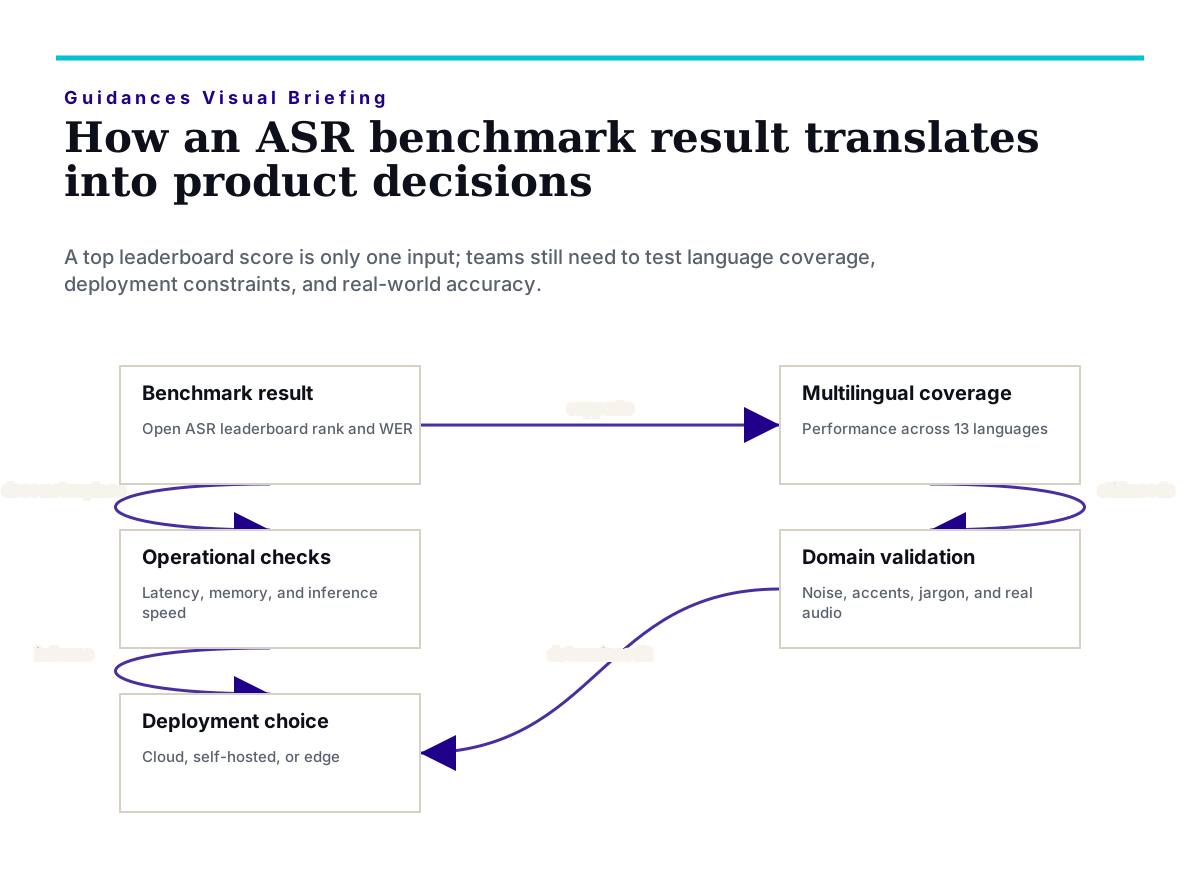
A benchmark win can justify attention, but production adoption depends on multilingual performance and operational testing.
Corrections and safety
See a factual, privacy, rights, or safety issue? Review the corrections process or contact Guidances before relying on this article for important decisions.