AI
Developing · 0 updatesFact 9/10OpenAI Unveils GPT-Rosalind for Life Sciences Research—Reasoning Model for Biology and Drug Discovery
OpenAI announced GPT-Rosalind on April 16, 2026, as a research preview for biology, drug discovery, and translational medicine. The model supports tool use and multi-step scientific workflows, and is available through ChatGPT, Codex, and the API to qualified customers via the Trusted Access Program.
Open article · no sign-in required
Sources and disclosure
All key factual claims regarding OpenAI's GPT-Rosalind, including its announcement date, designation as a frontier reasoning model for life sciences, specific domains (biology, drug discovery, translational medicine), features (tool use, multi-step scientific workflows), and availability channels (ChatGPT, Codex, API via Trusted Access Program for qualified customers), are directly supported by the provided OpenAI web search context. The article accurately reflects the information from the sources and maintains a neutral, informational tone, avoiding any speculative or reputation-damaging language. The contextual information and implications discussed in the article are reasonable extensions of the verified facts.
Market lens
Agent runtime spending can spill into security, observability, and workflow infrastructure
The market signal is not another chatbot category; it is a possible budget shift toward the control layer around enterprise AI.
Impact path
Runtime spend → infra stack
Signals to watch
- Procurement language around audit logs and cost ceilings
- Security and observability vendors attaching agent controls
- Workflow platforms exposing approval and tool-call governance
Verification schedule
D+1 · Jun 15
Do buyers repeat audit/cost-control requirements?
D+3 · Jun 17
Do vendors publish runtime-control SKUs or partnerships?
D+7 · Jun 21
Do budgets move from pilots into operating infrastructure?
Informational context only — not investment, legal, tax, or financial advice.
OpenAI announced GPT-Rosalind on April 16, 2026, as a research preview—a frontier reasoning model designed for biology, drug discovery, and translational medicine. The model supports tool use and multi-step scientific workflows, and is available through ChatGPT, Codex, and the API to qualified customers via the Trusted Access Program.
This announcement signals OpenAI's expansion beyond general-purpose language models into domain-optimized reasoning systems for specific scientific fields. GPT-Rosalind is designed to assist life sciences researchers in analyzing complex biological data, validating hypotheses, and exploring drug candidates through sequential reasoning processes. The model's capabilities extend beyond text generation to include the ability to invoke tools at each stage of a scientific workflow and integrate results.
Life sciences is a domain where AI reasoning capabilities are particularly important due to data complexity and the precision required in experimental design. Drug development involves multiple stages—screening thousands of compounds, predicting protein structures, interpreting clinical data—each requiring different data formats and analytical tools. GPT-Rosalind's support for multi-step workflows suggests the potential to assist with these complex pipelines.
Translational medicine refers to the process of converting basic research findings into clinical applications. In this field, AI models can connect laboratory data with clinical data, predict treatment effects in patient populations, and assist in preparing regulatory documentation. GPT-Rosalind's explicit support for translational medicine indicates the model is designed not only for research stages but also for integration into clinical development pipelines.
The restricted distribution through the Trusted Access Program reflects OpenAI's consideration of the sensitivity and regulatory requirements of life sciences. Life sciences research demands high levels of security and ethical standards due to patient data, intellectual property, and regulatory compliance. By limiting access to qualified customers, OpenAI can monitor early use cases and collect feedback.
Multi-channel availability through ChatGPT, Codex, and the API addresses the needs of diverse user groups. The ChatGPT interface is suitable for researchers to explore hypotheses and review literature interactively, while Codex can support writing bioinformatics pipeline code. API access enables enterprise customers to integrate the model into their own research platforms.
This announcement comes at a time of intensifying competition in life sciences AI. Alphabet's DeepMind has been prominent in protein structure prediction with the AlphaFold series, and several biotech startups are applying generative models to drug design. GPT-Rosalind demonstrates OpenAI's approach of combining general reasoning capabilities with domain-specific knowledge in this field.
However, the research preview designation indicates the model is not yet a fully commercial product and requires further validation of performance and safety. In life sciences, AI model outputs can influence experimental design, clinical decisions, and regulatory submissions, so rigorous standards for accuracy and reliability must be applied. OpenAI plans to improve the model through collaboration with qualified customers and validate its utility in real research environments.
Tool use capability is one of GPT-Rosalind's key differentiators. Life sciences research relies on a variety of specialized tools, including molecular dynamics simulations, genomic analysis software, and chemical structure databases. If the model can invoke these tools and interpret results, researchers can direct complex analytical pipelines in natural language and have the model orchestrate the necessary computations. This has the potential to enhance research productivity.
However, specific performance metrics, training data sources, accuracy of biological knowledge, and validation results in actual drug development pipelines have not yet been disclosed. The life sciences community will need additional information on what advantages the model offers compared to existing domain-specific tools, and how it supports reproducibility and interpretability of research results.
The model's ability to handle multi-step workflows is particularly relevant for drug discovery, where researchers must navigate a sequence of interdependent tasks: target identification, hit discovery, lead optimization, preclinical testing, and clinical trial design. Each stage generates data that informs the next, and errors or inefficiencies at any point can cascade through the pipeline. A reasoning model that can maintain context across these stages, invoke appropriate computational tools, and synthesize results could reduce cycle times and improve decision quality.
Translational medicine presents additional challenges, as it requires bridging the gap between mechanistic understanding in model organisms and therapeutic outcomes in human patients. GPT-Rosalind's support for this domain suggests it may be capable of integrating diverse data types—genomic, proteomic, clinical, and epidemiological—and reasoning about how findings in one context apply to another. This capability would be valuable for identifying biomarkers, stratifying patient populations, and designing adaptive clinical trials.
The Trusted Access Program structure implies that OpenAI is treating life sciences applications with heightened caution, likely due to the potential for high-impact errors and the regulatory environment. Pharmaceutical development is subject to oversight by agencies such as the FDA and EMA, which require documentation and validation of all tools and methods used in the development process. By working with qualified customers, OpenAI can ensure that GPT-Rosalind is deployed in contexts where users have the expertise to validate outputs and the infrastructure to maintain compliance.
The availability through Codex is noteworthy, as it suggests the model can assist with writing and debugging code for bioinformatics pipelines, a common bottleneck in computational biology. Many life sciences researchers have domain expertise but limited programming experience, and a model that can translate scientific intent into executable code could broaden access to advanced computational methods.
API access enables integration into existing laboratory information management systems (LIMS), electronic lab notebooks (ELNs), and data analysis platforms. This is critical for enterprise adoption, as life sciences organizations typically have established workflows and data governance policies that require custom integration rather than standalone tools.
The announcement does not specify the model's architecture, parameter count, or training methodology, leaving open questions about how it achieves domain specialization. Possible approaches include fine-tuning on life sciences literature and datasets, incorporating structured knowledge from databases such as PubChem or UniProt, or using reinforcement learning from expert feedback. The choice of approach has implications for the model's generalization capabilities, interpretability, and susceptibility to biases in training data.
The timing of the announcement, in April 2026, places it in a competitive landscape where several organizations are pursuing AI for drug discovery. The success of GPT-Rosalind will depend not only on its technical capabilities but also on its ability to integrate into existing research workflows, meet regulatory standards, and demonstrate improvements in research outcomes.
Builder Implications
- AI product developers in life sciences should consider combining domain-specific reasoning models with tool integration capabilities, and adopt phased deployment strategies such as trusted access programs to meet regulatory and ethical requirements.
- Biotech startups and pharmaceutical companies should review API access qualification requirements and data security protocols for integrating frontier models like GPT-Rosalind into their research platforms, and evaluate utility in actual workflows through early pilot projects.
- AI infrastructure providers should prepare computing environments and data pipelines that support the unique demands of life sciences workloads—large-scale molecular data processing, simulation tool integration, regulatory compliance logging—and prioritize features that support traceability and reproducibility of model outputs.
Want follow-up alerts? Subscribe by email after reading the public article.
Market lens
Agent runtime spending can spill into security, observability, and workflow infrastructure
The market signal is not another chatbot category; it is a possible budget shift toward the control layer around enterprise AI.
Impact path
Runtime spend → infra stack
Signals to watch
- Procurement language around audit logs and cost ceilings
- Security and observability vendors attaching agent controls
- Workflow platforms exposing approval and tool-call governance
Verification schedule
D+1 · Jun 15
Do buyers repeat audit/cost-control requirements?
D+3 · Jun 17
Do vendors publish runtime-control SKUs or partnerships?
D+7 · Jun 21
Do budgets move from pilots into operating infrastructure?
Informational context only — not investment, legal, tax, or financial advice.
Visual Briefing
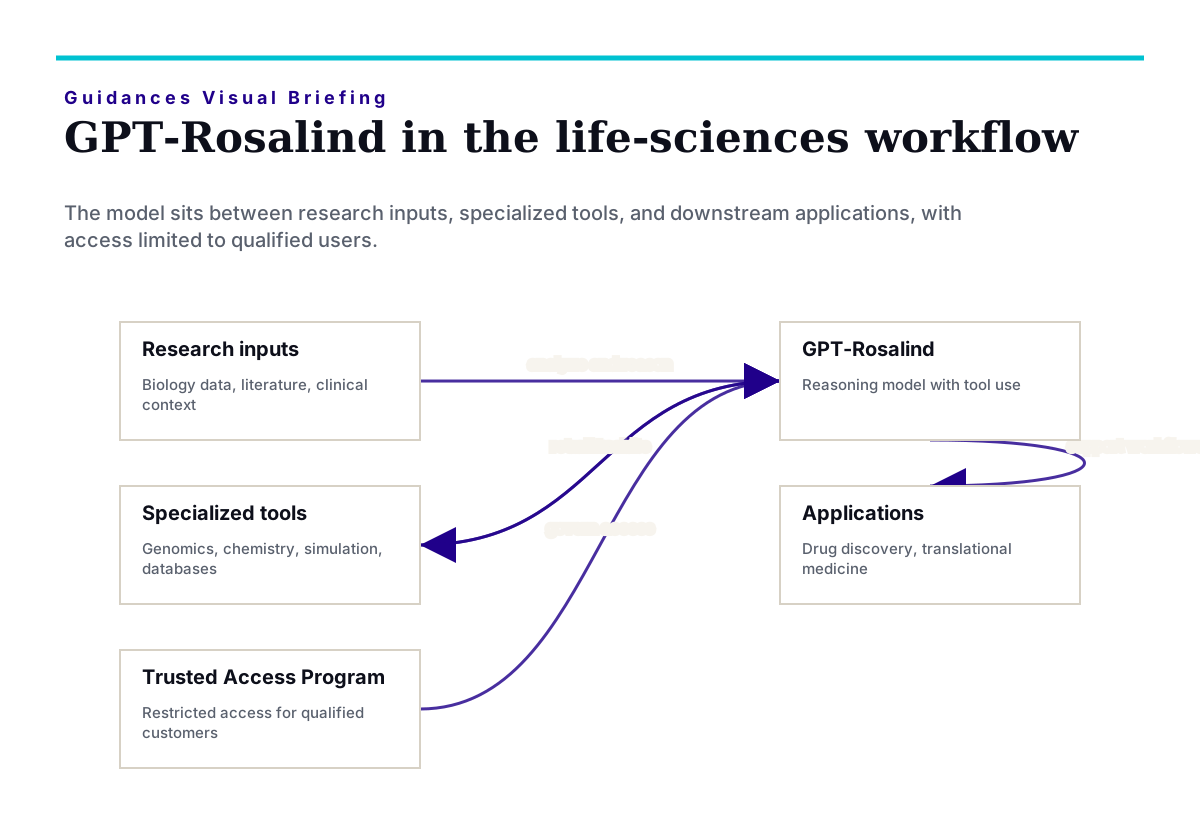
A simple view of how GPT-Rosalind fits into life-sciences research, from inputs and tools to applied use under restricted access.
Corrections and safety
See a factual, privacy, rights, or safety issue? Review the corrections process or contact Guidances before relying on this article for important decisions.