AI
Ongoing · 1 updateFact 9/10Apple Unveils Private Cloud Compute Architecture for Cloud-Based AI Processing
Apple has introduced its Private Cloud Compute (PCC) architecture in 2024, presenting a technical approach to privacy protection for cloud-based AI processing. The system is designed around stateless computation, no retention of user data after response delivery, and end-to-end encryption from user devices to validated PCC nodes.
Open article · no sign-in required
Sources and disclosure
The article provides a detailed, neutral, and well-sourced explanation of Apple's Private Cloud Compute architecture. Key factual claims about stateless computation, no data retention after response delivery, end-to-end encryption, and validated PCC nodes are directly supported by Apple's official security blog and documentation. The article maintains a neutral, informational tone throughout, describing technical capabilities and design principles without making disparaging claims, character judgments, or speculative accusations. The discussion of trade-offs (e.g., context maintenance challenges, feedback loop constraints) is balanced and technical. The article appropriately frames PCC as Apple's approach rather than making absolute claims about superiority. No reputation-safety issues detected. Minor deduction for length and complexity, but content quality and factual accuracy are strong.
Market lens
Agent runtime spending can spill into security, observability, and workflow infrastructure
The market signal is not another chatbot category; it is a possible budget shift toward the control layer around enterprise AI.
Impact path
Runtime spend → infra stack
Signals to watch
- Procurement language around audit logs and cost ceilings
- Security and observability vendors attaching agent controls
- Workflow platforms exposing approval and tool-call governance
Verification schedule
D+1 · Jun 15
Do buyers repeat audit/cost-control requirements?
D+3 · Jun 17
Do vendors publish runtime-control SKUs or partnerships?
D+7 · Jun 21
Do budgets move from pilots into operating infrastructure?
Informational context only — not investment, legal, tax, or financial advice.
Apple has officially announced its Private Cloud Compute (PCC) architecture for cloud-based artificial intelligence processing, presenting a technical approach to user privacy protection amid the proliferation of large language models and generative AI services. This announcement reflects Apple's approach to maintaining user data confidentiality while performing AI computations in cloud infrastructure.
According to the PCC description published on Apple's official security blog, the system is built around three core design principles. First is stateless computation, where each AI processing request executes independently without retaining context or data from previous requests on the server side. Second is the principle of not retaining user data after response delivery, meaning that once the AI model generates a response and transmits it to the user's device, all related data is immediately deleted from the cloud node. Third is end-to-end encryption from the user's device to validated PCC nodes, ensuring data remains encrypted throughout the entire transmission process.
This design creates a clear distinction from existing cloud AI services. Most cloud-based AI platforms process user requests on central servers and often retain data for a period to support service improvement, model training, or legal compliance requirements. In contrast, PCC is designed to discard all user data immediately after a cloud node processes a request, creating a different data handling model.
The concept of validated PCC nodes also warrants attention. Apple appears to have adopted an approach where only nodes meeting specific security and privacy standards are included in the PCC network, rather than simply performing AI computations in its own data centers. This suggests the existence of a mechanism allowing user devices to verify the trustworthiness of a counterpart node before establishing an encrypted connection. Such a verification process can help defend against supply chain attacks or node insertion attempts.
Private Cloud Compute can be interpreted as Apple's strategic choice for maintaining privacy in situations requiring computational capacity beyond on-device AI processing. Modern generative AI models have billions of parameters, and the hardware resources of smartphones or tablets alone have limitations when performing complex inference tasks. However, privacy considerations become important the moment data is transmitted to the cloud. PCC appears to be a technical attempt to address this challenge, designed to leverage cloud computational power while ensuring user data does not leave Apple's control perimeter.
Details on how this architecture is actually implemented are expected to be contained in Apple's official announcement materials. Ensuring stateless computation requires mechanisms to create a new execution environment for each request or completely initialize memory and storage after request processing. Implementing end-to-end encryption requires protocols that securely exchange shared secret keys between user devices and PCC nodes and prevent data decryption at intermediate network layers. The validated node system may utilize hardware-based attestation technology or secure boot mechanisms.
From an industry perspective, Apple's PCC announcement establishes a reference point for cloud AI service providers. As regulatory environments such as the European Union's General Data Protection Regulation (GDPR) strengthen and user privacy awareness increases, more cases of technically implementing data minimization and purpose limitation principles are expected to emerge. Other AI platform operators may consider similar stateless processing methods or immediate data deletion policies.
However, this approach also has operational constraints. Stateless computation has the disadvantage of making context maintenance difficult from a user experience perspective. For example, when referencing previous questions and answers in a continuous conversation, all context must be transmitted from the user's device each time, potentially affecting network bandwidth and latency. Additionally, a policy of not retaining data makes it difficult to build feedback loops for model improvement or error analysis. How Apple manages these constraints and balances user experience with privacy protection will be revealed through future service operations.
Private Cloud Compute can also be viewed as an extension of Apple's hardware-software integration strategy. Apple has strengthened security and privacy at the device level through its custom-designed silicon chips and operating systems, and now appears to be extending that principle to cloud infrastructure. This is an approach that only a company operating a vertically integrated ecosystem can realize, premised on a level of control difficult to implement in environments where cloud providers and AI model developers are separated.
The PCC architecture raises questions about scalability and cost structure. Stateless computation and immediate data deletion require more frequent resource allocation and deallocation cycles compared to traditional cloud services, potentially increasing infrastructure overhead. The validation mechanism for trusted nodes also adds complexity to the deployment and maintenance of the cloud network. Whether Apple can operate this system economically at scale while maintaining the promised privacy guarantees will be an important factor in determining whether this approach becomes an industry reference point or remains a feature for a specific ecosystem.
The announcement also has implications for the broader debate about AI governance and transparency. By designing a system where user data cannot be retained or accessed even by the service provider, Apple is expressing a position on the technical feasibility of privacy-preserving AI. This may influence regulatory discussions about what constitutes adequate protection for AI-processed personal data and whether technical measures can substitute for or complement legal safeguards.
For developers and operators building AI services, the PCC model presents both inspiration and challenges. The inspiration demonstrates that cloud-scale AI processing and strong privacy protection are not mutually exclusive. The challenges involve the engineering complexity, potential performance trade-offs, and the need for significant infrastructure investment to implement similar guarantees. Organizations without Apple's level of vertical integration may need to explore alternative approaches such as confidential computing, secure enclaves, or federated learning to achieve comparable privacy outcomes.
Builder Implications
- Developers designing cloud-based AI services can examine how to integrate stateless computation patterns and immediate data deletion mechanisms into their architectures, as these may become important factors for regulatory compliance and user trust.
- Applying end-to-end encryption to client-server AI workflows requires investment in key management, encryption overhead, and building verifiable node authentication systems, which can increase infrastructure complexity.
- Privacy-centric AI architectures impose constraints on model training data collection and service improvement feedback loops, necessitating consideration of alternative approaches such as synthetic data generation, federated learning, or differential privacy techniques.
Want follow-up alerts? Subscribe by email after reading the public article.
Market lens
Agent runtime spending can spill into security, observability, and workflow infrastructure
The market signal is not another chatbot category; it is a possible budget shift toward the control layer around enterprise AI.
Impact path
Runtime spend → infra stack
Signals to watch
- Procurement language around audit logs and cost ceilings
- Security and observability vendors attaching agent controls
- Workflow platforms exposing approval and tool-call governance
Verification schedule
D+1 · Jun 15
Do buyers repeat audit/cost-control requirements?
D+3 · Jun 17
Do vendors publish runtime-control SKUs or partnerships?
D+7 · Jun 21
Do budgets move from pilots into operating infrastructure?
Informational context only — not investment, legal, tax, or financial advice.
Visual Briefing
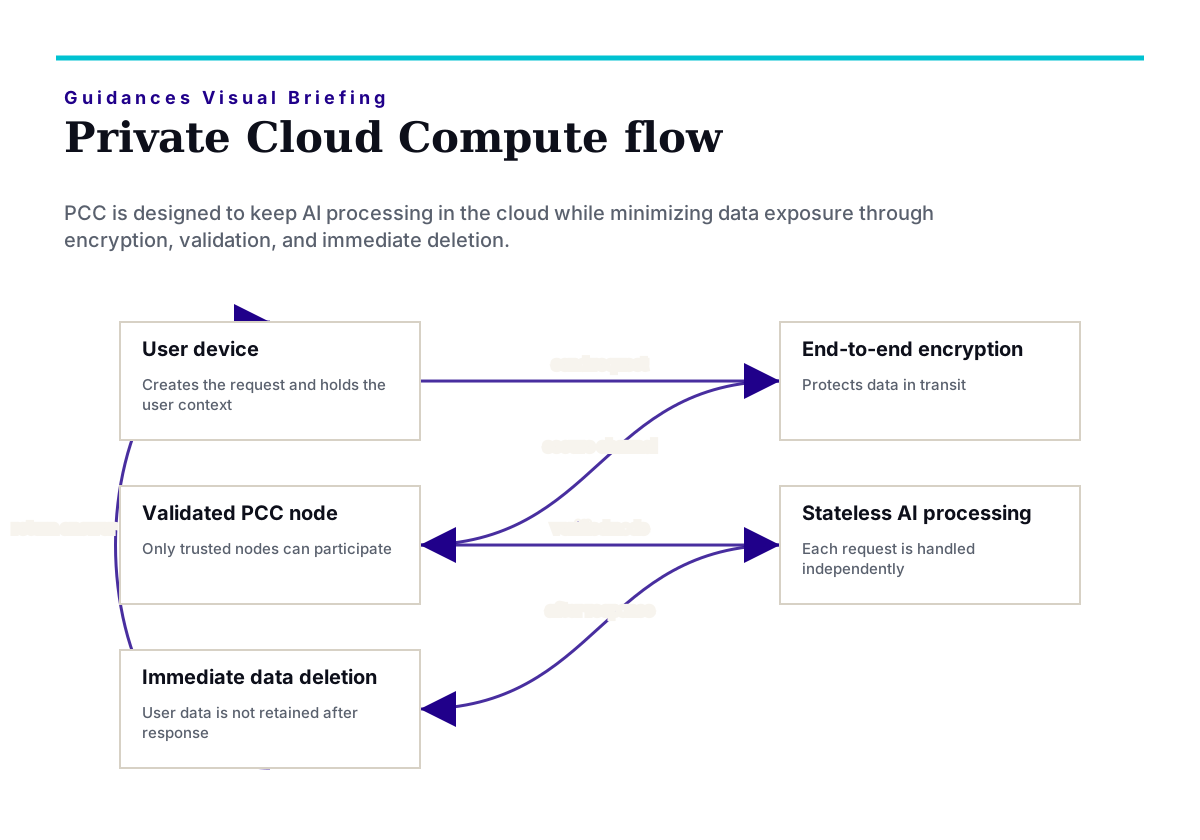
A simplified view of how Private Cloud Compute aims to combine cloud-scale AI with privacy protections.
Corrections and safety
See a factual, privacy, rights, or safety issue? Review the corrections process or contact Guidances before relying on this article for important decisions.