AI
Developing · 0 updatesFact 9/10Anthropic Puts Security Research at the Center With Project Glasswing
Anthropic has framed Claude Mythos Preview through its Project Glasswing page as a cybersecurity-oriented model for security research and selected partners. The available metadata also points to benchmark claims, but the source material is too limited to establish the model’s full scope, deployment path, or performance significance with confidence.
Open article · no sign-in required
Sources and disclosure
The article accurately describes Anthropic's Project Glasswing and Claude Mythos Preview based on the provided context. It correctly identifies the model's focus on cybersecurity research and partner access, and appropriately notes the limitations of publicly available information regarding specific benchmarks, pricing, or a general release timeline. The language is neutral and adheres to reputation safety guidelines, avoiding speculation or pejorative framing.
Market lens
Agent runtime spending can spill into security, observability, and workflow infrastructure
The market signal is not another chatbot category; it is a possible budget shift toward the control layer around enterprise AI.
Impact path
Runtime spend → infra stack
Signals to watch
- Procurement language around audit logs and cost ceilings
- Security and observability vendors attaching agent controls
- Workflow platforms exposing approval and tool-call governance
Verification schedule
D+1 · Jun 15
Do buyers repeat audit/cost-control requirements?
D+3 · Jun 17
Do vendors publish runtime-control SKUs or partnerships?
D+7 · Jun 21
Do budgets move from pilots into operating infrastructure?
Informational context only — not investment, legal, tax, or financial advice.
Anthropic has introduced Claude Mythos Preview through a page titled Project Glasswing, placing the model in a cybersecurity context rather than presenting it as a general-purpose release. Based on the available metadata, the company describes Mythos as a high-capability model oriented toward security research, with access extended to selected partners. The page also references benchmark claims, including a comparison with CTI Realm, although the limited source material does not provide enough detail to assess the test design, the scoring method, or the practical meaning of the results.
The announcement matters less as a product launch than as a signal of where the AI market is moving. The first wave of generative AI competition centered on broad conversational ability and general task performance. The next phase is increasingly about specialized workflows: code review, vulnerability analysis, incident response support, log summarization, and other security operations that require both technical depth and careful control. In that sense, Anthropic is positioning AI as infrastructure for a sensitive enterprise function.
Security is a particularly consequential category because the stakes are asymmetric. A model that helps defenders triage alerts, summarize logs, or reason about suspicious activity can create clear operational value. Yet the same domain also demands strict governance. Access control, auditability, data handling, and human oversight matter as much as raw benchmark performance. A model that appears strong in a controlled evaluation may still require substantial integration work before it can be trusted in production security environments. For buyers, the question is not only whether the model can reason well, but whether it can be embedded into a process that remains traceable and accountable.
The limited public information suggests a staged distribution strategy. Rather than a broad consumer rollout, Anthropic appears to be emphasizing research use and partner access. That approach is common in enterprise AI, especially where the model may interact with sensitive systems or proprietary data. It allows the vendor to gather feedback, refine safeguards, and observe real-world usage patterns before widening availability. For buyers, it also signals that the product is likely to be evaluated not only on capability but on governance. In practice, that means procurement teams will need to ask how access is granted, how outputs are reviewed, and how the model fits into existing security operations.
The benchmark reference should be treated carefully. Without details on the dataset, baseline configuration, scoring method, or reproducibility, the claim is best understood as directional rather than definitive. In AI procurement, especially in security, benchmark leadership is only one input. Buyers will also ask whether the model reduces false positives, how it handles ambiguous cases, whether outputs can be audited, and how it integrates with existing security information and event management systems, ticketing tools, and analyst workflows. Those questions often determine whether a promising model becomes a useful product. A model that looks strong in a controlled test may still fail to deliver value if it cannot fit into the operational rhythm of a security team.
This is also a market signal. AI vendors are increasingly competing in verticals where budgets are real and use cases are concrete. Security is one of the clearest examples because enterprises already spend heavily on tooling and personnel, and because the promise of automation is easy to articulate. For model providers, that creates an opportunity to sell not just intelligence, but controlled intelligence: systems that can be constrained, monitored, and embedded into enterprise processes. The commercial logic is straightforward, but the execution burden is high. Vendors must prove that their systems can operate within policy boundaries, support review, and preserve evidence for later analysis.
There are, however, important uncertainties. The source metadata does not reveal the model’s exact capabilities, pricing, geographic availability, partner criteria, or release timeline. It is therefore premature to read the page as evidence of a near-term public launch. It is safer to interpret Project Glasswing as a strategic preview: a way for Anthropic to frame its model work around security research and to test how the market responds to a more specialized AI offering. That framing matters because it suggests a product category that is narrower than a general assistant but potentially more valuable in enterprise settings where control is a requirement rather than a preference.
For developers and operators, the practical lesson is that AI evaluation is becoming more domain-specific. A model that performs well in general conversation may not be suitable for security operations, where traceability and control are essential. Conversely, a model designed for security research may create value only if teams redesign workflows around it. That means integration work, policy design, and human review are not peripheral tasks; they are part of the product itself. The competitive frontier is shifting from raw capability to deployable capability, and that distinction will matter increasingly across enterprise software.
In short, Anthropic’s Project Glasswing page points to a broader transition in AI: from general-purpose assistants toward tightly governed systems for critical work. Security is one of the first arenas where that transition is becoming visible, and it is likely to shape how vendors, buyers, and regulators think about model deployment in the months ahead.
Builder Implications
- Security-focused AI products should be evaluated on governance features, not only model quality: audit logs, access controls, and review workflows matter.
- Partner-only or limited-access launches usually indicate a validation phase, so teams should plan for integration work before expecting broad availability.
- Founders building in enterprise AI should treat domain-specific deployment as a product requirement, since operational fit can matter more than benchmark leadership.
Want follow-up alerts? Subscribe by email after reading the public article.
Market lens
Agent runtime spending can spill into security, observability, and workflow infrastructure
The market signal is not another chatbot category; it is a possible budget shift toward the control layer around enterprise AI.
Impact path
Runtime spend → infra stack
Signals to watch
- Procurement language around audit logs and cost ceilings
- Security and observability vendors attaching agent controls
- Workflow platforms exposing approval and tool-call governance
Verification schedule
D+1 · Jun 15
Do buyers repeat audit/cost-control requirements?
D+3 · Jun 17
Do vendors publish runtime-control SKUs or partnerships?
D+7 · Jun 21
Do budgets move from pilots into operating infrastructure?
Informational context only — not investment, legal, tax, or financial advice.
Visual Briefing
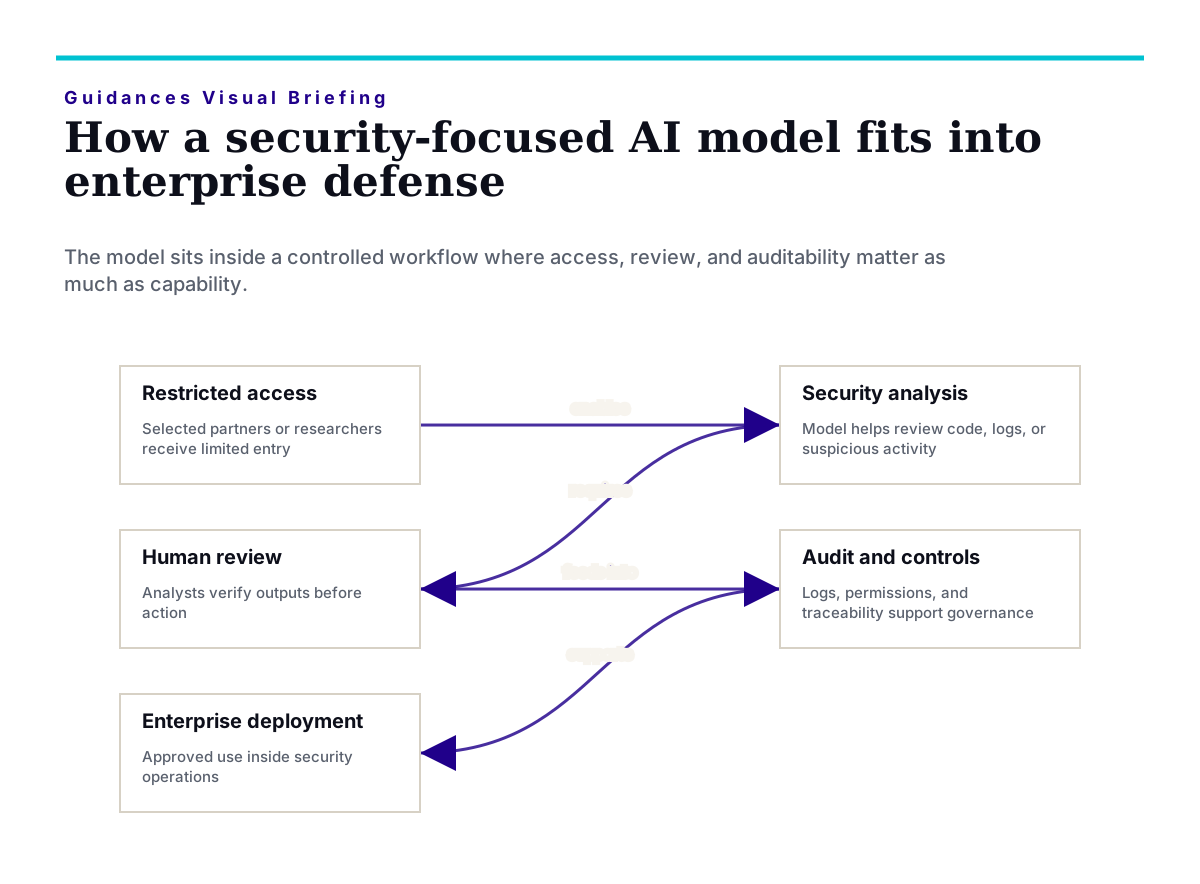
A limited-access AI model can support security work only when it is wrapped in review and governance.
Corrections and safety
See a factual, privacy, rights, or safety issue? Review the corrections process or contact Guidances before relying on this article for important decisions.