Policy
Ongoing · 1 updateFact 9/10Anthropic reiterates preference for a federal AI framework over state-by-state rules
Anthropic has restated its view that the social effects of AI should be addressed through policy design and that a single federal standard is preferable to a fragmented set of state rules. The message highlights how predictability and consistency can influence product design, compliance costs, market expansion, and infrastructure investment.
Open article · no sign-in required
Sources and disclosure
The article accurately reflects Anthropic's stated position regarding a federal AI framework, which is directly supported by multiple official statements from Anthropic. The article's elaborations on the benefits of consistency and predictability for the industry are logical extensions of Anthropic's preference for a uniform standard. The language used is neutral and adheres to reputation safety guidelines.
Market lens
AI governance becomes an operating checklist buyers can audit
The market effect depends on whether policy language turns into required logs, evaluations, incident-response records, and launch gates.
Impact path
Policy memo → ops checklist
Signals to watch
- Draft rules specifying retention or audit evidence
- Enterprise RFPs requiring AI operation logs
- Product launches centered on governance workflows
Verification schedule
D+1 · Jun 15
Do rules move from principles into required artifacts?
D+3 · Jun 17
Do RFPs ask for evidence before model benchmarks?
D+7 · Jun 21
Do vendors ship audit workflows as core product?
Informational context only — not investment, legal, tax, or financial advice.
What happened
Anthropic has restated a long-held view: the social effects of artificial intelligence should be governed primarily through policy design, not political theater, and the United States would be better served by a single federal framework than by a patchwork of state-level rules. The statement is notable less for introducing a new product or commercial initiative than for clarifying how one of the most prominent AI companies wants the regulatory map to look.
That distinction matters because regulation in AI is not a peripheral issue. It shapes how models are trained, evaluated, deployed, and sold. It also influences how much a company must spend on compliance, legal review, documentation, monitoring, and customer assurances. When rules differ across states, firms may need to build multiple operating modes or default to the strictest standard across the country. A federal framework, by contrast, can reduce fragmentation and make product planning more predictable.
The company’s position should therefore be read as a statement about operating conditions as much as about public policy. Anthropic is not merely saying that AI should be regulated. It is saying that the form of regulation will determine whether the industry can scale with manageable friction or whether it will face a rising burden of jurisdiction-specific adaptation. For developers and founders, that is not an abstract constitutional question. It is a question about how quickly a product can move from prototype to national deployment without being re-engineered for each market.
Why it matters
For AI developers and founders, the structure of regulation can be as important as its substance. A uniform federal regime would likely simplify market access for startups and large vendors alike. It could reduce duplicated legal work, lower the cost of compliance tooling, and make it easier to ship products nationally without redesigning them for each jurisdiction. Enterprise buyers, in turn, often prefer vendors that can demonstrate consistent controls across the full U.S. market.
At the same time, a federal approach does not necessarily mean lighter oversight. It may instead mean clearer expectations. That can raise the bar for internal governance, testing, recordkeeping, and incident response. In practice, companies often find that predictability is valuable even when the rules are demanding, because it allows them to plan investment and staffing with less uncertainty. For infrastructure providers, too, a stable rule set can support longer-term decisions on data centers, model evaluation systems, and security layers.
Anthropic’s position therefore speaks to a broader industry calculation. The central question is not only how strict AI rules should be, but whether the United States will allow a fragmented compliance environment to persist. If state-by-state divergence continues, the cost of operating nationally may rise, especially for smaller firms that lack large legal and policy teams. If a federal standard emerges, the competitive field may shift toward execution, reliability, and the ability to operationalize governance at scale.
There is also a market-design dimension. Fragmented rules can create a de facto advantage for firms with the largest compliance budgets, even when the underlying technology is similar. That can slow entry for smaller companies and narrow the range of products that reach customers. A federal baseline would not eliminate compliance costs, but it could make them more legible and more evenly distributed. In a sector where speed and iteration matter, that difference can influence which companies survive the transition from experimentation to durable business.
Operating implications
The practical implications are immediate for builders. Product teams can no longer treat policy as an external afterthought. Model evaluation, data provenance, user disclosures, logging, and usage restrictions increasingly need to be designed alongside core features. The more formal the regulatory environment becomes, the more these controls move from optional safeguards to standard product requirements.
Founders should also expect procurement scrutiny to deepen. Enterprise customers are likely to ask not only whether a model performs well, but how the vendor handles safety testing, documentation, and policy compliance. That can advantage companies that invest early in governance infrastructure, even if such work does not directly improve benchmark scores. In a market where trust is becoming a commercial feature, operational maturity can be a differentiator.
There is also a capital-allocation angle. A more predictable federal framework could encourage investment in adjacent layers of the AI stack: evaluation tools, monitoring systems, security products, and compute infrastructure. Conversely, a fragmented regulatory landscape may slow deployment and push companies to be more conservative about geographic expansion. For investors, the policy environment is increasingly part of the infrastructure thesis.
For operators, the lesson is that compliance architecture should be built as a reusable system rather than a series of one-off responses. Teams that create common controls for logging, red-teaming, access management, and incident review will be better positioned whether the eventual rule set is federal, state-based, or hybrid. That is particularly important for companies selling into regulated industries, where procurement teams often require evidence of process, not only claims about model quality.
Constraints and uncertainty
The limits of this development should be kept in view. Anthropic has stated a position, not announced a law or a binding rule. The United States remains a complex policy environment in which Congress, federal agencies, state governments, and industry groups all shape outcomes. A federal framework may be desirable to many firms, but the path to one is uncertain, and the eventual content of such a framework could vary widely.
It is also unclear whether future rules will emphasize safety, competition, consumer protection, transparency, or some combination of these goals. Each version would create different operational burdens. A safety-first regime may require more testing and documentation; a lighter-touch regime may reduce friction but leave more ambiguity for companies trying to scale. For now, the main takeaway is not a settled policy outcome, but the direction of industry preference: large AI developers increasingly want clarity, consistency, and national scope.
That preference is understandable. AI companies are building products that cross state lines by default. Their users, data flows, and customers are national or global. Regulation that remains local in design may prove difficult to administer in a market that is not. Anthropic’s statement is therefore best read as a call for regulatory coherence in an industry where fragmentation can quickly become an operating cost.
The remaining uncertainty is practical rather than rhetorical. Even if federal lawmakers eventually move toward a national framework, the transition period could be lengthy, and state rules may continue to shape behavior in the meantime. Builders should therefore avoid assuming that one policy signal will settle the matter. The more prudent approach is to design systems that can absorb stricter requirements without major redesign, while preserving enough flexibility to adapt if the final framework differs from current expectations.
Builder Implications
- Build governance, evaluation, and documentation into the product stack early; policy requirements are becoming part of core engineering.
- Prepare for a dual-track compliance strategy: monitor state rules now, but design systems that can scale to a federal baseline later.
- Expect enterprise buyers to weigh safety controls and policy readiness alongside model quality when selecting vendors.
Want follow-up alerts? Subscribe by email after reading the public article.
Market lens
AI governance becomes an operating checklist buyers can audit
The market effect depends on whether policy language turns into required logs, evaluations, incident-response records, and launch gates.
Impact path
Policy memo → ops checklist
Signals to watch
- Draft rules specifying retention or audit evidence
- Enterprise RFPs requiring AI operation logs
- Product launches centered on governance workflows
Verification schedule
D+1 · Jun 15
Do rules move from principles into required artifacts?
D+3 · Jun 17
Do RFPs ask for evidence before model benchmarks?
D+7 · Jun 21
Do vendors ship audit workflows as core product?
Informational context only — not investment, legal, tax, or financial advice.
Visual Briefing
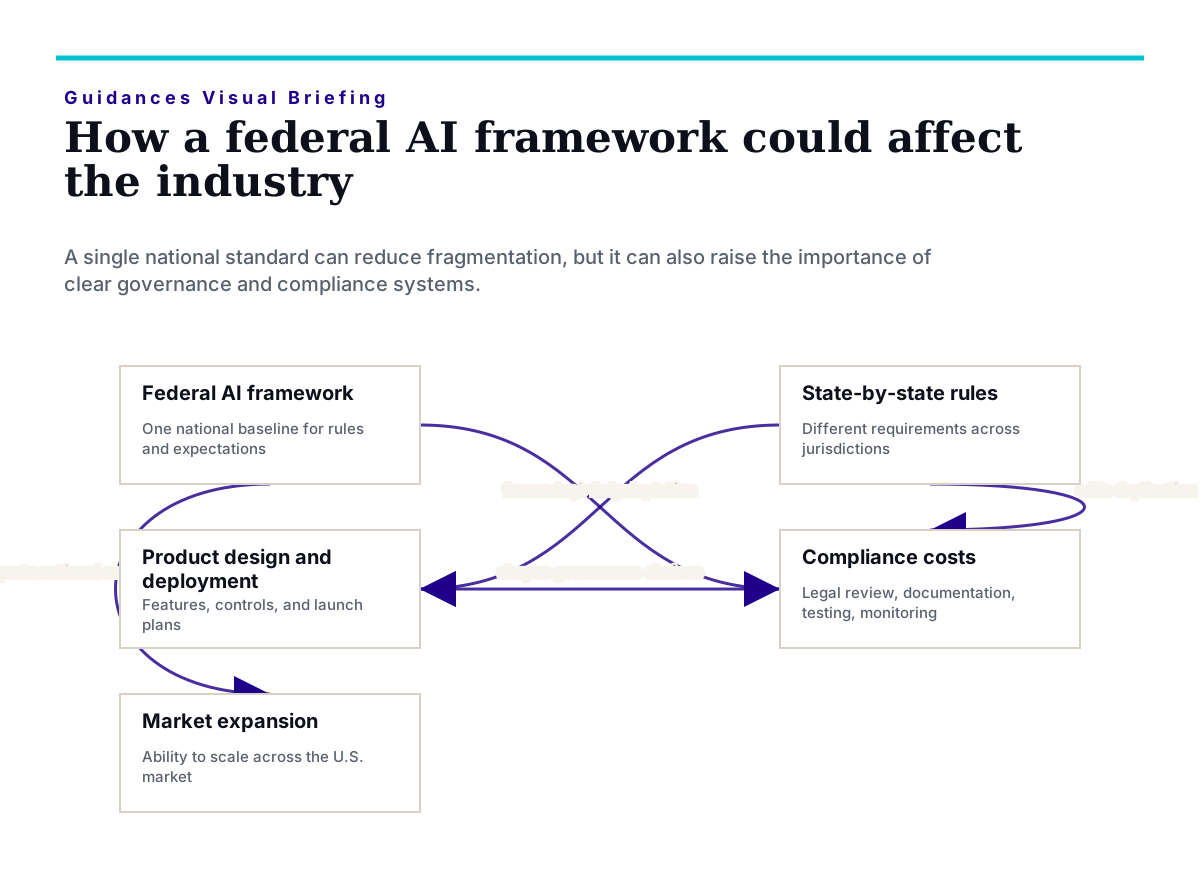
The diagram shows why AI companies often prefer a single federal standard: it can simplify operations, while still requiring stronger internal controls.
Corrections and safety
See a factual, privacy, rights, or safety issue? Review the corrections process or contact Guidances before relying on this article for important decisions.