What Happened
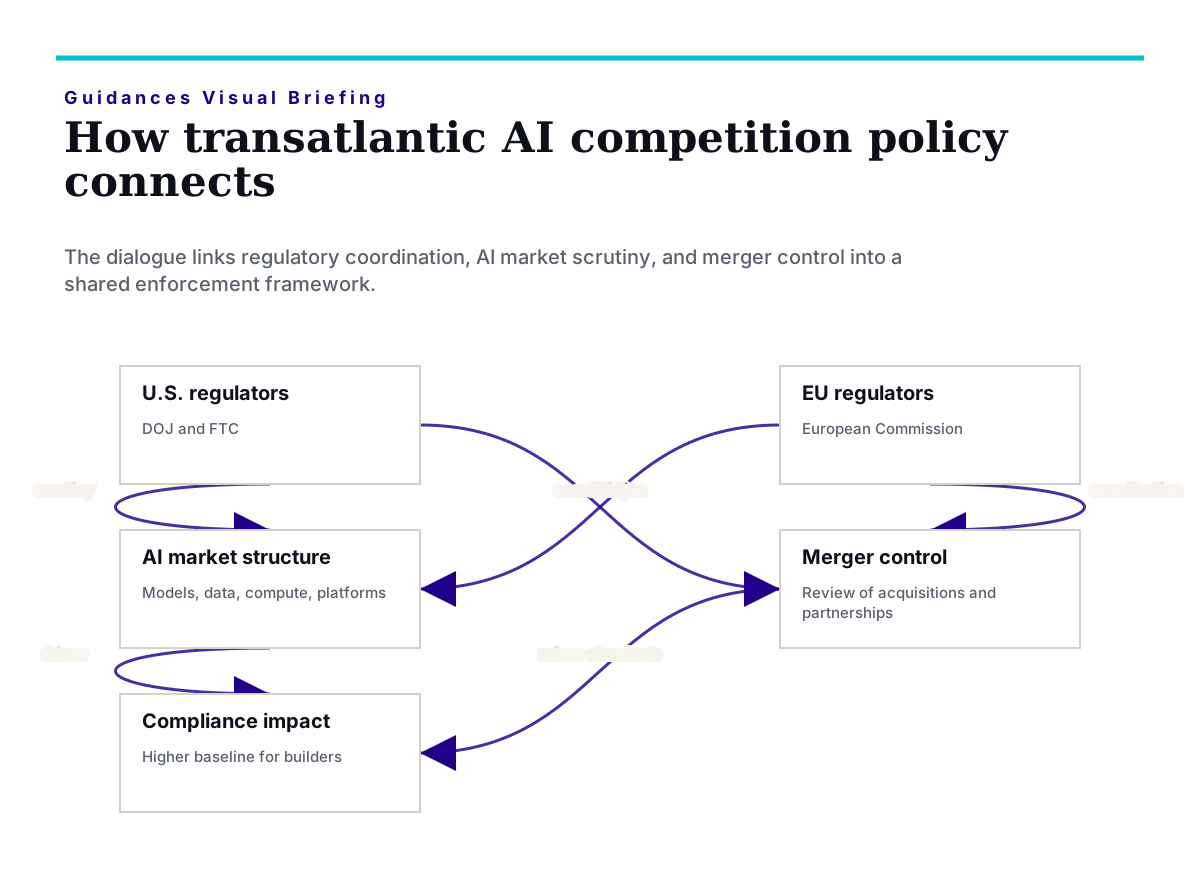
On or around September 1, 2024, senior officials from the U.S. Department of Justice (DOJ), the Federal Trade Commission (FTC), and the European Commission gathered for the fourth iteration of the U.S.-EU Joint Technology Competition Policy Dialogue. According to the official DOJ press release, the agenda centered on three interlocking themes: fair competition in the digital economy broadly, the competitive issues posed by artificial intelligence, and the application of merger control frameworks to transactions occurring within digitalized markets.
This article is based on a September 2024 source, now approximately 658 days old as of the current date of June 21, 2026. The source's age is explicitly noted in accordance with editorial policy. Its continued relevance is explained below.
Why the Market Cares
The U.S.-EU Joint Technology Competition Policy Dialogue is not a ceremonial forum. It is a structured channel through which the two largest regulatory jurisdictions in the global technology economy coordinate enforcement approaches, share investigative intelligence within legal limits, and signal to markets which competitive behaviors are likely to attract scrutiny. Each successive round has historically been discussed alongside enforcement developments on both sides of the Atlantic.
The fourth round's explicit focus on AI competition is significant because it was one of the early formal, bilateral acknowledgments at the senior regulatory level that AI-specific market dynamics—including foundation model concentration, access to training data, compute infrastructure dependencies, and the bundling of AI capabilities within dominant platform ecosystems—may require dedicated antitrust review. That framing has since become one of the reference points regulators in both jurisdictions use when examining AI market structure.
By mid-2026, the enforcement environment that this dialogue helped shape is continuing to evolve. The European Union's AI Act has entered its phased implementation schedule. The European Commission's Digital Markets Act is actively designating and imposing obligations on gatekeepers. In the United States, the DOJ and FTC have reviewed or expanded review of AI partnerships, cloud bundling, and foundation model access. The September 2024 dialogue can be viewed as one point in the broader expansion of transatlantic AI antitrust discussion.
Technology and Policy Linkage
The three substantive areas discussed at the fourth dialogue map directly onto some of the most contested regulatory questions in AI infrastructure today.
Fair competition in the digital economy encompasses the question of whether dominant platform operators use their control over distribution, data, and developer ecosystems to affect competition from AI-native challengers. This includes app store policies, default settings, API access terms, and the presentation of AI features within search, productivity, and cloud environments.
AI-specific competitive issues represent the newer and more technically complex dimension. Regulators on both sides of the Atlantic have been examining whether concentration in foundation model development—driven by the capital requirements for pre-training large language models—creates structural barriers that may not be fully addressed through traditional merger review alone. The compute layer, influenced by a small number of chip designers and cloud providers, adds a further dimension: access to inference and training infrastructure can itself be a competitive variable.
Merger control in digitalized economies reflects the recognition that standard revenue- and market-share-based thresholds for triggering merger review may be insufficient when the most competitively significant acquisitions involve companies with limited current revenue but substantial data assets, talent pools, or technology capabilities. The acquisition of AI startups by large platform operators has been a recurring subject of regulatory review in both jurisdictions.
The dialogue format itself is a policy instrument. When the DOJ, FTC, and European Commission align on analytical frameworks—even informally—it reduces the probability of regulatory arbitrage, where a company structures a transaction or a product architecture to exploit divergence between U.S. and EU standards. For AI platform operators, transatlantic regulatory convergence can raise the compliance floor across the board.
Market Lens
Trigger: The fourth U.S.-EU Joint Technology Competition Policy Dialogue, held in September 2024, formalized bilateral coordination on AI antitrust and digital merger control.
Mechanism: Regulatory coordination between the two largest enforcement jurisdictions reduces the scope for jurisdictional arbitrage. When both the DOJ/FTC and the European Commission apply similar analytical frameworks to AI market structure, the likelihood of enforcement review against dominant platform behaviors may increase, and the cost of compliance may rise for operators across both markets. This mechanism operates over a medium-to-long time horizon, as enforcement actions typically follow investigative periods of one to three years.
Affected sectors: Cloud infrastructure providers, foundation model developers, AI application platform operators, and semiconductor companies with important roles in AI compute are the sectors most directly exposed to the regulatory framework this dialogue reinforces. Broader digital advertising, search, and productivity software markets are also within scope given the digital economy framing.
Time horizon: Medium-term, 12 to 36 months from the dialogue date, aligning with the 2025–2027 enforcement cycle.
Next check: Concrete enforcement milestones to monitor include European Commission gatekeeper designation updates under the Digital Markets Act, DOJ and FTC filing activity in AI-adjacent merger reviews, any published joint statements or follow-on dialogue announcements from the DOJ or FTC, and the European Commission's AI Act compliance deadlines for high-risk system providers.
This section is market context only and does not constitute investment advice.
Unverified link: The source does not directly report any specific company investigation, stock price movement, or named enforcement action. Any connection between this dialogue and specific company outcomes remains unverified at the level of this source.
What to Watch Next
Several developments in 2025 and 2026 have given the September 2024 dialogue renewed analytical relevance. First, the pace of AI-related merger and partnership reviews has accelerated in both jurisdictions, with regulators examining not only outright acquisitions but also commercial partnership structures that may confer effective control without triggering traditional merger thresholds. Second, the compute concentration question—whether a small number of chip and cloud providers constitute a bottleneck that requires regulatory review—has moved from academic discussion to active policy consideration. Third, the question of data access for AI training, including whether dominant platforms must provide interoperability or data portability to competing AI developers, is now on the legislative agenda in the EU and under informal review in the United States.
A fifth round of the U.S.-EU Joint Technology Competition Policy Dialogue, if convened, would be a significant signal of continued coordination momentum. The absence of a publicly announced fifth round as of the current date is itself a data point worth monitoring.
Uncertainty and Constraints
The source available for this analysis is a DOJ press release snippet, not the full text of any joint statement or working document. The specific positions taken by each delegation, the degree of agreement or divergence on AI-specific questions, and any concrete follow-on commitments are not available from the snippet alone. Analysis of the dialogue's content therefore includes inference grounded in the publicly stated agenda items and the broader regulatory context observable from other official sources.
Additionally, the political and institutional context for U.S. antitrust enforcement has shifted since September 2024. Changes in FTC and DOJ leadership, shifts in enforcement priorities, and evolving U.S. trade policy toward the EU all introduce uncertainty about the degree to which the coordination framework established through this dialogue remains operationally active in mid-2026.