What happened
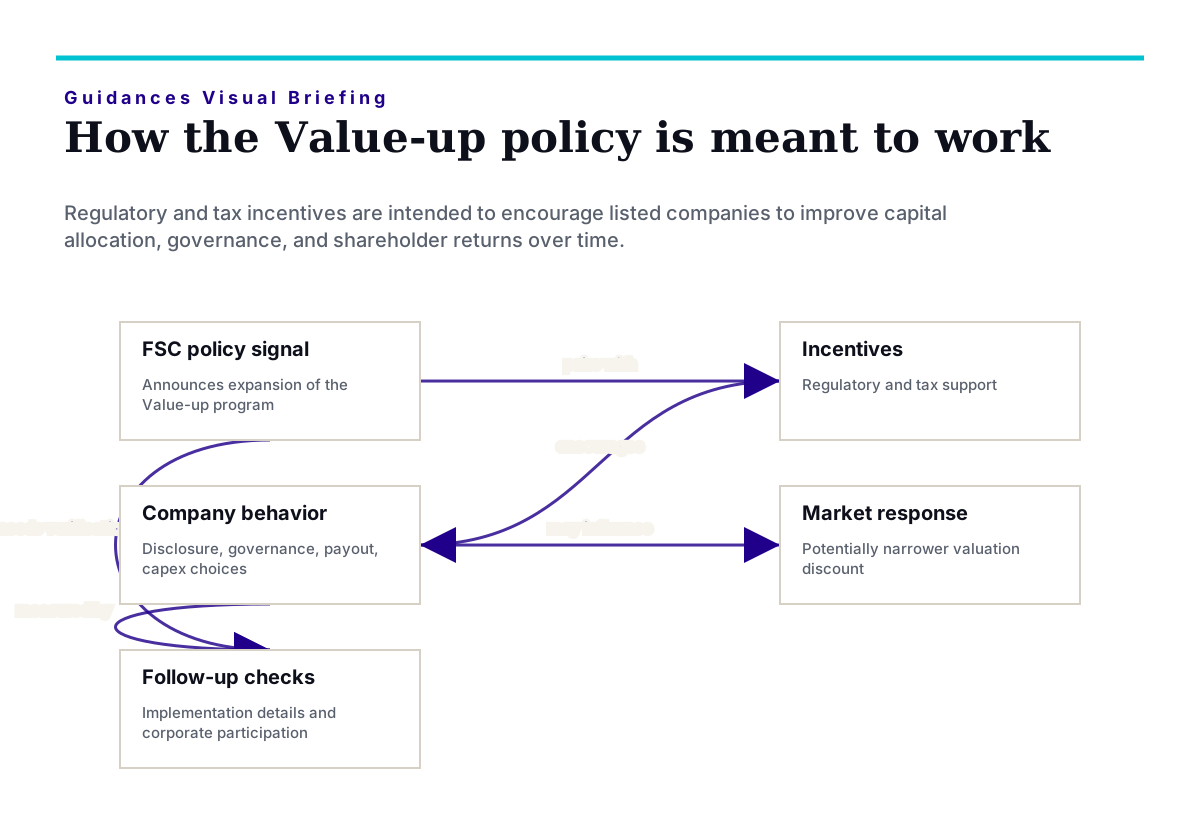
South Korea’s Financial Services Commission has said it intends to broaden the Corporate Value-up Program. The official signal is straightforward: the regulator wants listed companies to improve capital efficiency, governance practices, and shareholder returns, and it plans to support that effort with both regulatory and tax incentives. That combination matters. A disclosure-led framework can encourage companies to talk about reform; an incentive-linked framework is meant to make reform harder to ignore.
The source is thin, so the safest reading is also the most useful one. This is not a fully specified rulebook. It is a policy direction, announced by the agency that oversees market conduct and disclosure, aimed at changing how listed Korean companies use capital. The program sits inside a broader and long-running debate about the valuation gap in Korean equities, often described as the Korea discount. The policy is therefore less about a single announcement than about whether the state can move corporate behavior from passive acknowledgment to measurable action.
There is also a date caveat. The search provider supplied an unverified publication date of 2024-05-28, but that date is not verified on the source page metadata available here. It should not be treated as the canonical publication date. Even so, the item still deserves attention today because the underlying issue has not gone away. Corporate governance, payout policy, and capital allocation remain live variables for Korean public markets, and any official move to deepen the incentive structure can still affect how operators, investors, and policy watchers frame the next round of disclosures.
Why the market cares
The market cares because this is a policy attempt to influence valuation through behavior, not just through messaging. In public markets, capital efficiency is not an abstract virtue. It is the bridge between earnings power and how investors assign value to that earnings power. If companies retain too much cash, keep payout ratios low, or leave governance structures opaque, the market often applies a discount. If companies show clearer capital discipline, the discount can narrow over time.
That is why the FSC’s choice to pair incentives with the Value-up Program matters. It suggests the regulator is trying to move beyond voluntary encouragement. The policy logic is that listed companies may respond more quickly if there is a tangible benefit attached to better disclosure, stronger governance, or more disciplined capital use. For investors, the question is not whether the policy sounds constructive. The question is whether it changes the behavior of companies that matter most to the index.
The relevance extends beyond a narrow governance debate. Korean equities are heavily shaped by large industrial, financial, and technology groups. When policy changes affect how those firms allocate capital, the implications can reach index composition, foreign investor appetite, and the relative attractiveness of Korean listings versus other Asian markets. That does not mean the announcement itself creates a market move. It means the announcement changes the policy backdrop against which future corporate decisions will be judged.
Tech / policy link
The technology link is indirect but important. Korea’s large listed technology and manufacturing companies sit inside global supply chains for semiconductors, displays, batteries, and AI infrastructure. If the Value-up framework encourages better capital allocation, some firms may be more willing to redirect resources toward productive investment, strategic restructuring, or clearer shareholder-return policies. That can matter for suppliers, customers, and partners that depend on Korean industrial capacity.
For AI operators and founders, the practical point is not to read this as a stock story. It is to recognize that governance policy can shape the operating environment of major Korean counterparties. A supplier with clearer capital discipline may be easier to diligence. A strategic investor with more transparent governance may be easier to partner with. A listed customer that is under pressure to improve capital efficiency may adjust procurement, capex, or partnership timing.
There is also a policy-design angle. By linking incentives to corporate behavior, the FSC is implicitly acknowledging that disclosure alone may not be enough. That is a useful signal for anyone building in or around regulated markets. It suggests that future policy in Korea may continue to favor frameworks that reward measurable action rather than broad statements of intent. For builders, that means compliance, reporting, and governance tooling may remain relevant product categories.
Market Lens
Trigger: The FSC’s formal plan to expand the Corporate Value-up Program with regulatory and tax incentives.
Mechanism: Incentives tied to governance and capital-efficiency improvements → stronger pressure on listed companies to adjust payout, disclosure, and capital-allocation behavior → possible reduction in the structural valuation gap applied to Korean equities.
Affected assets and sectors: Korean listed equities broadly, with the clearest relevance for large-cap financials, industrials, and technology names that dominate the KOSPI. Index-linked products and Korea-focused funds could also be affected indirectly if the policy changes foreign investor perception. Any direct asset-price link remains unverified from the source alone.
Time horizon: Medium to long term. Policy announcements can shift sentiment quickly, but actual corporate behavior usually changes over several reporting cycles. Tax measures, in particular, require implementation steps that can take time.
Next check: Official FSC implementation details, Ministry of Economy and Finance tax-legislation timing, Korea Exchange disclosure participation data, and subsequent earnings or annual-report language from major listed companies. Those are the points at which the policy can be tested against behavior.
This is market context only, not investment advice.
What to watch next
The first thing to watch is whether the FSC publishes concrete criteria. The difference between a broad policy signal and an operational program is material. Companies need to know what qualifies, what is rewarded, and what is merely encouraged. Without that, participation may remain symbolic.
The second check is legislative. If tax incentives are part of the design, the Ministry of Economy and Finance and the National Assembly become central to the timeline. A policy that depends on tax treatment cannot be evaluated only through regulator statements. The legal path matters.
The third check is corporate response. The most informative evidence will come from listed companies that file Value-up plans with specific commitments. Investors and operators should look for details on payout policy, share repurchases, board structure, and capital deployment. Broad language will be less informative than measurable targets.
The fourth check is whether the policy reaches the companies that shape the market. If only smaller or already well-governed firms participate, the macro effect may be limited. If major technology, industrial, or financial groups engage meaningfully, the policy could have a larger read-through for index valuation and foreign capital flows.
Uncertainty and constraints
The source does not provide enough detail to infer the exact tax mechanism, the eligibility rules, or the enforcement model. That is a meaningful limitation. A policy can be directionally important while still being operationally vague. Until the implementation text is visible, it is not possible to say how strong the incentive will be or how broad the coverage may become.
There is also a broader constraint: governance reform is slow. Even when policy is well designed, corporate behavior changes only gradually. Boards, controlling shareholders, and management teams often adjust in stages. That means the market may see a long period in which the policy is discussed more than it is reflected in financial outcomes. For that reason, the next official documents matter more than the initial announcement.