What Happened
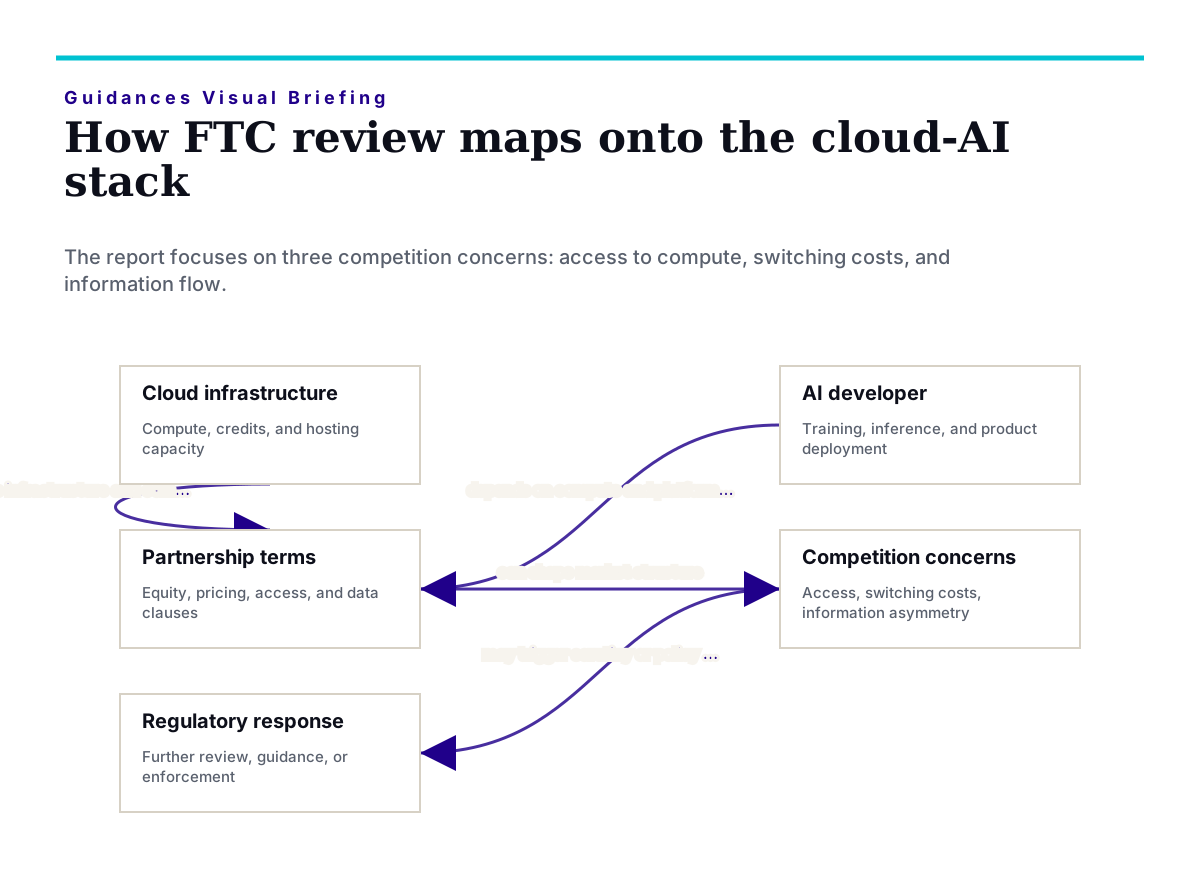
The U.S. Federal Trade Commission published a staff report under its Section 6(b) authority examining the nature and competitive implications of large-scale partnerships and investment relationships between major cloud service providers and AI developers. The report—sourced from the FTC's official policy and research channel—focuses on three interlocking issues: whether these arrangements affect access to compute infrastructure, whether they may increase switching costs for AI developers, and whether they may affect information flows relevant to competition.
Note on source recency: The FTC report was published in January 2025, according to the URL path metadata. Although this predates the current analysis date of June 2026 by approximately 17 months, the report remains relevant because cloud-AI co-investment, preferential compute allocation, and data-sharing provisions continue to be discussed in policy and market contexts.
Why the Market Cares
The FTC's 6(b) authority is a compulsory information-gathering power that allows the agency to request detailed operational and financial data from companies without initiating a formal enforcement action. Reports produced under this authority can serve as reference material for later investigations, Congressional review, and international regulatory discussions.
In the AI infrastructure sector, a small number of hyperscale cloud providers account for a substantial share of the compute layer. When a cloud provider takes an equity stake in, or forms a deep commercial partnership with, an AI developer, the arrangement can include compute credits, model access, data pipelines, and go-to-market support. The FTC report treats this type of combination as a competition-related issue.
Switching costs are another focal point. AI workloads are not fully interchangeable across cloud environments. Training runs often depend on specific hardware configurations, networking topologies, and software stacks. Once a developer has invested significant engineering resources in a given cloud environment, migration can involve direct costs and potential delays in development. The FTC's analysis suggests that these costs may vary depending on partnership terms.
The third issue is sensitive information flows. When a cloud provider hosts an AI developer's workloads while also holding an equity relationship, it may be positioned to observe operational information related to training data characteristics, model architecture choices, inference traffic patterns, and customer usage data. The report examines what this structure may mean for competition-related information flows.
Technology and Policy Linkage
The FTC report sits alongside two policy trends that have continued since its January 2025 publication. The first is the international expansion of antitrust review around AI infrastructure. Regulators in the United Kingdom, the European Union, and parts of the Asia-Pacific region are examining cloud-AI combinations, and the FTC's analytical categories—compute concentration, switching costs, and information asymmetry—appear in multiple documents.
The second is the U.S. legislative environment. As Congressional interest in AI market structure has increased, bills have been proposed that address interoperability requirements, certain forms of equity co-investment, and data portability for AI workloads. The FTC report functions as one of the empirical references in those discussions.
For technology operators, compliance posture is becoming an important variable. Companies that document workload portability, maintain multi-cloud or hybrid architectures, and review information-sharing clauses are better positioned to respond to future regulatory developments.
Market Lens
Trigger: The FTC's formal documentation of competition-related issues in cloud-AI partnerships establishes a reference point for later investigations and policy discussions.
Mechanism: If regulators move into additional investigation or enforcement, or if legislation introduces interoperability requirements or investment-related limits, the economics of cloud-AI combinations could change. Preferential pricing, information-sharing clauses, and compute-credit structures could be revisited.
Affected sectors: Cloud infrastructure providers, AI model developers with close cloud partnerships, semiconductor companies linked to data-center GPU demand, and enterprise software vendors that rely on specific cloud integrations may all be affected. Independent cloud operators and AI infrastructure startups could also see changes in competitive conditions if structural remedies are considered.
Time horizon: Regulatory processes of this type typically unfold over several years. The 6(b) report is an early-stage document, and any formal enforcement action would likely require additional review. Near-term effects are more likely to appear through uncertainty and strategic adjustments.
Next check: Watch for FTC enforcement filings, Congressional consideration of AI competition bills, the UK Competition and Markets Authority's final reports on cloud and AI, EU enforcement decisions, and earnings calls from major cloud providers that discuss partnership economics or compute pricing structures. This analysis is market context only and does not constitute investment advice.
Unverified links: Without current market data, specific price movements or valuation changes cannot be directly tied to this report.
What to Watch Next
Whether the FTC's analytical framework leads to enforceable obligations will depend on several developments. First, the agency's future actions—whether litigation, consent orders, or rulemaking—will shape the outcome. Second, the pace of international regulatory convergence matters: if the EU or UK adopt structural measures first, companies operating in those jurisdictions will need to review their compliance obligations. Third, the response of the companies under review is also relevant. Voluntary interoperability commitments, revised partnership terms, or restructured equity arrangements could influence the policy discussion.
For AI developers currently reviewing cloud partnerships, it is useful to compare the report's issues with the terms of proposed agreements.
Uncertainty and Constraints
The source for this analysis is a snippet from the FTC's official website, supplemented by URL path metadata indicating a January 2025 publication date. The full text of the report is not available within the source material provided, which means specific quantitative findings, named companies, and detailed recommendations cited in the report cannot be independently verified from this analysis. Readers should consult the primary FTC document directly for evidentiary detail.