What Happened
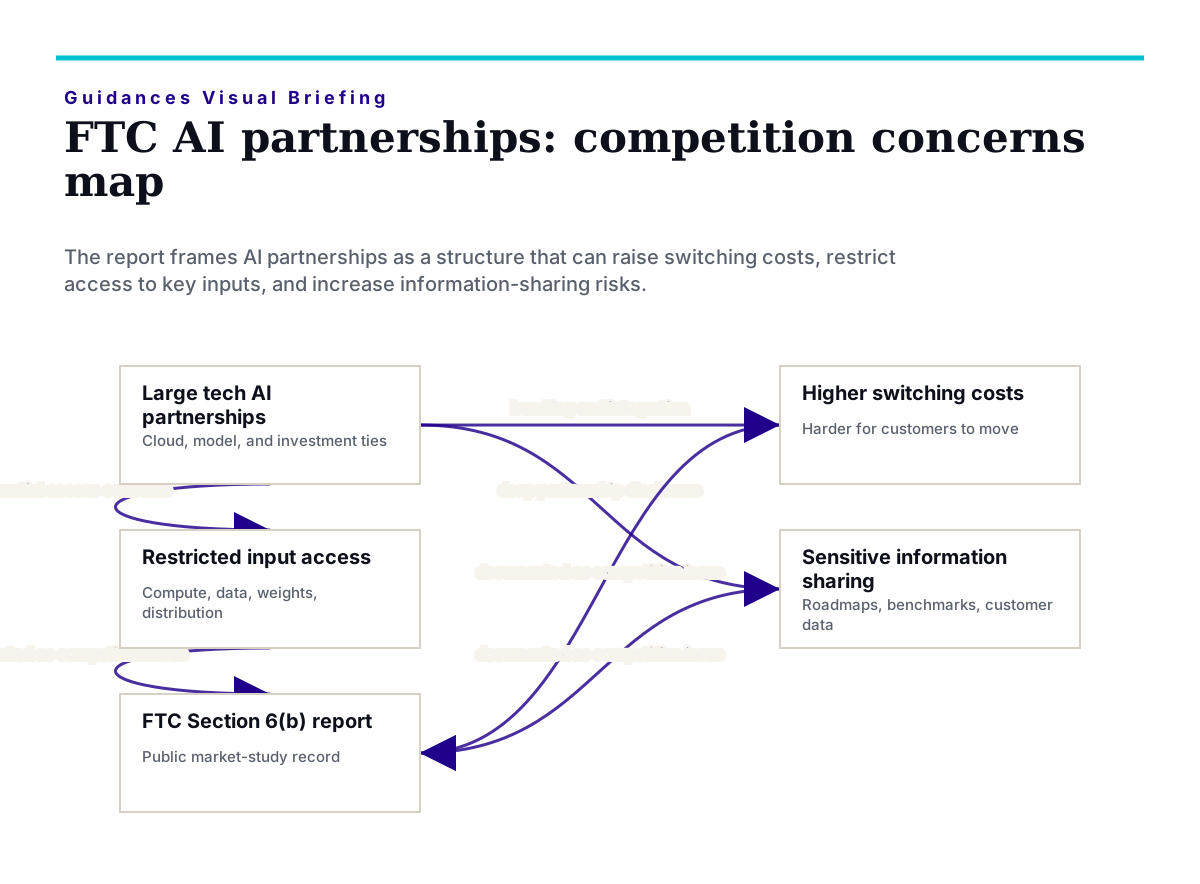
The U.S. Federal Trade Commission released a staff report in January 2025 examining AI partnerships and investments among large technology companies. The study was conducted under the agency's Section 6(b) authority, which grants the FTC broad power to compel detailed business information from companies for market-study purposes without requiring an active enforcement proceeding. According to the snippet from the official FTC press release, the report identifies three principal concerns: that major technology companies' AI alliances may increase customer switching costs, that they may make access to key AI inputs more difficult for startups, and that they may involve the sharing of sensitive competitive information through the structure of the partnerships themselves.
This is a primary official source. The analysis below is grounded in the snippet and the publicly available regulatory context of Section 6(b) studies; it does not extend to the full report text, which was not available for direct review.
Why the Market Cares
The FTC's Section 6(b) authority is not a passive research tool. Historically, staff reports produced under this authority have been used as reference material for later rulemaking, enforcement actions, or Congressional referrals. The three concerns the report identifies—switching costs, input access, and information-sharing risk—map onto structural features of the current AI industry that investors, operators, and founders are already navigating.
Switching costs in AI contexts can be more layered than in traditional software. When a hyperscaler bundles proprietary foundation models with compute credits, data pipelines, fine-tuning tooling, and enterprise support contracts, the switching cost is not merely contractual—it is also architectural. Enterprises that build workflows on a specific model API, store embeddings in a proprietary vector database, or integrate agents with a cloud-native orchestration layer may face higher migration costs. The FTC's framing of this as a competition concern indicates that regulators are examining these bundles closely.
Input access is the more structurally significant concern for the startup ecosystem. The key AI inputs at issue can include compute (GPU clusters and TPU access), proprietary training data, foundation model weights, and distribution channels such as cloud marketplaces and enterprise sales relationships. If large incumbents preferentially allocate these inputs to affiliated or invested entities—or structure partnership terms that make independent access difficult—the competitive dynamics of the AI layer can shift toward incumbents. This is the mechanism that regulators in the EU, UK, and now the U.S. have been examining in parallel, suggesting a convergent international regulatory posture.
Sensitive information sharing through partnership structures is a subtler but operationally important concern. When a startup enters a deep commercial or investment relationship with a hyperscaler, it may share roadmaps, customer data, model architectures, or benchmark results. The FTC's inclusion of this concern in a formal staff report elevates it from a standard contractual negotiation issue to a regulatory-level structural issue.
Technology and Policy Linkage
The Section 6(b) study mechanism is worth understanding precisely because it shapes what comes next. Unlike a civil investigative demand tied to a specific enforcement target, a 6(b) study produces a public record that can be cited in future rulemakings, used to support merger challenges, or transmitted to Congress as a basis for legislative action. The January 2025 report therefore functions as a regulatory foundation document—it establishes the FTC's factual and analytical record on AI market structure at a moment when the industry's competitive architecture is still being set.
The timing matters. The report was issued in January 2025, a period when several major AI partnership arrangements were either newly announced or under active regulatory scrutiny in multiple jurisdictions. The FTC's decision to publish a staff-level report rather than immediately pursue enforcement suggests a deliberate sequencing: build the evidentiary record first, then determine the appropriate regulatory instrument.
For technology operators, the policy linkage is direct. Cloud procurement decisions, API dependency choices, and partnership term negotiations are now occurring in an environment where the regulator has formally documented its concerns about the structural effects of those decisions. That can affect the risk calculus for legal, compliance, and product teams.
Market Lens
Trigger: FTC staff report documenting competition-related concerns in AI partnerships, issued in January 2025 under Section 6(b) authority.
Mechanism: Formal documentation of switching costs, input access concerns, and information-sharing risks creates a record that may be cited in future enforcement actions, merger reviews, or legislative discussions. It also signals to enterprise buyers and startup founders that regulatory scrutiny around AI partnerships is increasing.
Affected sectors: Cloud infrastructure providers, foundation model developers, AI-adjacent venture-backed startups, and enterprise software companies with deep hyperscaler integrations may be most directly implicated. Sectors with heavy AI infrastructure dependencies—financial services, healthcare technology, and defense-adjacent AI—may face secondary exposure through procurement and compliance requirements.
Time horizon: The effects of a staff report typically unfold over a medium-term horizon of one to three years, as the agency moves from documentation to enforcement or rulemaking review. However, more cautious partnership structures and M&A activity in the AI sector may appear sooner.
Next check: Watch for FTC enforcement actions or additional information requests in AI-related M&A transactions; Congressional hearings citing the January 2025 report; parallel actions from the EU's Digital Markets Act enforcement body or the UK's Competition and Markets Authority; and any formal rulemaking notices that reference the Section 6(b) findings. Earnings calls from major cloud providers that mention AI partnership-related regulatory risk disclosures are also worth monitoring.
Note: This section is market context only, not investment advice. No specific ticker movements, price changes, or financial results are cited because the source does not support those connections.
What to Watch Next
Several concrete developments will determine whether the January 2025 staff report translates into enforceable regulatory action or remains a policy signal. First, the composition and priorities of the FTC under the current administration will shape whether the report's findings are pursued actively or treated as a reference document for future use. Second, international regulatory coordination—particularly between the FTC, the European Commission, and the UK CMA—will determine whether AI partnership scrutiny becomes more harmonized or remains fragmented by jurisdiction. Third, the behavior of large technology companies in structuring new AI partnerships will itself be a leading indicator: if deal terms begin to include explicit interoperability commitments, data portability provisions, or non-exclusivity clauses, that suggests the industry is adjusting in response to regulatory pressure.
For startups, the most actionable near-term signal is whether hyperscalers begin offering more standardized, less proprietary API and infrastructure terms as a preemptive response to regulatory scrutiny. That could affect the competitive environment for independent AI developers.
Uncertainty and Constraints
This analysis is based on the official FTC press release snippet and publicly available context about Section 6(b) authority. The full report text was not available for direct review, and the specific companies named, the precise partnership structures examined, and the detailed evidentiary findings remain outside the scope of this analysis. Readers should consult the full FTC staff report directly for the complete factual record. Additionally, the regulatory posture of the FTC can shift with changes in agency leadership and administration priorities, introducing uncertainty about the enforcement trajectory.