Policy
Developing · 0 updatesFact 8/10Anthropic Export Control Directive: Federal Regulatory Authority and AI Policy
Article language
English
The Trump administration issued an export control directive ordering Anthropic to suspend foreign-national access to its newest Claude models, Fable 5 and Mythos 5. Anthropic publicly stated its disagreement with the directive, marking the second time this year the company has publicly taken a position on a policy matter involving the administration—raising questions about the relationship between frontier AI developers and federal regulatory authority.
Open article · no sign-in required
Sources and disclosure
What Happened
Late on a Friday in June 2026, Anthropic disclosed that it had received an export control directive from the Trump administration ordering the company to suspend access to its two most advanced Claude models—Fable 5 and Mythos 5—for any foreign national, regardless of whether that individual is located inside or outside the United States. Critically, the directive extends to foreign-national employees of Anthropic itself, a provision that would affect the company's own internal workforce.
The timing was notable: the directive arrived within hours of SpaceX completing its first day of trading following what was described as a record initial public offering, compressing two significant technology-sector developments into a single Friday news cycle. Anthropic responded publicly, stating that it disagreed with the administration's underlying finding that its newest models warranted a recall-level access suspension. This marks the second occasion in 2026 that Anthropic has found itself in direct conflict with the Trump administration over AI policy.
Why the Market Cares
The directive is significant for several reasons that extend well beyond Anthropic as a single company. First, it establishes a precedent: a federal administration has now invoked export control authority specifically against a frontier AI model's accessibility, treating advanced language models as controlled technology in a manner analogous to semiconductor export restrictions. This is a meaningful escalation in the regulatory toolkit available to Washington.
Second, Anthropic occupies a distinctive position in the AI landscape. The company has been among the most vocal advocates for AI safety regulation, actively engaging with policymakers and, in some respects, inviting regulatory frameworks. The irony that the company now finds itself on the receiving end of a federal enforcement action—and one it publicly contests—illustrates the gap between advocating for regulation in principle and accepting specific regulatory determinations in practice.
Third, the scope of the directive—covering foreign nationals inside the United States, including employees—raises immediate operational questions for any AI company with an internationally diverse workforce. This is not a narrow trade restriction targeting foreign customers; it is a workforce-level access control with direct implications for how AI laboratories staff and operate their most sensitive research programs.
For the broader AI sector, the directive signals that the federal government is willing to use existing export control infrastructure, rather than waiting for new AI-specific legislation, to assert authority over frontier model deployment. That is a faster and less predictable regulatory mechanism than the legislative process, and it carries implications for every company developing models at or near the capability frontier.
Technology and Policy Linkage
Export control authority in the United States has historically been applied to hardware—semiconductors, advanced manufacturing equipment, dual-use components—and to certain categories of software with direct military or intelligence applications. Extending that authority to large language models represents a conceptual expansion of what constitutes a controlled technology.
The mechanism matters. Export control directives can be issued administratively, without congressional action, and can be applied rapidly. The Bureau of Industry and Security (BIS) within the Department of Commerce administers the Export Administration Regulations (EAR), and the framework has been used aggressively in recent years to restrict semiconductor exports to specific countries. Applying a similar logic to AI model access—particularly to foreign nationals regardless of location—suggests that the administration views frontier AI models as having strategic or security significance comparable to advanced chips.
For Anthropic specifically, the directive creates an immediate operational constraint. Fable 5 and Mythos 5 represent the company's most capable publicly accessible models. Suspending foreign-national access affects not only commercial API customers but, according to the company's own disclosure, its internal research staff. The company's public disagreement with the administration's finding suggests it may pursue administrative or legal channels to contest the directive, though the outcome and timeline of any such process remain uncertain.
The policy linkage also connects to the broader U.S.-China technology competition narrative that has driven semiconductor export controls since 2022. Whether the administration's concern about Fable 5 and Mythos 5 is framed around specific adversary access, general dual-use risk, or a broader assertion of federal authority over AI is not fully clarified in available source material, and that ambiguity itself is a material uncertainty for the sector.
Market Lens
Trigger: A federal export control directive ordering Anthropic to suspend foreign-national access to its two most advanced Claude models, Fable 5 and Mythos 5, including access by foreign-national employees.
Mechanism: Export control authority applied to AI model access creates an administrative enforcement pathway that does not require new legislation. If this precedent holds and is extended, it could constrain the international deployment and staffing strategies of any U.S.-based frontier AI developer.
Affected sectors and considerations: The most directly affected sector is frontier AI development, particularly private companies such as Anthropic, OpenAI, and others operating at the capability frontier. Publicly traded companies with significant AI model exposure—cloud providers that distribute or integrate frontier models, enterprise software companies building on API access, and AI infrastructure providers—face indirect exposure to the extent that regulatory constraints on model access affect their product roadmaps or customer commitments. The semiconductor sector, which has already navigated export control regimes extensively, may find its compliance infrastructure increasingly relevant to AI software companies seeking guidance. These are structural observations, not verified causal market reactions; no source-supported price moves or financial impacts are available at this time.
Time horizon: Near-term operational disruption for Anthropic is immediate. The broader precedent-setting effect on sector regulation is a medium-term dynamic, likely to develop over months as the administration's posture becomes clearer and as other AI developers assess their own exposure.
Next check: Watch for Anthropic's formal response or any administrative or legal filing contesting the directive; any clarifying statements from the Department of Commerce or BIS regarding the scope and legal basis of the action; congressional reaction from members with jurisdiction over export controls or AI policy; and disclosures from other frontier AI developers regarding whether they have received similar directives or are adjusting their access policies preemptively.
This analysis is market context only and does not constitute investment advice.
What to Watch Next
Several developments will determine how consequential this directive proves to be. The most immediate question is whether Anthropic's public disagreement translates into a formal legal or administrative challenge, and if so, on what grounds. The company's position—that the administration's finding does not justify a recall-level suspension—suggests it believes the directive exceeds the appropriate application of export control authority to AI models.
Beyond Anthropic, the AI industry will be watching to see whether the administration issues similar directives to other frontier model developers. If the action is isolated to Anthropic's specific models, it may reflect a narrow concern about particular capabilities. If it is the opening move in a broader campaign to apply export control logic across the frontier AI sector, the operational and strategic implications for the entire industry are substantially larger.
The workforce dimension also warrants attention. A directive that restricts foreign-national employees from accessing their employer's own models is an unusual form of access control, and its implementation raises practical questions about how AI laboratories—which draw heavily on international talent—can comply without significant disruption to research operations.
Finally, the legislative environment matters. Congress has been debating various AI governance frameworks, and a high-profile enforcement action against a prominent AI safety advocate could accelerate, complicate, or redirect those discussions in ways that are difficult to predict from current vantage points.
Uncertainty and Constraints
The available source material is a snippet from a CNBC report, and the full legal basis, precise scope, and administrative origin of the directive are not fully detailed in available metadata. The specific capabilities of Fable 5 and Mythos 5 that prompted the administration's concern are not described in the source. Anthropic's precise legal or administrative response strategy is not confirmed. All analysis of broader sector implications is structural inference grounded in the observable facts of the directive, not verified reporting on financial or market outcomes.
Market lens
AI governance becomes an operating checklist buyers can audit
The market effect depends on whether policy language turns into required logs, evaluations, incident-response records, and launch gates.
Impact path
Policy memo → ops checklist
Signals to watch
- Draft rules specifying retention or audit evidence
- Enterprise RFPs requiring AI operation logs
- Product launches centered on governance workflows
Verification schedule
D+1 · Jun 19
Do rules move from principles into required artifacts?
D+3 · Jun 21
Do RFPs ask for evidence before model benchmarks?
D+7 · Jun 25
Do vendors ship audit workflows as core product?
Informational context only — not investment, legal, tax, or financial advice.
Builder Implications
- Compliance architecture is now a frontier AI requirement. Developers building on or adjacent to frontier models should assess whether their access agreements, workforce structures, and API distribution practices could be affected by export control directives applied at the model level. Waiting for legislative clarity is no longer a safe default posture.
- International workforce and access policies need review. The directive's extension to foreign-national employees—not just foreign customers—signals that federal access controls on AI models may intersect with employment and HR policy in ways that require legal review, particularly for companies with internationally diverse research teams.
- Contingency planning for model access disruption is operationally prudent. Builders whose products depend on access to specific frontier models should evaluate fallback options and the contractual or operational risk of sudden access suspension, whether from regulatory action or other causes.
Want follow-up alerts? Subscribe by email after reading the public article.
Market lens
AI governance becomes an operating checklist buyers can audit
The market effect depends on whether policy language turns into required logs, evaluations, incident-response records, and launch gates.
Impact path
Policy memo → ops checklist
Signals to watch
- Draft rules specifying retention or audit evidence
- Enterprise RFPs requiring AI operation logs
- Product launches centered on governance workflows
Verification schedule
D+1 · Jun 19
Do rules move from principles into required artifacts?
D+3 · Jun 21
Do RFPs ask for evidence before model benchmarks?
D+7 · Jun 25
Do vendors ship audit workflows as core product?
Informational context only — not investment, legal, tax, or financial advice.
Visual Briefing
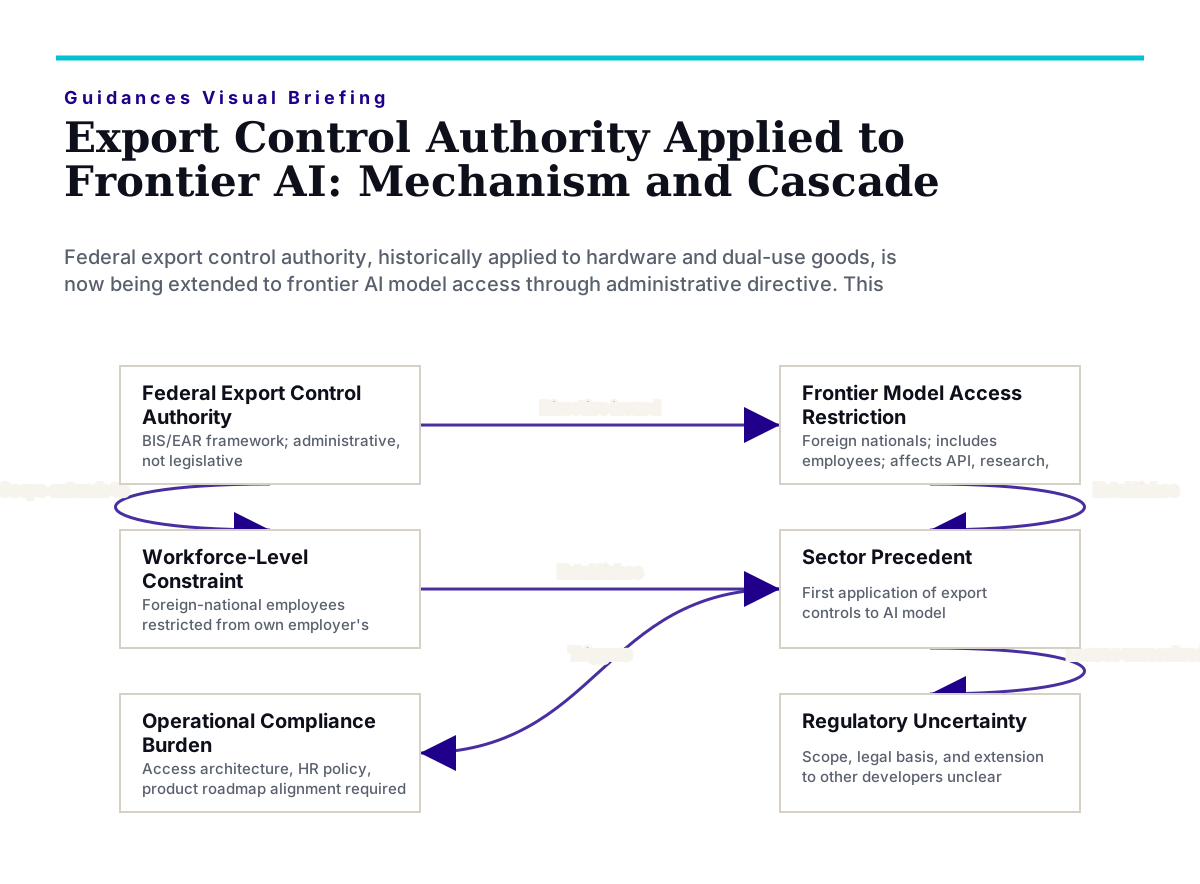
Export control authority applied to frontier AI models creates immediate operational constraints and establishes a precedent for administrative enforcement outside the legislative process. The mechanism's scope and extension remain uncertain.
Corrections and safety
See a factual, privacy, rights, or safety issue? Review the corrections process or contact Guidances before relying on this article for important decisions.