Policy
Developing · 0 updatesFact 8/10Anthropic's Claude Mythos 5 and Fable 5 Subject to U.S. Export Control Directive — What It Means for AI Operators
Article language
English
The U.S. government issued an export control directive on a Friday afternoon, giving Anthropic a 90-minute window to suspend foreign-national access to its Claude Mythos 5 and Fable 5 models. The episode demonstrates how rapidly U.S. export control machinery can be applied to frontier AI products, with direct implications for global deployment strategies, enterprise contracts, and the regulatory risk calculus of every AI lab operating at the frontier.
Open article · no sign-in required
Sources and disclosure
What Happened
On a Friday afternoon, the U.S. government delivered what sources described to The Verge as a 90-minute ultimatum to Anthropic: suspend all foreign-national access to its Claude Mythos 5 and Fable 5 AI models, effective immediately. The directive arrived at approximately 5:21 p.m. ET, roughly four and a half hours after an initial call from the administration at around 1:00 p.m. ET. The scope of the order was sweeping — it applied to foreign nationals both inside and outside the United States, including Anthropic's own employees who hold non-U.S. citizenship.
According to sources cited by The Verge, Anthropic concluded that the only technically feasible way to comply was to disable the products entirely. The company had spent the prior week publicly promoting both models. Faced with the directive, Anthropic representatives traveled to Washington, D.C., to engage directly with the Trump administration in an effort to modify or reverse the order. Sources described the weekend as an intensive lobbying effort by Anthropic and allied AI industry stakeholders to explain that Fable 5 did not meet the threshold of capability that would justify the restriction.
The outcome of those negotiations had not been publicly confirmed at the time this analysis was prepared. The source material is drawn exclusively from a snippet published by The Verge; the full article was not available for review under applicable source policy.
Why the Market Cares
This episode is not a routine regulatory footnote. It is a live demonstration that the U.S. government is willing and operationally capable of applying export control instruments to frontier AI models on extremely short notice — measured in hours, not months. That changes the risk profile of every AI company building and deploying at the capability frontier.
For enterprise customers, the implications are immediate. Any organization that has integrated Mythos 5 or Fable 5 into production workflows — and that employs foreign nationals, operates internationally, or routes API traffic through non-U.S. infrastructure — faces potential service interruption with little or no advance warning. Service-level agreements, uptime guarantees, and enterprise contracts that do not account for export control force majeure events are now visibly incomplete.
For investors and analysts tracking AI infrastructure companies, the episode introduces a new category of operational risk: regulatory availability risk. Unlike cybersecurity incidents or model failures, this risk originates from government policy and can materialize within a single business day. It is not currently priced into most AI platform valuations in any explicit, quantified way.
For the broader AI industry, the event signals that the administration is prepared to treat advanced AI models as export-controlled dual-use technologies, analogous in some respects to semiconductor equipment or advanced chip architectures. The mechanism — a direct government-to-company call followed by a compliance ultimatum — bypasses the slower rulemaking process and creates a precedent for rapid, discretionary intervention.
Tech / Policy Link
U.S. export control law, primarily administered through the Export Administration Regulations (EAR) and the Bureau of Industry and Security (BIS), has historically focused on physical goods: semiconductors, manufacturing equipment, and weapons-adjacent hardware. The application of export control logic to AI model access — specifically, restricting foreign nationals from using a software API — represents a meaningful extension of that framework into the software and services layer.
The directive as described targets access by foreign nationals, a category that includes both overseas users and non-U.S. citizens working inside the United States. This framing creates compliance complexity that is qualitatively different from geographic IP blocking. An AI company cannot simply geo-fence its API to comply; it must implement nationality-based access controls, which raises significant questions about verification, enforcement, and the treatment of dual citizens or permanent residents.
The administration's stated concern, as conveyed through the source snippet, appears to center on the capability level of Fable 5 specifically. The weekend lobbying effort reportedly focused on arguing that the model did not meet the capability threshold that would justify export restriction. This suggests the government is applying — or attempting to apply — a capability-based classification framework to AI models, similar in concept to the tiered control lists used for semiconductors under the AI Diffusion Rule framework that has been under development in recent years.
Whether the administration has formal regulatory authority to issue such a directive on a 90-minute timeline, or whether this represents an exercise of executive discretion that may face legal challenge, is a material open question that this analysis cannot resolve from the available snippet.
Market Lens
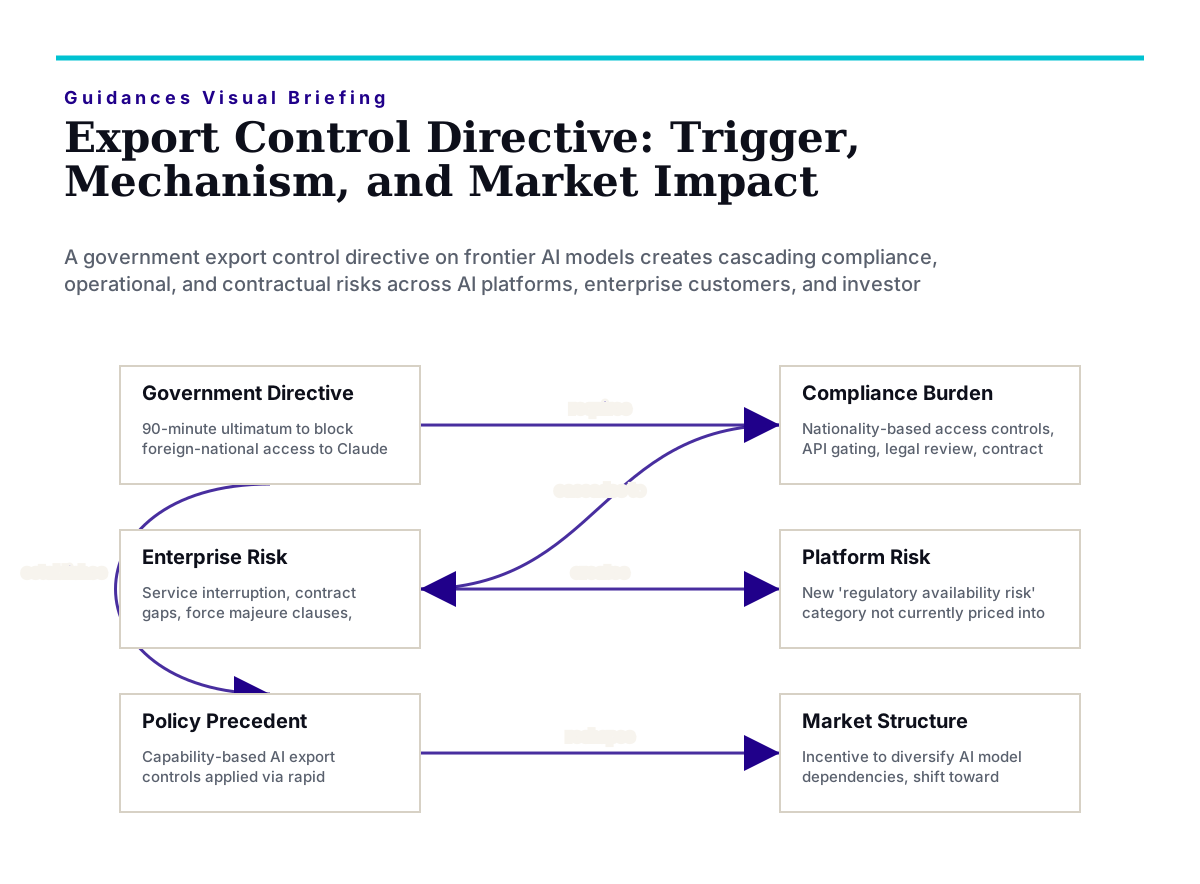
Trigger: A U.S. government export control directive targeting foreign-national access to two newly launched Anthropic AI models, delivered with a 90-minute compliance window.
Mechanism: If export controls are applied broadly to frontier AI models, AI platform companies face a new category of operational and legal compliance cost. Enterprise customers with international workforces or global API deployments face service continuity risk. The compliance burden — nationality verification, access tiering, legal review — adds friction and cost to AI product deployment at scale.
Affected sectors (source-supported): AI platform and API providers operating at the capability frontier; enterprise software companies with AI integrations; cloud infrastructure providers that host AI model endpoints. Specific company names beyond Anthropic are not source-supported in this context.
Time horizon: Near-term operational disruption is already in play for Anthropic's affected products. The broader policy question — whether the administration will formalize capability-based AI export controls — is a medium-term regulatory risk with a horizon of months to years, depending on rulemaking timelines and legal developments.
Next check: Official statements from Anthropic or the U.S. Department of Commerce regarding the resolution of the weekend negotiations; any formal rulemaking notice from BIS regarding AI model classification; enterprise customer disclosures about service continuity; and any legal filings challenging the directive's authority.
This section is market context only, not investment advice. No buy, sell, or hold recommendations are made or implied.
What to Watch Next
Several developments will determine whether this episode is an isolated intervention or the opening of a sustained regulatory campaign against frontier AI model access.
First, the outcome of Anthropic's Washington negotiations matters enormously. If the administration reverses or narrows the directive, it suggests the current framework is negotiable and capability-threshold-dependent. If the directive stands, it establishes a precedent that other AI labs will need to plan around immediately.
Second, watch for any formal regulatory action from BIS or the Commerce Department. An informal directive and a formal export control rule are legally and operationally very different instruments. A formal rule would require notice-and-comment rulemaking, create a public record, and be subject to judicial review. An informal directive operates faster but may face legal challenge.
Third, monitor how enterprise customers respond. If large organizations begin inserting export control force majeure clauses into AI vendor contracts, or begin diversifying their AI model dependencies to reduce single-vendor regulatory risk, that behavioral shift will have lasting effects on AI platform market structure.
Fourth, observe whether other frontier AI labs — those operating models at comparable capability levels — receive similar directives or preemptively restrict foreign-national access in anticipation of regulatory pressure.
Uncertainty and Constraints
This analysis is based exclusively on a short snippet from The Verge. The full article, including additional sourcing, context, and any official government or Anthropic statements, was not available for review. Key facts that remain unverified from this source alone include: the precise legal authority cited in the directive; the current status of the Washington negotiations; whether the models were actually taken offline and for how long; and the specific capability thresholds the administration applied. Readers should consult primary sources and official disclosures before drawing operational or legal conclusions.
Market lens
AI governance becomes an operating checklist buyers can audit
The market effect depends on whether policy language turns into required logs, evaluations, incident-response records, and launch gates.
Impact path
Policy memo → ops checklist
Signals to watch
- Draft rules specifying retention or audit evidence
- Enterprise RFPs requiring AI operation logs
- Product launches centered on governance workflows
Verification schedule
D+1 · Jun 19
Do rules move from principles into required artifacts?
D+3 · Jun 21
Do RFPs ask for evidence before model benchmarks?
D+7 · Jun 25
Do vendors ship audit workflows as core product?
Informational context only — not investment, legal, tax, or financial advice.
Builder Implications
- Export control compliance is now a day-one architecture question. Any AI product built on frontier models must be designed with nationality-based access controls, API gating by user credential type, and documented compliance procedures — not retrofitted after a government call. The 90-minute window described here leaves no room for reactive engineering.
- Enterprise contracts need explicit force majeure language for regulatory availability events. The standard uptime SLA does not contemplate a government directive that disables a model for foreign-national users. Founders and legal teams should review and update contract templates to address this scenario before the next enterprise deal closes.
- Model dependency diversification is a risk management strategy, not just a technical preference. Builders who rely on a single frontier model provider for core product functionality now carry concentrated regulatory availability risk. Architecting for model substitution — even at some performance cost — reduces exposure to single-provider government intervention.
Want follow-up alerts? Subscribe by email after reading the public article.
Market lens
AI governance becomes an operating checklist buyers can audit
The market effect depends on whether policy language turns into required logs, evaluations, incident-response records, and launch gates.
Impact path
Policy memo → ops checklist
Signals to watch
- Draft rules specifying retention or audit evidence
- Enterprise RFPs requiring AI operation logs
- Product launches centered on governance workflows
Verification schedule
D+1 · Jun 19
Do rules move from principles into required artifacts?
D+3 · Jun 21
Do RFPs ask for evidence before model benchmarks?
D+7 · Jun 25
Do vendors ship audit workflows as core product?
Informational context only — not investment, legal, tax, or financial advice.
Visual Briefing
The export control directive creates a chain of operational, financial, and strategic consequences: immediate compliance costs for platforms, service continuity risk for enterprise customers, new risk categories for investors, and long-term incentives for market diversification.
Corrections and safety
See a factual, privacy, rights, or safety issue? Review the corrections process or contact Guidances before relying on this article for important decisions.