What Happened
The U.S. Food and Drug Administration operates a dedicated regulatory framework for artificial intelligence and machine learning-enabled medical devices, embedded within its broader Software as a Medical Device (SaMD) policy architecture. The agency's public resource on this topic covers premarket submission requirements, regulatory considerations specific to AI/ML systems, and the standards by which these tools are evaluated before they can be legally marketed in the United States.
The source page carries no verified machine-readable publication date and should not be treated as newly published material. That said, the FDA's AI/ML device framework is a living policy document—updated iteratively through the agency's 2021 action plan for AI/ML-based SaMD and subsequent guidance drafts—and its relevance to market participants is structural and ongoing rather than tied to a single news event. The framework's importance has grown as the number of AI/ML device submissions reaching the FDA has increased over the past several years.
Why the Market Cares
For the medtech AI sector, FDA clearance or approval is not simply a compliance milestone. It is the prerequisite that unlocks downstream commercial steps. A device that has not cleared the FDA's premarket submission process cannot receive reimbursement from the Centers for Medicare and Medicaid Services (CMS), cannot be procured by hospital systems under standard clinical protocols, and cannot be integrated into electronic health record workflows that require certified, regulated software.
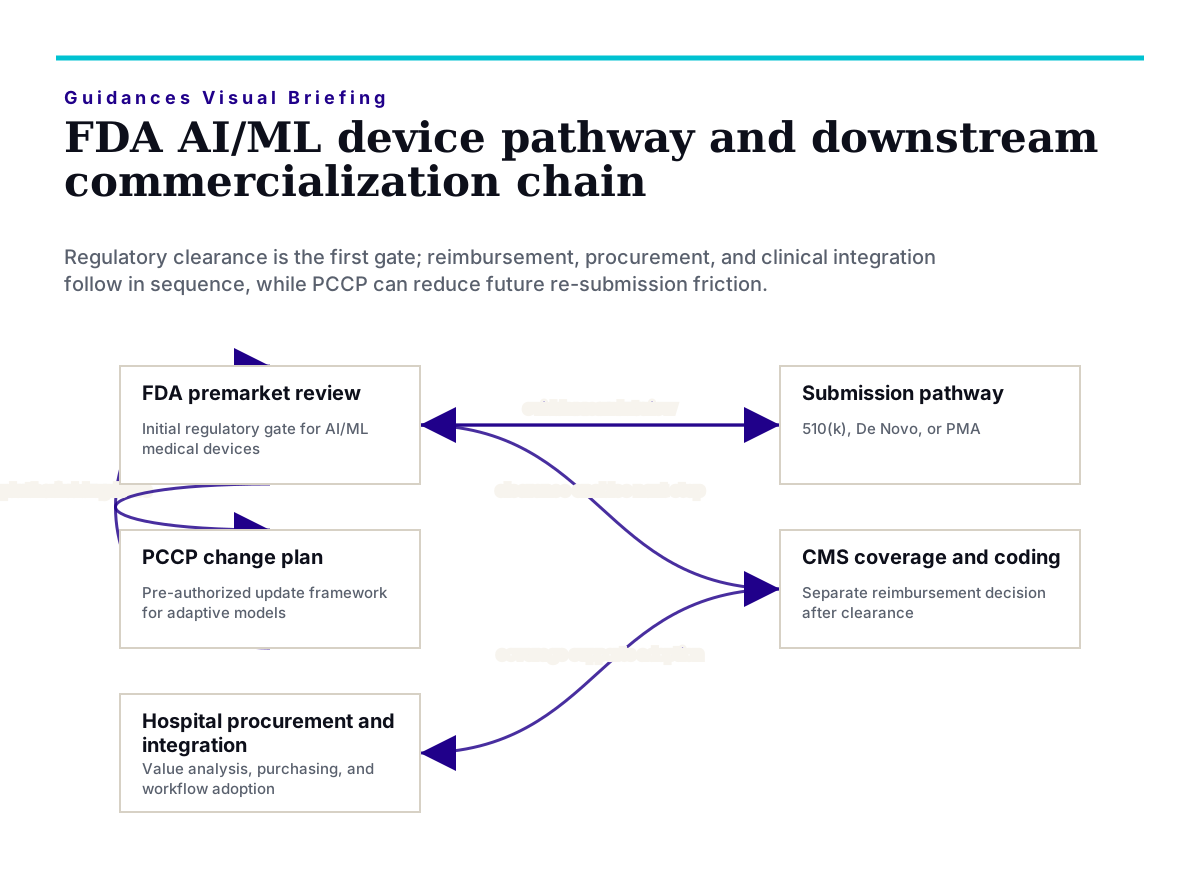
This creates a sequenced dependency chain that governs the commercial timeline for AI/ML medical device companies: regulatory clearance → CMS coding and coverage determination → hospital value analysis committee review → procurement and deployment. Each stage introduces its own timeline uncertainty, and the FDA gateway is the first link in that chain.
The commercial stakes are substantial. AI-enabled medical imaging, clinical decision support, remote patient monitoring, and diagnostic software represent a rapidly expanding segment of the broader medtech industry. Venture capital and public-market investors have committed significant capital to companies in this space, and the pace at which those companies can convert R&D investment into cleared, reimbursable products is a central variable in their operating economics. Delays at the regulatory stage can push back launch dates, affect cash runway, and influence milestone-based financing reviews and partnership timelines.
Technology and Policy Linkage
The FDA's approach to AI/ML devices introduces regulatory complexity that has no direct parallel in traditional, static medical software. Conventional medical device software is evaluated once; if cleared, it can be marketed without re-submission unless the manufacturer makes a significant change. AI/ML systems—particularly those using adaptive algorithms that continue learning from new data after deployment—present a structurally different challenge: the device evaluated at time T may behave differently at time T-plus-twelve months as its underlying model updates.
The FDA has been developing a mechanism to address this through the Predetermined Change Control Plan (PCCP), which would allow manufacturers to pre-specify the types of algorithm modifications they anticipate and receive regulatory pre-authorization for those changes. If finalized and widely adopted, the PCCP framework could reduce the re-submission burden for adaptive AI systems and potentially compress the commercial update cycle for cleared devices—a meaningful shift in the unit economics of companies with large SaMD portfolios.
For SaMD developers, the distinction between 510(k) clearance, De Novo classification, and full Premarket Approval (PMA) carries direct commercial weight. The chosen pathway determines the evidentiary burden, the review timeline, and the cost of market entry. AI/ML tools positioned as high-risk—those making autonomous clinical decisions without clinician review—face a higher regulatory bar than tools classified as decision-support systems that keep a clinician in the loop. This risk-stratification logic is not merely a regulatory technicality; it shapes product architecture decisions from the earliest stages of development.
The same risk-stratification framework intersects with how CMS approaches reimbursement coding. The agency has historically been cautious about creating new billing codes for AI-enabled services without evidence of clinical utility that extends beyond regulatory clearance alone. FDA clearance establishes that a device meets a regulatory standard for safety and effectiveness; CMS coverage requires a separate demonstration of clinical and economic value under its own evidentiary framework. Developers who treat these two thresholds as equivalent may encounter commercial delays that were not anticipated in their original go-to-market plans.
The international dimension adds a further layer of complexity. CE marking under the EU's Medical Device Regulation (MDR) and equivalent frameworks in other jurisdictions operate on different standards and timelines. A device cleared by the FDA is not automatically eligible for deployment in other markets, and the divergence between regulatory regimes creates additional planning and resource requirements for companies pursuing global commercialization.
Market Lens
Trigger: The FDA's standing regulatory framework for AI/ML-enabled medical devices sets the conditions under which any AI-driven clinical tool can enter the U.S. market. Policy updates within this framework—such as the finalization of PCCP guidance—can function as structural inflection points for an entire cohort of developers simultaneously.
Mechanism: Regulatory clearance is an important precondition for CMS reimbursement eligibility, hospital procurement, and clinical integration. Delays or denials at the FDA stage can cascade through the commercial timeline. Conversely, a finalized PCCP framework could compress time-to-market for adaptive AI systems and improve the operating economics of companies with large SaMD portfolios by reducing the frequency and cost of re-submissions.
Affected sectors: Publicly listed medtech companies with significant AI/ML device pipelines, hospital systems evaluating AI procurement, health IT platform vendors integrating SaMD into EHR workflows, and venture-backed AI diagnostics companies approaching their first premarket submission are all directly exposed to this regulatory environment. Broader medtech-focused indices and health technology ETFs carry indirect exposure through their constituent holdings. The source does not support specific ticker-level causal claims, and none are made here.
Time horizon: The regulatory framework operates on a multi-year cycle. Individual premarket submissions typically require six to twelve months for 510(k) reviews under standard timelines, with De Novo and PMA pathways extending further. Policy updates such as finalized PCCP guidance can shift the operating environment for a broad cohort of developers at once, making them higher-order events than individual clearance decisions.
Next check: Concrete checkpoints to monitor include FDA finalization of PCCP guidance (draft guidance has been in circulation; a final rule would materially alter the re-submission calculus for adaptive AI devices), CMS annual Physician Fee Schedule and Hospital Outpatient Prospective Payment System updates, which periodically introduce or modify billing codes relevant to AI-enabled services, and individual company disclosures in quarterly filings that reference FDA submission status, clearance timelines, or reimbursement coverage decisions as operating milestones.
This section is market context only, not investment advice. No buy, sell, or hold recommendation is implied.
Uncertainty and Constraints
Several material uncertainties limit the precision of any market analysis grounded in this regulatory framework. The FDA's approach to AI/ML devices remains in active development; guidance documents in draft form do not carry the same regulatory weight as finalized rules, and the timeline for finalization is not publicly fixed. The relationship between FDA clearance and CMS coverage is not automatic—a cleared device may still face years of coverage uncertainty at the payer level. And the international dimension means that U.S. clearance does not translate directly into global deployment eligibility.
For companies that have raised capital on the assumption of a specific regulatory timeline, slippage at the FDA stage has implications for cash runway, milestone-based financing tranches, and partnership agreements contingent on clearance. These operating constraints are not always visible in public disclosures until they become material events.
It is also worth noting that this article does not constitute medical advice. The regulatory and market mechanisms described here are informational in nature; clinical decisions should be made in consultation with qualified medical professionals and with reference to current official guidance.
What to Watch Next
Three developments deserve close attention from operators and market participants tracking this space. First, the FDA's finalization of its PCCP framework will be an important inflection point for adaptive AI device developers—Federal Register notices and agency guidance publications are the primary signal channels. Second, CMS's annual rulemaking cycles, particularly the Physician Fee Schedule and Hospital Outpatient Prospective Payment System updates, are the venues where AI-specific billing codes are created or modified; the comment periods for these rules represent the practical opportunity for industry to shape coverage policy. Third, individual company earnings calls and annual reports that reference FDA submission status, clearance receipt, or coverage determination outcomes provide the most granular real-time signal about how the regulatory environment is translating into commercial results for specific players.