What Happened
The U.S. Food and Drug Administration published a draft guidance document in January 2025 setting out lifecycle management and marketing submission recommendations for AI-enabled device software functions. The document was subsequently the subject of a Digital Health Advisory Committee (DHAC) session, where the committee examined its implications for generative AI-enabled digital mental health medical devices. A committee participant noted an active collaboration between the FDA and the Centers for Medicare and Medicaid Services (CMS) directed at expanding Medicare coverage for digital behavioral health devices, and called for faster, more coordinated processes to address what was described as unclear reimbursement pathways for AI startups.
The search provider supplied a date associated with this material, but that date has not been verified against the FDA's official source-page metadata and is treated here only as a soft recency indicator. The January 2025 draft issuance and the DHAC session are the confirmed factual anchors. Both remain directly relevant to operators and founders working through the current regulatory environment as of mid-2026, because the draft has not been publicly confirmed as finalized.
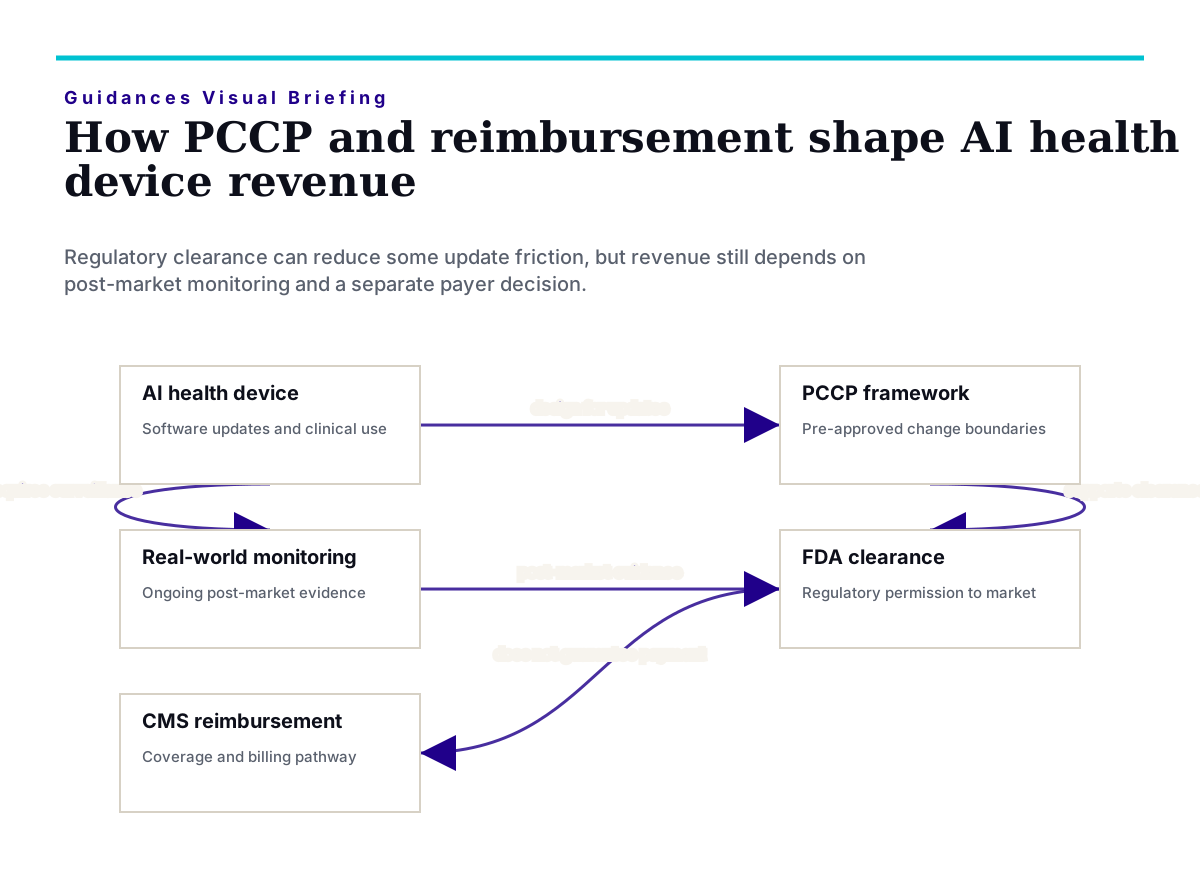
Two structural pillars define the draft guidance. The first is the Predetermined Change Control Plan (PCCP) framework, which requires manufacturers to specify in advance the categories of algorithm modification they anticipate making after clearance, along with the performance boundaries within which those changes may occur without triggering a new marketing submission. The second is an explicit expectation of real-world performance monitoring as a continuous post-market obligation rather than a one-time pre-clearance demonstration. Taken together, these two requirements convert AI device development from a discrete regulatory event into an ongoing compliance relationship.
Why the Market Cares
For any company building AI-enabled health software, the commercial question is not simply whether a product can be cleared—it is whether clearance produces a viable revenue stream. The draft guidance restructures both sides of that equation.
On the cost side, the PCCP framework introduces a documentation and governance burden that most early-stage teams have not yet internalized. Specifying a change envelope in advance requires manufacturers to have already mapped their anticipated model update cycles, defined measurable performance thresholds, and built the internal audit infrastructure to demonstrate that any given update stays within the pre-approved boundary. This is not a form-filling exercise; it is a systems-engineering requirement that must be embedded in the product architecture from the outset.
The real-world monitoring obligation compounds this. Unlike a physical device whose performance is stable after manufacture, an AI software function can behave differently as patient populations shift, as input data distributions change, or as the model is retrained. The FDA's insistence on post-market surveillance for these products means that the regulatory cost of an AI health device does not terminate at clearance. It becomes a recurring operational expenditure—data collection pipelines, drift-detection systems, adverse-event reporting workflows, and the personnel to run them. Founders and investors who model unit economics without this line item are working from an incomplete cost structure.
On the revenue side, the reimbursement gap identified at the DHAC session is arguably the more commercially consequential constraint. A product can hold FDA clearance and still generate no billable revenue if payers—particularly Medicare and Medicaid, which cover a disproportionate share of behavioral health patients in the United States—have not assigned a reimbursable billing code. The FDA-CMS collaboration signals that both agencies recognize this structural disconnect, but institutional recognition is not the same as a resolved pathway. Until CMS issues formal coverage determinations or new billing codes specifically applicable to AI-enabled digital behavioral health tools, the commercial route to scale remains structurally incomplete for a large portion of the startup cohort.
Technology and Policy Linkage
The PCCP framework is as much a regulatory technology concept as it is a policy instrument. It demands that manufacturers build internal change-management infrastructure—version control, performance benchmarking, deviation detection, and auditable records—that mirrors mature software engineering practice but is formalized for regulatory submission purposes. Companies already operating disciplined MLOps pipelines carry a structural advantage here. Those that do not will need to invest in compliance infrastructure before they can benefit from the PCCP pathway's reduced re-submission friction.
Generative AI introduces a layer of complexity that the existing framework was not originally designed to accommodate. Discriminative models have bounded output spaces that lend themselves to pre-specified performance metrics. Generative systems—particularly those producing therapeutic dialogue, psychoeducational content, or crisis-response language—generate outputs that are inherently variable and difficult to bound in advance. Defining a PCCP for such a system requires the manufacturer to establish performance metrics for outputs that may not have established clinical benchmarks. The DHAC session's specific focus on generative AI mental health devices signals that the FDA is actively working through this interpretive challenge rather than having resolved it. Founders building in this space should expect further guidance rather than treating the January 2025 draft as the final word on generative AI compliance.
The FDA-CMS coordination dimension carries its own policy-infrastructure implications. Historically, the two agencies have operated on separate and often misaligned timelines: FDA clearance can precede a CMS coverage determination by multiple years, leaving cleared products in a commercial limbo where they are legally marketable but not reimbursable. If the collaboration produces a synchronized or parallel review pathway—where coverage eligibility is assessed concurrently with or shortly after device clearance—it would materially compress the time between regulatory approval and revenue generation for cleared AI health devices. The source does not confirm that such a pathway has been established; it records only that the collaboration exists and that faster coordination was urged by a committee participant. The distinction between an aspiration and an operational program matters significantly for founders making product-roadmap and fundraising decisions.
Market Lens
Trigger: FDA draft guidance on AI device software lifecycle management (January 2025) and a DHAC session examining generative AI mental health device implications, with a noted FDA-CMS collaboration on Medicare coverage expansion for digital behavioral health tools.
Mechanism: The PCCP framework reduces re-submission friction for iterative AI updates, potentially compressing long-run regulatory cost per product iteration for companies that invest in the required governance infrastructure. Simultaneously, mandatory real-world monitoring adds a recurring post-market compliance cost that is not present in traditional device economics. The unresolved reimbursement gap between FDA clearance and CMS coverage determination remains the primary commercial bottleneck for AI behavioral health startups seeking Medicare and Medicaid revenue.
Affected sectors: Digital health software companies, AI-enabled medical device manufacturers, behavioral health technology platforms, health IT infrastructure providers, and payers with digital health coverage exposure. The source does not support specific ticker-level attribution, and no market-data context was provided with this source. Sector-level linkages are analytical inferences from the regulatory mechanism, not source-confirmed market effects.
Time horizon: The draft guidance was issued in January 2025 and remained in draft form as of the DHAC session. FDA guidance finalization timelines are not fixed; comment-and-finalization cycles commonly extend twelve to twenty-four months or longer. CMS coverage determinations for new device categories operate on a separate and independent schedule.
Next check: The FDA's official public docket for this draft guidance is the primary checkpoint—comment periods, agency response summaries, and finalization notices will appear there. CMS's annual Medicare Physician Fee Schedule proposed rule, typically released in July, and the final rule, typically