What happened
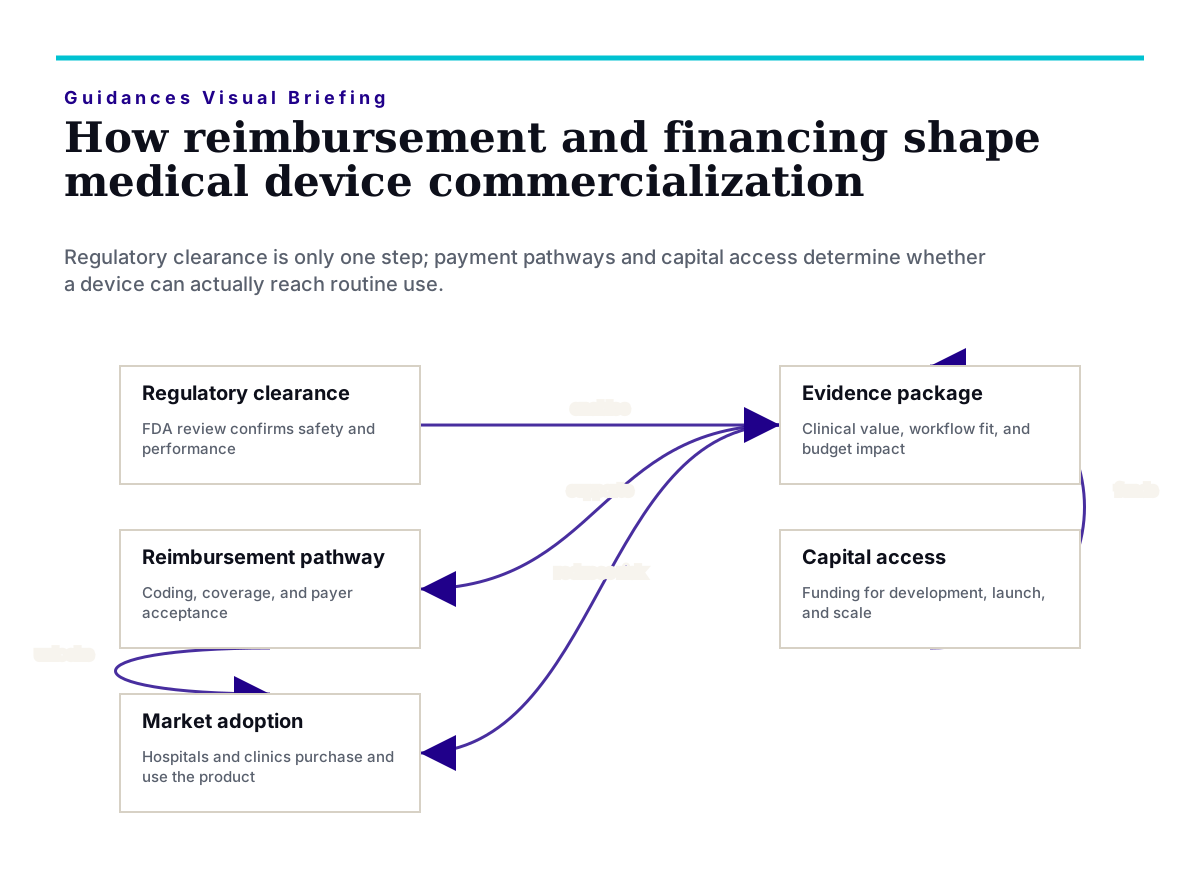
The FDA’s Center for Devices and Radiological Health has placed financing and reimbursement among the research topics in its FY2026 Broad Agency Announcement. In plain terms, the agency is asking outside researchers to study how payment structures and capital risk shape the path from device development to real-world use. The emphasis is not on a single product category or a one-off policy tweak. It is on the commercial plumbing that determines whether a medical device can move from technical validation to routine adoption.
This is an official FDA policy document hosted on fda.gov. The search provider did not supply a machine-readable publication date, so the piece should not be read as a newly dated release. It is better understood as a current policy signal tied to FY2026 and retrieved on June 26, 2026.
The wording matters because it shifts the frame. Rather than treating reimbursement as a late-stage administrative hurdle, CDRH is treating it as part of the development problem itself. That is a meaningful change in emphasis for a sector where many companies spend years proving safety and performance, only to discover that the payment system is not ready to absorb the product.
Why the market cares
For operators and investors in medtech, the central issue is not whether a device can clear a regulatory review. It is whether a hospital, clinic, or payer can justify paying for it at scale. That distinction is especially important for software-heavy products, including AI-enabled diagnostics, clinical decision support, and monitoring tools. These products often sit awkwardly between existing billing categories. They may be clinically useful, but still lack a clean reimbursement path.
That gap creates a commercialization bottleneck. A startup can raise capital, complete validation work, and even secure regulatory clearance, yet still face a weak sales cycle if buyers cannot see a durable payment route. The result is a mismatch between technical progress and business readiness. CDRH’s research priority suggests the agency sees that mismatch as structural rather than incidental.
The market relevance extends beyond startups. Larger medtech firms also care because reimbursement uncertainty affects launch timing, sales force planning, and portfolio selection. If the payment environment is unclear, companies may delay launches, narrow indications, or rework product design to fit existing billing logic. In that sense, the policy signal can influence capex allocation, product road maps, and the pace at which new categories reach revenue.
Tech / policy link
The policy link runs through CMS and the broader payment architecture. FDA clearance and reimbursement approval are separate processes with different incentives, timelines, and evidence standards. A device can be cleared for use and still remain commercially constrained if the payment system does not recognize how to value it.
That issue is particularly acute for AI medical software. These tools can update over time, depend on workflow integration, and generate value in ways that are not always captured by legacy billing codes. If a model changes, the evidence base may also need to change. That creates a moving target for payers and providers. CDRH’s interest in early-stage de-risking implies that the agency wants research that can help bridge that gap before companies reach the market.
There is also a broader policy logic here. If regulators and researchers can define how to measure economic value earlier in the development cycle, then future coverage discussions may become less ad hoc. That does not mean a new payment rule is imminent. It does mean the agency is acknowledging that evidence generation must include business viability, not just clinical performance.
Market Lens
Trigger: CDRH added financing and reimbursement to its FY2026 research agenda.
Mechanism: Research on payment design and capital risk can produce frameworks that later inform CMS, hospital procurement teams, and private payers. Over time, that can reduce uncertainty around adoption for devices that otherwise struggle to fit existing billing categories.
Affected sectors and assets: The most exposed areas are AI-enabled medical software, digital diagnostics, remote monitoring, and medtech companies whose products depend on new or revised payment pathways. Hospital IT and revenue-cycle vendors may also benefit indirectly if reimbursement workflows become more complex and data-intensive. Any direct link to specific tickers, ETFs, or index moves is unverified from this source alone.
Time horizon: This is a medium-term policy signal, not an immediate operating event. The practical effects, if they emerge, would likely show up over the next 12 to 36 months through research awards, CMS discussions, or payer guidance rather than through near-term revenue changes.
Next check: Watch for the actual BAA award list, any CMS payment-rule references to innovative devices, and any public workshop or joint agency discussion that connects device evidence to reimbursement design. Those are the points where the policy signal could become operational.
What to watch next
The first thing to monitor is the scope of the funded research. If awards go to health-economics teams, payer-policy researchers, or groups studying coding and coverage, that would suggest CDRH is trying to build practical tools rather than simply documenting the problem. If the awards are narrow or purely academic, the market read-through is weaker.
Second, the CMS calendar matters. FDA can shape the evidence conversation, but CMS controls payment decisions. Any reference to innovative devices in fee schedule proposals, coverage discussions, or public comment periods would be a more concrete sign that the issue is moving from research into policy.
Third, builders should watch how buyers respond. Hospital systems and integrated delivery networks often act as the first real stress test for reimbursement logic. If procurement teams begin asking for stronger budget-impact evidence, clearer coding pathways, or version-specific performance data, that would confirm the commercial relevance of CDRH’s research agenda.
Uncertainty and constraints
The source is a search snippet from an official FDA document, not the full BAA text. That means the analysis can identify the policy direction, but not the full scope, budget, or selection criteria. It would be a mistake to infer more precision than the metadata supports.
It is also important not to overstate CDRH’s authority. The agency can set research priorities and generate evidence, but it does not control reimbursement on its own. Payment policy is shared across agencies and private actors, each with its own process. So the signal is real, but the path from research topic to market change is indirect.
For that reason, the article should be read as market context only, not investment advice. It is also not medical advice. The relevant question for operators is how to design products, evidence packages, and launch plans around a payment system that remains fragmented.