What Happened
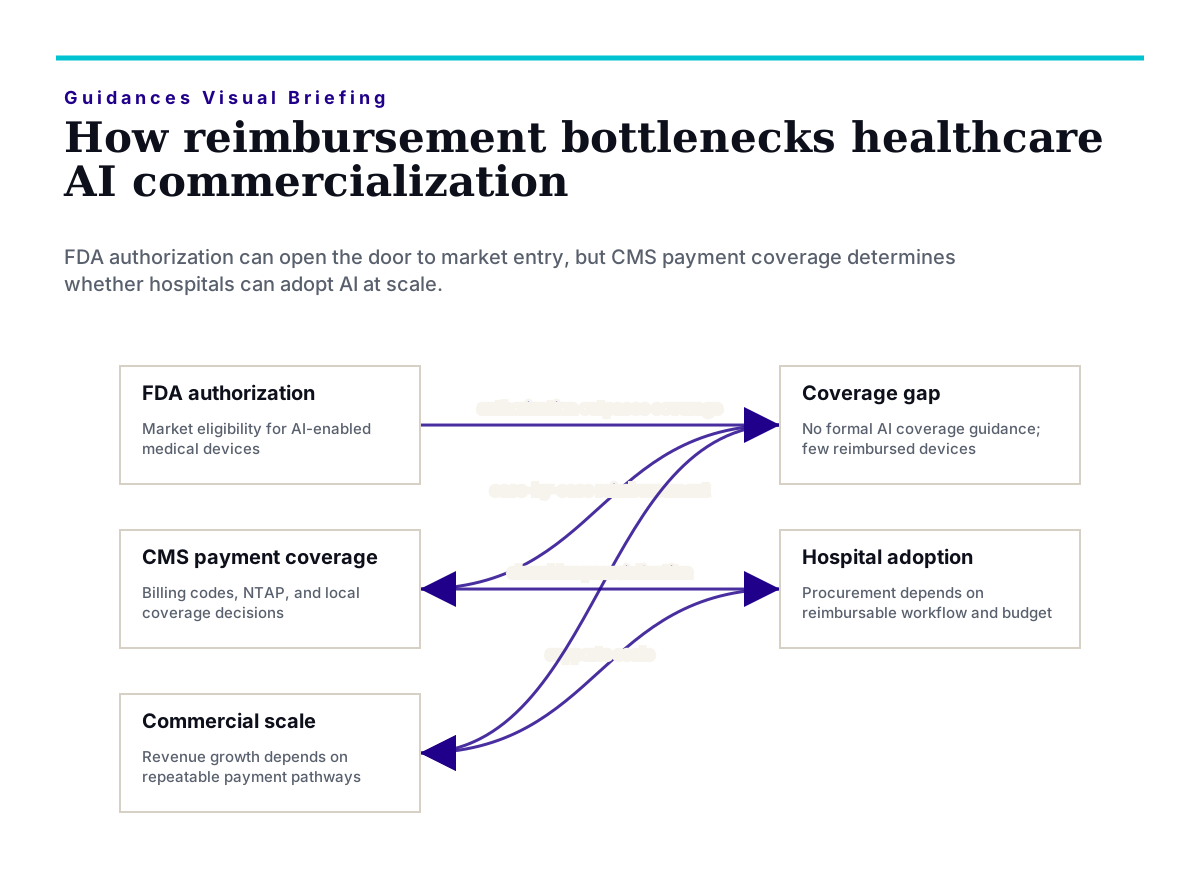
A peer-reviewed study published in npj Digital Medicine, a journal within the Nature Portfolio, examined the payment infrastructure surrounding artificial intelligence in clinical medicine. The source snippet available for this article establishes two key data points: the Food and Drug Administration has authorized more than 600 AI-enabled medical devices for commercial use in the United States, while the Centers for Medicare and Medicaid Services has extended AI-specific reimbursement—through dedicated billing codes or New Technology Add-On Payments—to only a small number of those devices. The source also notes that no formal CMS guidance establishing coverage standards for AI has been released.
The publication date of this source was not confirmed by machine-readable metadata; the search provider did not supply a verified date. Accordingly, the specific figures cited here should be understood as a research-period baseline rather than a live policy count. Both the number of FDA-authorized devices and the number receiving CMS reimbursement are likely to have shifted since the underlying research was conducted. The directional finding, however—that payment coverage trails regulatory authorization by a substantial margin—is structurally consistent with publicly available CMS and FDA records and remains a consequential dynamic in the healthcare AI sector as of mid-2026.
Why the Market Cares
For the healthcare AI sector, the distance between FDA authorization and CMS payment coverage is not an administrative detail. It is the primary commercial constraint. A medical AI product that cannot generate a reimbursable billing event cannot be sold at scale to hospitals and health systems operating under standard fee-for-service or value-based care arrangements. Without an established billing code or a temporary add-on payment designation, even a well-evidenced AI tool presents a difficult procurement case to hospital value-analysis committees, which must weigh adoption costs against identifiable revenue or cost offsets.
This dynamic reshapes the capital formation cycle for digital health companies. Venture-backed medtech firms that have treated FDA clearance as the primary commercial milestone are confronting a more complex reality: clearance establishes market eligibility, but payment coverage determines whether a product can generate revenue at the volume needed to justify its development cost. The gap between these two events can span years, and during that interval, companies must sustain operations through grant funding, pilot contracts, or bundled arrangements with larger health system partners—none of which produce the revenue recognition profile that supports durable growth.
For large, publicly traded medtech companies with established hospital relationships and existing billing code portfolios, this structural gap functions as a competitive advantage. They can embed AI capabilities into already-reimbursable clinical workflows, effectively absorbing AI adoption costs within existing billing infrastructure. Pure-play AI health companies, which lack this integration leverage, face a longer and more capital-intensive path from product launch to commercial scale.
Technology and Policy Linkage
The regulatory architecture governing healthcare AI in the United States involves two federal agencies operating on distinct timelines with distinct mandates. The FDA evaluates safety and efficacy for the purpose of market authorization. CMS evaluates clinical utility and cost-effectiveness for the purpose of payment coverage. These processes are not synchronized, and there is no automatic mechanism by which FDA authorization triggers CMS coverage review.
In the absence of formal CMS guidance on AI coverage standards—a gap the source explicitly identifies—coverage decisions for individual AI devices are made through a fragmented, case-by-case process. Medicare Administrative Contractors, which administer Medicare benefits across geographic regions, issue Local Coverage Determinations that can authorize payment for specific technologies within their jurisdictions. This means that an AI-assisted diagnostic tool might be reimbursable in one region and not in another, depending on which contractor has jurisdiction and whether it has issued a relevant determination. The result is geographic inconsistency that complicates national commercial planning for AI developers.
The New Technology Add-On Payment pathway, which provides temporary supplemental payments for novel technologies used in inpatient hospital settings, offers one route to near-term reimbursement. However, its eligibility criteria and annual application cycle were designed primarily with physical devices and implants in mind, not software-as-a-medical-device products. Many AI tools—particularly those that function as decision-support systems rather than standalone diagnostic instruments—face structural difficulty meeting NTAP criteria as currently written.
This policy architecture produces a technology development incentive that is worth examining carefully. Because reimbursement is most accessible in clinical domains where AI outputs map directly onto existing billing codes—radiology image interpretation, pathology slide analysis, certain cardiology applications—development activity concentrates in those areas. High-value but billing-ambiguous applications, such as longitudinal risk stratification, care coordination support, or early deterioration detection, attract less commercial investment despite their potential clinical significance. The payment system, in effect, shapes the innovation agenda.
Both Congress and CMS have acknowledged this misalignment. Legislative proposals to establish a dedicated AI coverage pathway have been introduced in recent sessions, and CMS has issued requests for information on AI reimbursement frameworks. As of the source's collection date, however, no formal rule or guidance had been finalized. The policy gap remains open, and its resolution timeline is uncertain.
Market Lens
Trigger: A peer-reviewed source documents that a small fraction of FDA-authorized AI medical devices receive AI-specific CMS reimbursement, with no formal coverage guidance in place to systematize future decisions.
Mechanism: Without payment coverage, hospital procurement of AI tools is constrained to grant-funded pilots, discretionary internal budget allocations, or bundled vendor arrangements. None of these channels scale to the revenue levels that justify the R&D investment embedded in most AI health platforms. This extends the interval between regulatory clearance and meaningful commercial revenue, compresses near-term revenue recognition for digital health companies, and increases the capital required to reach commercial sustainability.
Affected sectors: Digital health platforms, software-as-a-medical-device developers, AI-enabled diagnostics companies, and medtech conglomerates with AI product lines are all exposed to this dynamic. Within the AI health subsector, radiology AI, pathology AI, and cardiology AI have the most established billing precedents and are therefore relatively better positioned for near-term revenue generation. Companies operating in clinical domains with less-developed billing infrastructure face longer commercialization timelines. Hospital systems and integrated delivery networks are the procurement decision-makers whose budget cycles and committee processes set the practical adoption pace.
Time horizon: This is a medium-term structural constraint, measured in policy cycles—typically one to three years for CMS rulemaking—rather than fiscal quarters. Near-term catalysts that could shift the landscape include a CMS proposed rule on AI coverage standards, Congressional legislation advancing through committee markup, or a significant NTAP approval for a novel AI application category.
Next check: Monitor the CMS annual NTAP application cycle (applications are typically due in the spring for the following fiscal year), any CMS requests for information on AI coverage frameworks, and Congressional markup activity on digital health legislation. Earnings disclosures from publicly traded medtech companies with AI product lines may also surface reimbursement progress as a commercial milestone. FDA device authorization data and CMS coverage determination databases are the primary official sources for tracking changes in the authorization-to-coverage ratio.
This section is market context only and does not constitute investment advice. No buy, sell, or hold guidance is implied or intended.
What to Watch Next
Several developments could materially shift the reimbursement environment. A formal CMS guidance document or proposed rule establishing coverage standards for AI would immediately expand the addressable market for already-authorized devices and provide a more predictable pathway for products in development. Reform of the NTAP program to better accommodate software-based medical AI would open a faster payment route for inpatient AI tools. Movement by commercial insurers ahead of CMS—a pattern observed in other technology categories—could create a parallel reimbursement track that reduces sector dependence on Medicare and Medicaid coverage timelines.
On the technology side, the development of AI products whose outputs map directly onto existing billing codes—without requiring new code creation—will remain the dominant near-term commercialization strategy. The American Medical Association's CPT Editorial Panel sets the agenda for new code creation, and new code approvals are the upstream event that enables downstream CMS coverage consideration. Founders and product teams should treat the Panel's published agenda as a leading indicator of which clinical AI applications are approaching billing viability.
Uncertainty and Constraints
Several important limitations apply to this analysis. The source publication date was not confirmed by machine-readable metadata, and the specific figures cited—the number of FDA-authorized AI devices and the number receiving AI-specific CMS reimbursement—should be treated as a research-period snapshot. Both figures are likely to have changed since the research was conducted, and readers should verify current counts through official FDA and CMS databases before making operational or financial decisions.
Additionally, the billing pathways described here—CPT codes and NTAP—apply primarily to Medicare fee-for-service. Medicaid coverage, commercial insurance reimbursement, and value-based care contract structures each operate under distinct payment mechanics that are not fully captured in this analysis. The reimbursement landscape for any specific AI product will depend