What Happened
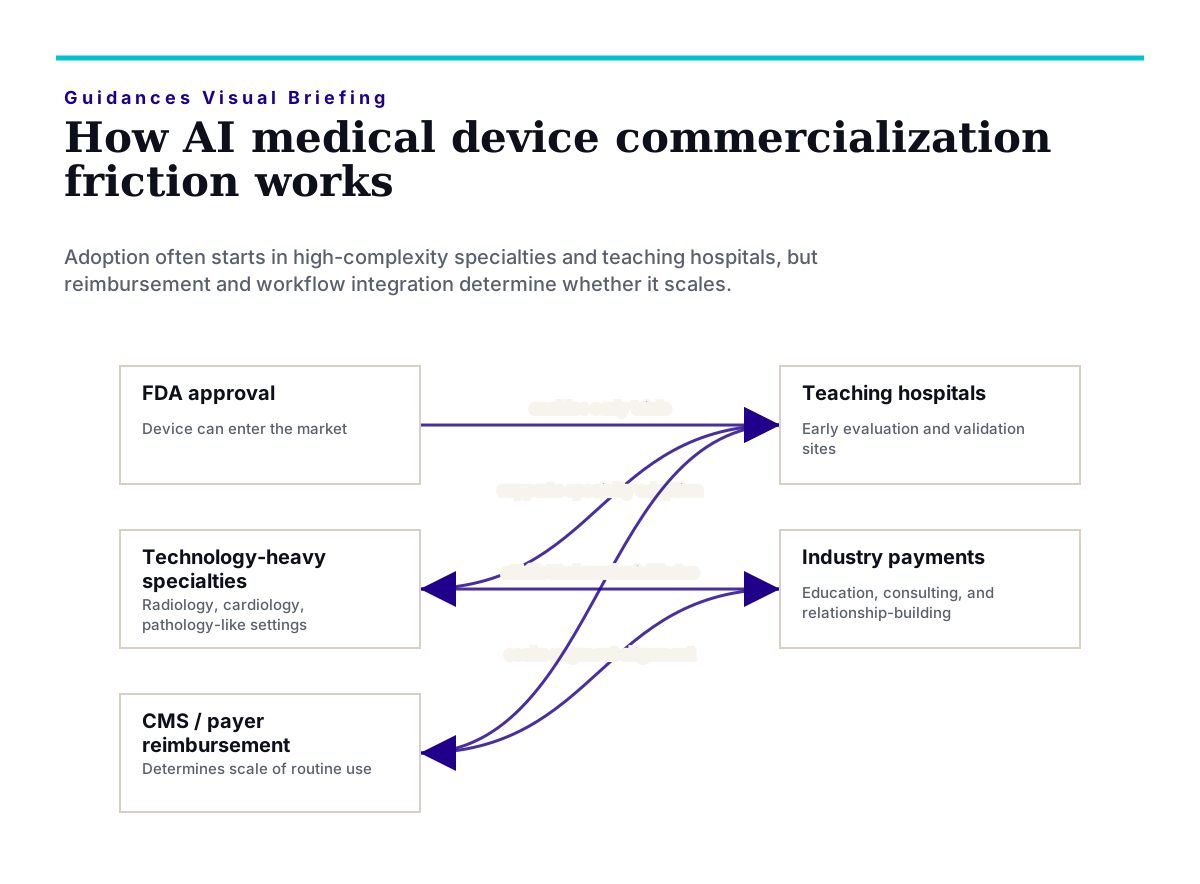
A peer-reviewed study indexed on PubMed Central examined industry payments linked to FDA-approved AI medical devices over the 2017 to 2023 period. The paper reports $59.3 million in aggregate payments across that span. It also finds that AIMDs’ share of total device-related payments rose from 0.43% to 1.01%. The payments were concentrated in technology-intensive specialties and among clinicians at larger teaching hospitals.
The source page did not provide a machine-verifiable publication date, so this should not be treated as a newly published development. Still, the underlying window matters. It covers the early commercialization phase of AI medical devices in the United States, which makes the findings relevant to current debates over medtech adoption, reimbursement design, and the pace at which clinical AI moves from approval to routine use.
This is market context only, not medical advice and not investment advice.
Why the Market Cares
The headline number is not the main story. In absolute terms, $59.3 million is modest relative to the broader medical device economy. The more important signal is the change in mix. A doubling of AIMD’s share of total device payments suggests that AI-enabled products are claiming a larger place in the commercial relationships that manufacturers build with clinicians and hospitals.
That matters because healthcare adoption is rarely a simple function of regulatory clearance. A device can be allowed onto the market and still face a slow path to broad use if hospitals are unsure how to fit it into workflow, if clinicians need training, or if payers have not settled the reimbursement question. Industry payments are one visible trace of how manufacturers try to move those pieces. They can reflect consulting, education, research support, or other forms of value transfer that help seed clinical familiarity and institutional trust.
The concentration in technology-intensive specialties is especially informative. Fields such as radiology, cardiology, and pathology are structurally more receptive to AI tools because they already rely on high-volume data interpretation and pattern recognition. In those settings, AI can be positioned as a workflow aid, a triage layer, or a decision-support tool. That does not guarantee adoption, but it does help explain why manufacturers may focus their commercial effort there first. The payment pattern therefore points to a practical commercialization logic: start where the use case is clearest, then try to expand outward.
The teaching-hospital concentration adds another layer. Large academic centers often have the staff, governance, and technical infrastructure to evaluate new devices earlier than smaller hospitals. They also carry reputational weight. If a product gains traction in a major teaching hospital, that can help with later discussions elsewhere, whether with other hospital systems, specialty groups, or payers. In that sense, the study is less about a single payment total than about the geography of early adoption.
Tech / Policy Link
The study sits at the intersection of FDA regulation and CMS payment policy. Those are related but separate systems. FDA approval or clearance determines whether a device can be marketed. CMS and private payers determine how easily it can be used at scale. For AI medical devices, that gap is often the central commercial constraint.
The payment concentration described in the paper may indicate that manufacturers are investing more heavily in clinical relationships because the reimbursement pathway remains incomplete. If a product does not yet have a dedicated payment structure, the company may need to spend more on education, evidence generation, and institutional engagement to build demand. That is a commercial response to policy friction, not proof of success.
This is where the policy link becomes concrete. CMS has been working on frameworks that could affect how emerging technologies are covered and paid for, including pathways intended to reduce the lag between innovation and reimbursement. Any update to those frameworks would matter for AI medical devices because it would change the economics of adoption. If payment becomes easier to secure, the need for intensive relationship-building may ease. If not, the current pattern of concentrated clinical engagement may persist.
The study also highlights a broader technology-policy issue: AI medical devices are not just software products. They sit inside regulated clinical workflows, often alongside imaging systems, electronic records, and hospital procurement processes. That means adoption depends on integration, validation, and governance as much as on model performance. The payment data is one sign that manufacturers understand this and are spending accordingly.
Market Lens
Trigger: A peer-reviewed analysis of industry payments associated with FDA-approved AI medical devices from 2017 through 2023.
Mechanism: Rising payment share suggests that manufacturers are devoting more commercial resources to clinician engagement, education, and institutional relationship-building. In healthcare, that often precedes or accompanies efforts to secure broader clinical use and eventual reimbursement support.
Affected sectors: Medtech companies with AI-enabled device portfolios, digital health vendors that integrate with hospital workflows, health IT providers, imaging and diagnostic technology suppliers, and hospital systems that evaluate AI procurement. Any market link to specific tickers, price moves, or valuation effects is unverified because the source does not provide that evidence.
Time horizon: The data are historical, but the mechanism is ongoing. Reimbursement policy, hospital adoption cycles, and specialty-specific workflow integration typically play out over multiple quarters or years rather than weeks.
Next check: CMS payment updates, annual Open Payments releases, and company disclosures that separate AI device revenue or adoption metrics from broader product lines. Those are the most useful checkpoints for determining whether the payment concentration seen in the study is widening, stabilizing, or fading.
What to Watch Next
The first thing to watch is whether CMS policy becomes more explicit about AI-enabled devices. If payment pathways become clearer, the economics of adoption could shift materially. That would not eliminate the need for clinical education or evidence generation, but it would reduce one of the main frictions that currently slows deployment.
Second, watch the specialty mix. The study suggests that technology-intensive specialties are where the commercial activity is concentrated. If future Open Payments data show broader dispersion into other specialties, that would imply that AI medical devices are moving beyond the earliest adopter base. If the concentration remains tight, the market is still in a selective phase.
Third, watch the hospital setting. Large teaching hospitals are important because they can absorb complexity and help validate new tools. The real test is whether adoption begins to move into community hospitals and outpatient settings, where procurement budgets, staffing, and integration capacity are different. That transition would be a more meaningful sign of scale than another round of early institutional interest.
Fourth, watch company disclosures. The most useful evidence will not be broad claims about AI momentum. It will be specific reporting on where the devices are used, how quickly they are being adopted, and whether the company can show a path from clinical interest to repeatable revenue. For operators, that is the difference between a promising pilot and a durable business.
Uncertainty and Constraints
Several limits matter here. The snippet does not provide the study design, the payment categories, the exact specialties involved, or the hospital-level breakdown. It also does not show whether the authors adjusted for the overall growth in FDA-approved AI devices over the period. Without the full paper, the $59.3 million figure should be treated as a useful but incomplete indicator.
The source also does not establish direct market effects. It does not report company revenue, stock performance, payer decisions, or procurement outcomes. Any broader market read-through is therefore analytical, not source-proven. That is important because healthcare commercialization often looks more advanced in policy or payment data than it does in actual revenue conversion.
Finally, the source date is not machine-verified. That makes it harder to place the study precisely against current CMS or FDA developments. Even so, the findings remain relevant because they describe a structural feature of the market: AI medical devices appear to be advancing first through high-complexity clinical settings, not through broad, frictionless adoption.