What Happened
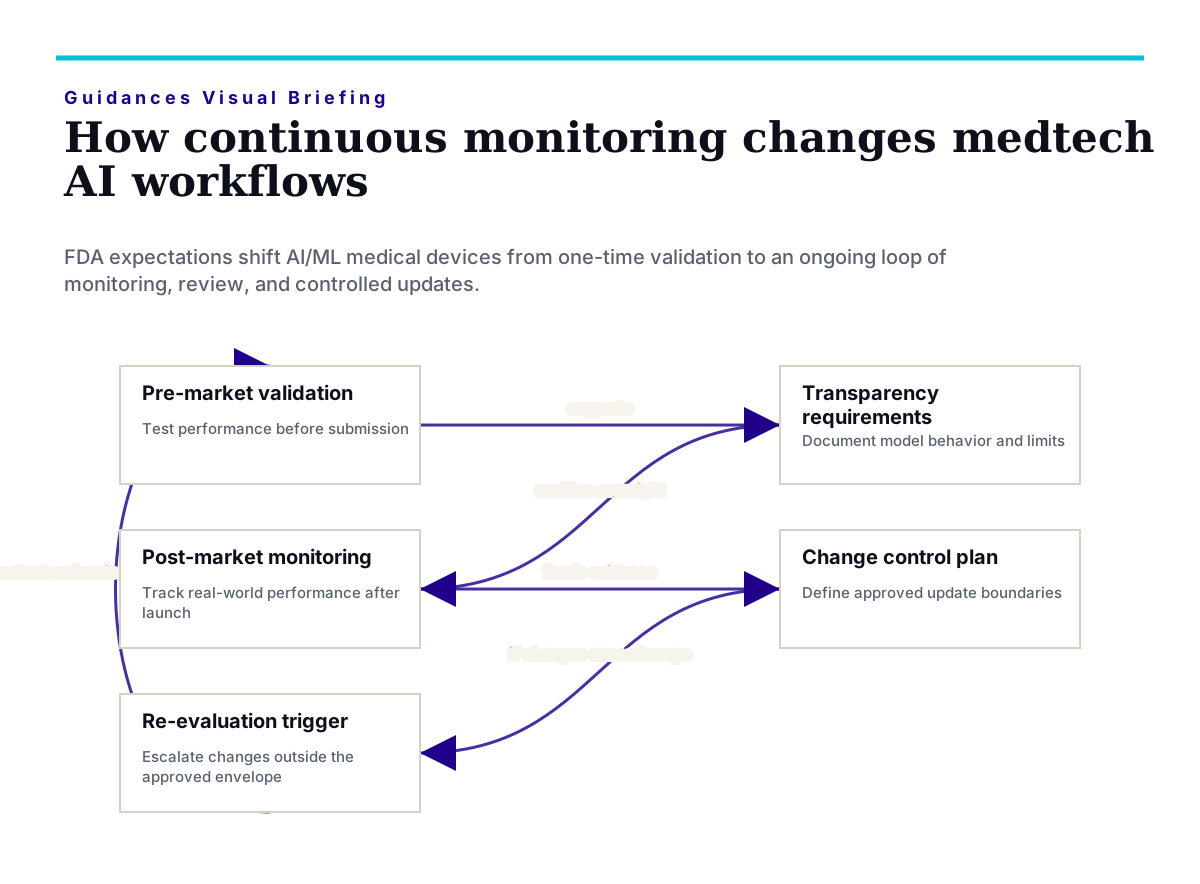
The U.S. Food and Drug Administration has updated guidance for medical devices that incorporate artificial intelligence and machine learning capabilities, according to materials published on the FDA's Digital Health Center of Excellence. The guidance places particular emphasis on three interconnected elements: pre-market validation, transparency in how AI/ML models operate and make inferences, and—most consequentially for product teams—continuous real-world performance monitoring after a device reaches the market.
A note on source dating: the search provider associated this page with a date of May 13, 2024, but that date is unverified provider metadata and should not be treated as the confirmed publication date. The FDA's Digital Health Center of Excellence page is a living regulatory reference that is updated periodically; the collected date for this analysis is June 20, 2026. Regardless of when any specific version was posted, the regulatory framework it describes remains an important reference point for understanding AI/ML medical device submissions today.
Why the Market Cares
Healthcare AI is no longer easy to treat as a purely experimental category. Hundreds of AI-enabled medical devices have already received FDA clearance or approval across radiology, pathology, cardiology, ophthalmology, and clinical decision support. Submission volumes have increased over the past three years, and the FDA's updated guidance reflects a view that the original, largely static validation model—train a model, validate it once, submit—may not be sufficient for software that can adapt or change performance in deployment.
For the medtech sector broadly, this matters because regulatory clarity is an important prerequisite for commercial scale. Investors, hospital procurement committees, and payers all look for a credible regulatory pathway before committing capital or reimbursement decisions. When the FDA signals that continuous monitoring is a core expectation, it can change the compliance baseline for companies building or acquiring AI-enabled clinical tools.
The financial implications may also be meaningful. Medtech companies that have already cleared devices under earlier frameworks may need to add post-market surveillance infrastructure. Startups entering the market now may need to architect for ongoing monitoring from day one, which can affect development timelines and operating cost structures.
Technology and Policy Linkage
The FDA's emphasis on continuous real-world performance monitoring reflects a regulatory philosophy that AI systems in high-stakes domains should be treated as dynamic rather than static artifacts. This aligns with the EU AI Act's classification of certain medical AI as high-risk systems requiring ongoing conformity assessment, and with the IMDRF's international harmonization work on AI/ML-based software as a medical device (SaMD).
For U.S.-focused operators, the practical policy linkage runs through the FDA's Predetermined Change Control Plan (PCCP) framework, which allows manufacturers to pre-specify the types of model updates they intend to make without requiring a new submission for each change—provided those changes stay within the approved envelope. The updated guidance reinforces that this envelope must be defined with precision and that performance changes outside it may require re-evaluation.
Transparency requirements add another layer. The guidance's focus on explainability and model transparency intersects with emerging hospital procurement standards and payer coverage policies. Several large health systems have adopted internal AI governance frameworks that require vendors to disclose model architecture, training data provenance, and known performance limitations. Regulatory guidance that formalizes these expectations at the federal level can influence the baseline for the vendor ecosystem.
Market Lens
Trigger: FDA updated guidance that presents continuous real-world performance monitoring and transparency as core elements for AI/ML medical devices.
Mechanism: Stricter post-market surveillance obligations can increase the operational and infrastructure costs for medtech AI vendors. Companies may need to invest in data pipelines, monitoring dashboards, and re-validation workflows that were previously optional or informal. This can raise the cost of compliance and, in turn, affect barriers to entry, while also creating service opportunities for compliance infrastructure vendors.
Affected sectors: Medical device companies with AI/ML product lines, digital health software vendors, clinical decision support platforms, health IT infrastructure providers, and contract research organizations offering regulatory consulting. Reimbursement dynamics at CMS are a secondary variable: if FDA clearance becomes more demanding, the lag between clearance and coverage decisions may lengthen, affecting revenue recognition timelines for early-stage medtech companies.
Time horizon: The compliance implications may be medium-term (12–36 months) for companies already in the market, and immediate for those in active development or pre-submission. The guidance does not show a hard enforcement deadline in the snippet, but regulatory expectations typically become clearer once formal guidance is published.
Caution: This source is a search-provider snippet from an official FDA page. The specific enforcement timeline, scope of applicability, and any grandfathering provisions for previously cleared devices are not confirmed by the available metadata. The market read-through described above is analytical inference from the regulatory direction, not a confirmed operating or financial impact. This analysis is market context only, not investment advice.
Next check: FDA's official guidance document on the Digital Health Center of Excellence page; any forthcoming FDA final guidance on PCCPs; CMS coverage and reimbursement policy updates for AI-enabled diagnostics; earnings calls from major medtech companies disclosing regulatory compliance costs; and FDA's annual report on AI/ML-based SaMD submissions.
What to Watch Next
Several near-term developments may help clarify how the FDA's updated framework translates into commercial and financial reality.
First, watch for FDA finalization of any draft guidance documents related to AI/ML SaMD that may be in the comment period. Draft-to-final transitions typically signal that regulatory expectations are becoming clearer.
Second, monitor earnings disclosures from medtech companies with significant AI product lines. If compliance infrastructure investment begins appearing as a line item in R&D or SG&A guidance, it may indicate that the regulatory shift is affecting cost structures.
Third, track CMS coverage decisions for AI-enabled diagnostic tools. Reimbursement is the commercial gateway; if FDA's higher bar for continuous monitoring affects clearance timelines, downstream revenue recognition for AI-first medtech companies could shift.
Fourth, observe how hospital systems and integrated delivery networks update their AI procurement policies in response to the FDA's transparency requirements. Procurement standards often move in parallel with regulatory guidance and can affect vendor selection criteria faster than formal enforcement.
Uncertainty and Constraints
The source for this analysis is a search-provider snippet from an official FDA regulatory page. The snippet confirms the existence and general direction of the guidance but does not provide the full text, specific applicability thresholds, enforcement timelines, or transition provisions. All market and operational implications described in this article are analytical inferences grounded in the regulatory direction indicated by the snippet and the known structure of FDA medical device oversight. They should be verified against the full guidance document before any compliance or business decisions are made.
The source page date of May 13, 2024 is unverified provider metadata. The FDA's Digital Health Center of Excellence is a living reference; the analysis here is based on the content as collected in June 2026.