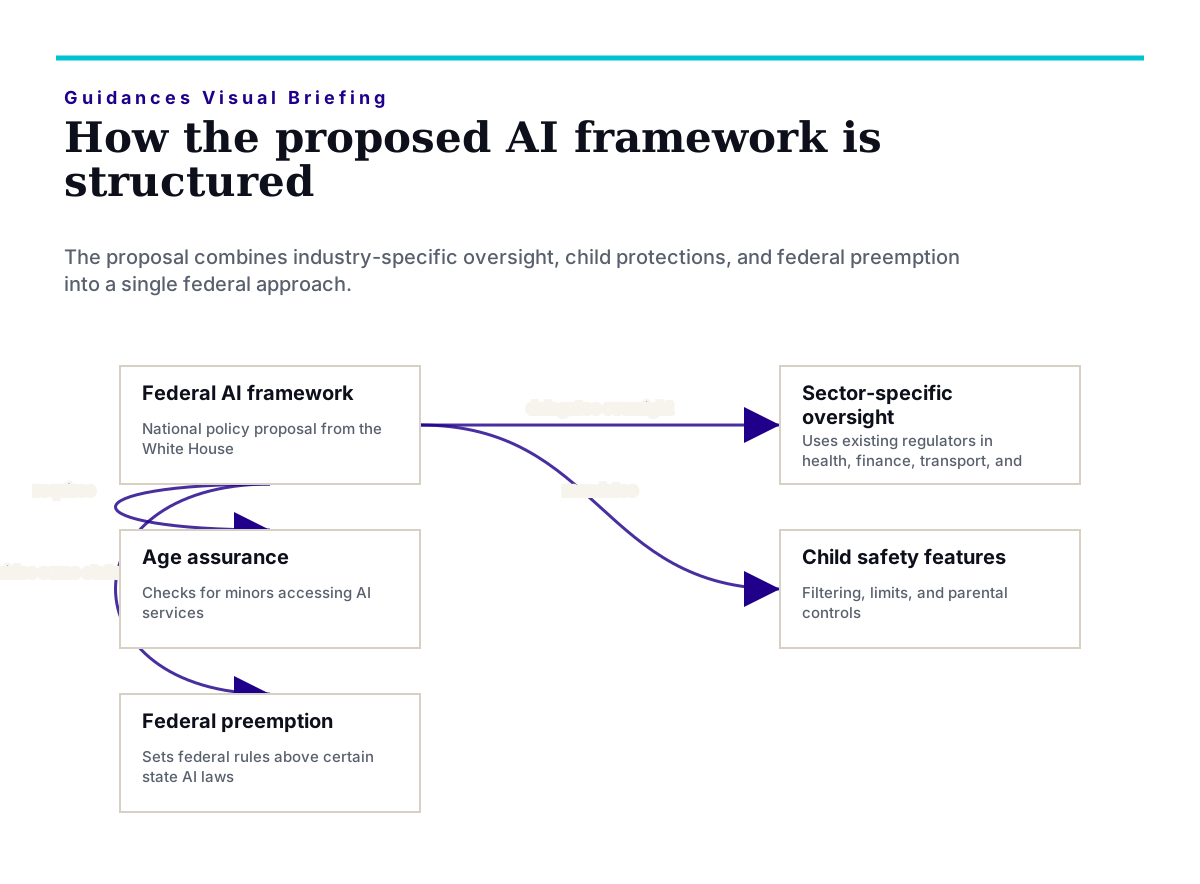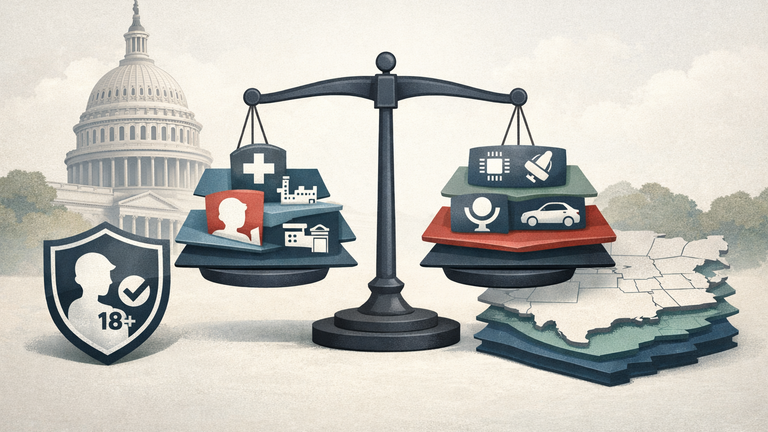
The White House has released a National Policy Framework for Artificial Intelligence containing legislative recommendations on AI regulation. The document outlines sector-specific oversight, age assurance for minors, child safety features, and federal preemption of certain state AI laws as key elements.
Sector-Specific Oversight
A central element of the recommendations is an approach that varies oversight according to the industry in which AI is used. Healthcare, finance, transportation, and energy already have existing regulatory structures, and the White House proposes using those frameworks to address AI-related issues.
This approach differs from the European Union's AI Act. While the EU has adopted a horizontal, risk-based framework, the United States appears to place greater emphasis on industry-specific expertise. Existing agencies such as the FDA, FTC, and SEC could play roles within their respective jurisdictions.
AI services that operate across multiple sectors may need to review several sets of requirements. For example, a system that processes both healthcare and financial data would need to consider the relevant standards in each area.
General-purpose AI systems may also require review to determine which framework applies. Foundation models and large language models, which can be used across many domains, may need to align with multiple requirements.
Age Assurance for Minors
Another element of the recommendations is age assurance for AI services accessible to minors. This could apply to social media, generative AI chatbots, and online gaming services.
The proposal is connected to discussions about modernizing the Children's Online Privacy Protection Act (COPPA). Current COPPA requires parental consent for collecting personal information from children under 13, but some observers say it does not fully reflect newer AI-related contexts such as interactions with generative AI and personalized influence.
Age assurance technologies may require additional personal data collection, making privacy considerations important. Methods under discussion include facial recognition, credit card verification, and third-party age verification services.
The effectiveness of age assurance also depends on enforcement. Technical requirements and compliance verification would both need to be addressed.
Child Safety Features
The recommendations also call for child safety features in AI systems. These may include content filtering, blocking harmful interactions, limits on excessive use, and parental control tools.
For generative AI, separate safety settings may be used to limit certain topics or forms of advice in interactions with children. Some companies already offer safety modes for minor users, and federal standards could establish baseline requirements.
These features would require additional design and review during development. Key issues include filter accuracy, support for different languages and cultural contexts, and minimizing false positives.
The scope of appropriate safety features may be discussed by stakeholders such as parents, educators, child development experts, and civil liberties advocates.
Federal Preemption of State AI Laws
Another major element of the recommendations is federal preemption of certain state AI laws. This is presented as a response to the growing number of state-level initiatives in places such as California, New York, and Illinois.
Federal preemption follows the Supremacy Clause, under which federal law takes precedence over state law. The White House appears to view divergent state rules in a national technology area like AI as a factor that could complicate compliance planning for businesses.
At the same time, preemption raises questions about the role of states. States have often introduced standards in areas such as consumer protection, privacy, and labor before federal action. California's CCPA and Illinois's BIPA have also influenced federal discussions.
The fact that the recommendations refer to certain state laws suggests that the intent may be to address specific conflicts rather than eliminate all state legislation. The exact scope would be determined during the legislative process.
Whether federal standards would serve as a minimum floor or a maximum ceiling is another important issue. That question is likely to be central in future debate.
Legislative Process
The White House recommendations do not have legal force on their own. For them to become law, Congress would need to act and the president would need to sign the legislation. Congress has shown interest in AI regulation, though views differ on the best approach.
Different political groups may emphasize innovation, regulation, consumer protection, or privacy to varying degrees. Sector-specific oversight and federal preemption align with some policy approaches, while child protection provisions may attract bipartisan discussion.
The legislative process may include input from the technology industry, civil society, academia, and state governments. Large technology companies and startups may take different positions depending on the scope and design of the rules.
The timeline remains uncertain. AI regulation has been discussed in Congress for several years, and this proposal may move the discussion forward, though detailed issues will still need review.
International Context
The proposal also fits into a broader international context. The European Union has passed the AI Act, and China has implemented rules for generative AI and recommendation algorithms. U.S. federal discussions are therefore relevant to global AI governance.
The United States is also considering the impact on innovation and competitiveness. The sector-specific approach is described as one way to use existing industry frameworks.
Alignment with international standards is another factor. If U.S. federal standards differ significantly from those in the EU or elsewhere, global companies may need to review multiple frameworks. Greater alignment could support international cooperation.