What Happened
A research team spanning IBM Research, the Swiss Federal Institute of Technology Lausanne (EPFL), and ETH Zurich published an open-access study in a Nature Chemistry-family journal on June 19, 2026, describing the fine-tuning of a Granite-based large language model to generate synthesis procedures for single-atom catalysts (SACs). The team assembled a curated dataset of 2,964 SAC-related publications and trained the model to recommend synthesis protocols in response to user-defined prompts covering metal-support combinations, synthesis methods, and target chemical reactions. The manuscript was released in an unedited early-access format.
Single-atom catalysts represent one of the more technically demanding areas in heterogeneous catalysis. Each catalyst consists of individual metal atoms dispersed on a support material, maximizing atomic efficiency and enabling highly selective chemical reactions. The design space is substantial: the combination of metal species, support materials, synthesis conditions, and target reactions creates a parameter landscape that is difficult to navigate systematically, particularly as the relevant literature has grown considerably over the past decade.
Philippe Schwaller, a researcher in machine learning for chemistry at EPFL, and Javier Pérez-Ramírez, a catalysis researcher at ETH Zurich, are among the co-authors. Their institutional affiliations and research backgrounds are verifiable facts that establish the academic context of the work.
The Technical Structure of the Research
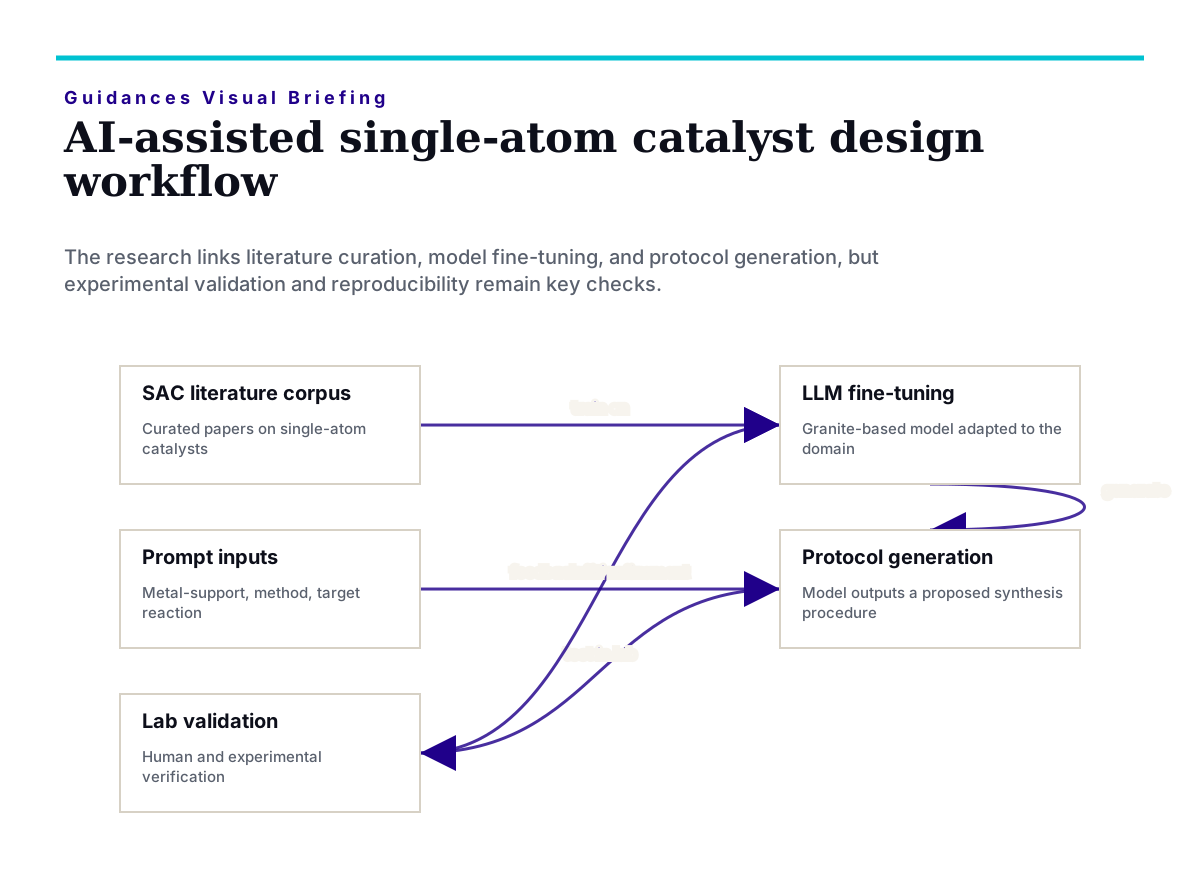
The study's core contribution operates across three layers. First, dataset construction: 2,964 SAC-related publications were selected and curated to form a domain-specific training corpus. Whether the full dataset has been made publicly available is not confirmed by the source snippet alone.
Second, model fine-tuning: IBM's Granite-based LLM was fine-tuned on this dataset to produce a model specialized in generating SAC synthesis protocols. Granite is IBM's open-weight model family, positioned as an enterprise-oriented alternative to proprietary frontier models.
Third, prompt-based protocol generation: the system accepts user inputs specifying metal-support combinations, synthesis methods, and target reactions, then outputs synthesis protocols. This approach represents an attempt to automate the extraction of actionable procedures from a large body of scientific literature.
Quantitative performance metrics—such as the model's accuracy in generating chemically valid protocols, its comparison against human expert baselines, or its performance across different metal-support combinations—are not available from the unedited early-access snippet. Readers should consult the full open-access paper for technical evaluation.
Technology and Policy Linkage
The research intersects with several active policy and technology contexts.
Open access and licensing: The paper was published under a Creative Commons Attribution 4.0 International license (CC BY 4.0). CC BY 4.0 permits reproduction, distribution, derivative works, and commercial use, subject to attribution. This means the dataset curation methodology and model training approach are, in principle, available for replication and extension. Whether replication is practically feasible depends on additional factors including the scope of data made publicly available, computational resources, and domain expertise.
Regulatory environment: The EU AI Act includes provisions concerning high-risk AI systems in scientific and industrial applications. Whether the model developed in this study would be classified as a high-risk system under the AI Act, or what specific obligations would apply, is not established by the available source. As a general matter, organizations considering commercial deployment of domain-specific fine-tuned models in industrial synthesis planning would typically review applicable regulatory requirements—including training data provenance documentation, model behavior records, and human oversight protocols—as part of standard engineering practice.
Clean energy policy context: Single-atom catalysts are directly relevant to hydrogen evolution reactions, CO₂ reduction, and nitrogen fixation—areas that feature in the U.S. Department of Energy's clean energy programs, the EU's Horizon Europe framework, and analogous national initiatives in South Korea, Japan, and China. Whether these programs explicitly support AI-assisted materials design tools of this type should be verified through each program's official documentation.
Market Lens
Trigger: Publication of a peer-reviewed, open-access study demonstrating that a fine-tuned LLM can generate synthesis protocols for single-atom catalysts using a dataset of nearly 3,000 publications.
Observable fact: IBM's Granite model was used as the base architecture in a scientific application study published in a Nature Chemistry-family journal. This is a verifiable fact. Whether and how this affects IBM's enterprise sales cycles, procurement decisions, or revenue is not supported by the available source and is not asserted here.
Potentially connected sectors (within source-supported scope): AI infrastructure providers with enterprise model offerings (IBM's Granite ecosystem is directly named in the source); specialty chemicals and advanced materials companies that invest in catalysis R&D; laboratory automation and scientific instrumentation vendors whose systems would need to interface with AI-generated protocols. Whether these sectors would experience material demand changes as a result of this research is not determinable from the available source.
Uncertainty: Any direct connection between this publication and near-term revenue, stock price movement, or procurement decisions for IBM or any named institution is not supported by the source. This analysis is provided for informational context and should not be used as a basis for investment decisions.
Next check: Follow-on publications from the same research group reporting expanded datasets or multi-task model capabilities; official IBM Research announcements about Granite's scientific application pipeline; procurement notices from national laboratories or clean energy programs that explicitly reference AI-assisted materials design; the EU AI Act's implementation timeline for high-risk industrial applications.
What to Watch Next
Several developments would materially advance the ability to assess this research's broader significance.
Independent replication: The dataset of 2,964 publications is curated, but whether the full dataset has been publicly released is not confirmed by the available source. The research community's ability to reproduce and extend the results is a key variable in determining how quickly the methodology could diffuse into other research or commercial contexts.
Comparison against general-purpose models: Whether Granite's domain-specific fine-tuning provides meaningful performance advantages over prompting larger general-purpose models is not addressed in the available source snippet. The answer to this question would have direct implications for build-versus-buy decisions at industrial R&D organizations, but it cannot be assessed without access to the full paper.
Integration with robotic laboratory platforms: Closing the loop between AI-generated protocols and physical experimentation is a natural extension of this line of research. Whether the authors or their institutions are pursuing integration with self-driving laboratory platforms is not indicated by the available source and would need to be confirmed through subsequent publications or official announcements.
Full paper access: This analysis is grounded in a search-provider snippet of an unedited early-access manuscript. Quantitative performance metrics, methodological details, and the authors' own discussion of limitations are only accessible through the full open-access paper.
Uncertainty and Constraints
The source available for this analysis is a search-provider snippet of an unedited early-access manuscript. As a result, the following cannot currently be confirmed: the model's accuracy in generating chemically valid protocols; comparison against human expert baselines; performance across different metal-support combinations; the full public availability of the dataset; and whether any commercial deployment is planned. The analysis above is grounded in verifiable metadata: author affiliations, dataset size, model family, publication venue, and licensing terms. Readers should consult the full open-access paper for technical evaluation.