What Happened
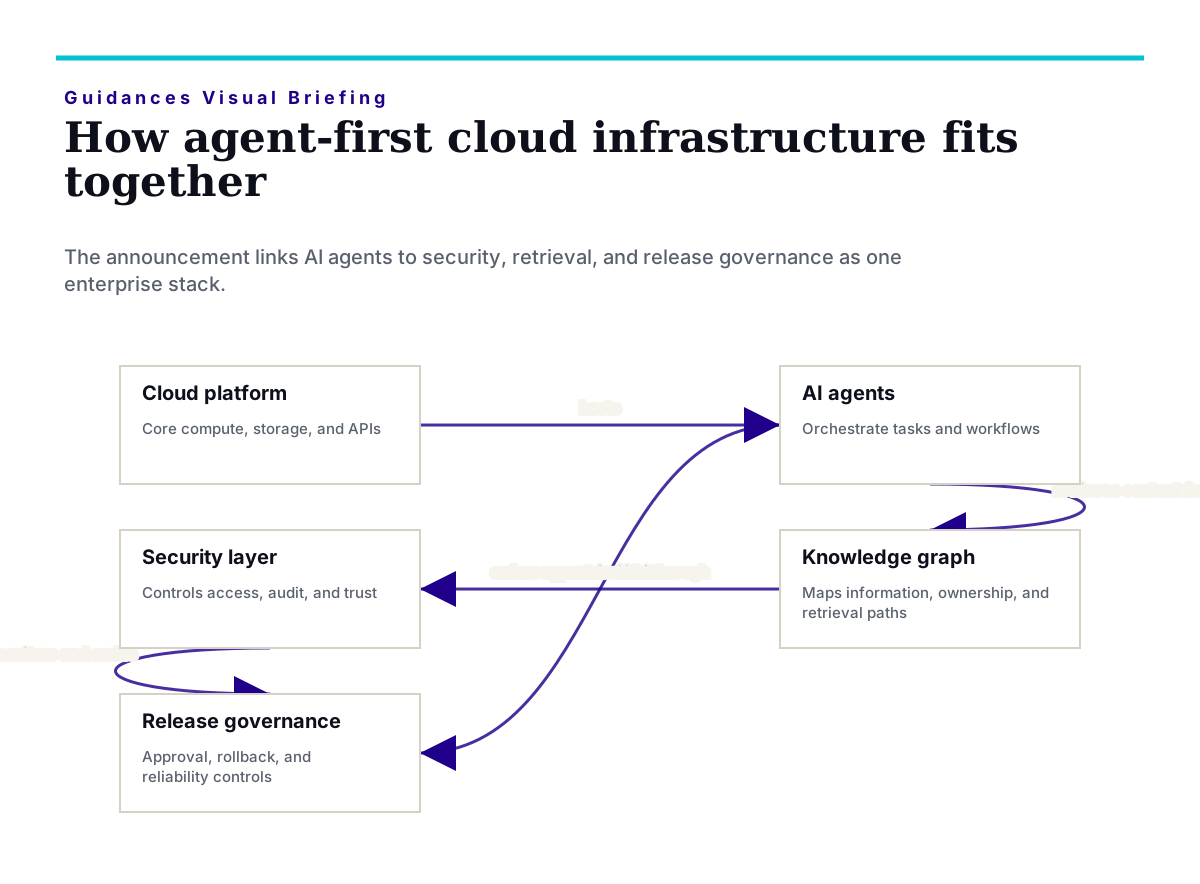
At AWS Summit New York 2026, Amazon Web Services presented a product set centered on AI agents. The core message was that AI agents should be treated not as an add-on to cloud services, but as a central unit for how enterprises consume and deliver software.
The headline additions span several product categories. AWS Continuum was introduced as an AI-native security service designed for agentic workloads. AWS Context was described as a knowledge graph that maps where organizational information resides and helps agents retrieve and use that information through structured pathways. Expanded capabilities were also announced across Amazon Bedrock AgentCore, AWS DevOps Agent, Amazon Q, Kiro, and AWS Transform.
DevOps Agent was framed more as a release-management layer than as a code-generation assistant. AWS emphasized safety and reliability controls built into the software shipping workflow. That framing suggests agents are being positioned to take on more integrated roles in enterprise operations.
AWS Context is one of the more architecturally notable announcements. Enterprise AI deployments have often run into retrieval and reasoning challenges, and agents without reliable access to internal context can produce inconsistent outputs. A structured knowledge graph that sits between agents and enterprise data—mapping information ownership, access permissions, and retrieval pathways—addresses that issue at the infrastructure layer.
Why the Market Cares
AWS is one of Amazon's major revenue drivers, and enterprise cloud usage remains an important variable for its growth. Against the backdrop of $716.9B in annual revenue and +12.4% year-over-year revenue growth, the market is watching whether AI agents can influence enterprise usage patterns and commitment structures.
Competition is active. Microsoft Azure has embedded Copilot-based agents across its enterprise product stack, while Google Cloud has expanded Gemini-powered agent capabilities into enterprise accounts. AWS will need to show how its agent infrastructure aligns with the reliability, security, and governance requirements of large enterprise deployments.
Amazon's market capitalization of $2.63T provides scale context for why even modest changes in enterprise AI adoption can matter for AWS revenue mix and customer usage. Enterprises that standardize on AWS's agent infrastructure may also increase consumption of adjacent services such as compute, storage, security tooling, and data services. That fits the familiar cloud usage-expansion pattern.
The agent infrastructure layer may also affect the broader enterprise software market. If agent layers abstract away parts of traditional application interfaces, SaaS and independent software vendors may need to reassess where value accrues in the enterprise stack over time.
Tech / Policy Link
The product architecture shown at the Summit reflects a broader industry reassessment of what enterprise AI deployment requires in practice. Large language models alone do not necessarily constitute deployable enterprise software; agents also need orchestration, persistent memory, access controls, audit trails, and reliable retrieval mechanisms. AWS's announcements address those layers together.
AWS Continuum's positioning as an AI-native security service is relevant from a compliance perspective. As regulatory frameworks around enterprise AI continue to evolve—including EU AI Act implementation, changing U.S. federal guidance, and sector-specific rules in finance and healthcare—enterprises face pressure to show that their AI deployments are auditable and controllable. A security service designed for agentic workloads can be read as one response to that need.
AWS Context's knowledge graph architecture also has policy implications beyond technical convenience. Enterprises subject to data residency requirements, information barrier rules, or sector-specific data governance mandates need infrastructure that can enforce access controls at the retrieval layer. A structured knowledge graph that maps information ownership and access permissions offers one way to make that control more explicit.
The combination of Continuum and Context suggests AWS is paying attention to regulated enterprise verticals such as financial services, healthcare systems, and government contractors, where security and governance requirements are important. The extent of actual adoption will need to be confirmed through customer examples and disclosures.
Market Lens
Trigger: AWS Summit New York 2026 product announcements, including AWS Continuum, AWS Context, and Bedrock AgentCore expansions.
Mechanism: If enterprise customers adopt AWS's agent infrastructure at meaningful scale, usage-based AWS consumption could rise as agents drive higher compute, storage, and API call volumes per customer. Deeper agent integration may also increase switching costs, and if the knowledge graph and security layers are adopted alongside it, additional stickiness could emerge.
Affected sectors: Cloud infrastructure providers (AWS, Microsoft Azure, Google Cloud) may see competitive shifts. Enterprise software vendors whose products could be supplemented or partially restructured by agent orchestration layers may face longer-term changes. AI chip manufacturers that support agent inference workloads could see changes in compute intensity per customer. Cybersecurity vendors may need to assess how AWS Continuum fits into the competitive landscape. The broader enterprise SaaS sector may also need to track interface changes as agent layers mature.
Time horizon: Early signals may appear in AWS quarterly revenue disclosures and enterprise customer commentary. Meaningful revenue contribution from agent-specific workloads may become clearer over a 12-to-24-month horizon, depending on procurement cycles, integration complexity, and regulatory clarity.
Next check: AWS segment revenue in Amazon's next quarterly earnings report; enterprise customer case studies and consumption data disclosed at re:Invent 2026; competitive announcements from Microsoft Build and Google Cloud Next; and any regulatory guidance on AI agent governance in enterprise settings.
Scale context only: Amazon's market capitalization stands at $2.63T, annual revenue at $716.9B, and year-over-year revenue growth at +12.4%. These figures are cited as business-scale context. This analysis is market context only, not investment advice. No recommendation to buy, sell, or hold any security is expressed or implied.
What to Watch Next
Several near-term indicators will help clarify whether the Summit announcements translate into durable enterprise adoption or remain primarily product positioning.
The most direct signal may come from AWS's next earnings disclosure. Observers can watch for commentary on agent-related workload growth, new enterprise commitments tied to Bedrock or DevOps Agent, and any changes in AWS revenue growth associated with AI infrastructure spending. Management commentary on the pace of enterprise AI adoption—and any friction points customers report—may be more informative than headline revenue figures alone.
The competitive response from Microsoft and Google will also shape market interpretation. If Azure or Google Cloud announce comparable knowledge graph or AI-native security capabilities, the differentiation implied by AWS Context and Continuum could narrow. If AWS maintains a meaningful lead in enterprise agent infrastructure architecture, expectations for medium-term AWS consumption growth may strengthen.
Enterprise procurement behavior remains the key test. Large organizations move slowly, and the gap between Summit announcements and signed contracts can span multiple quarters. Early signals from major system integrators that build and implement on AWS for large enterprise clients may show whether the agent infrastructure is being incorporated into active projects.
The regulatory environment is still evolving. Guidance from EU AI Act implementation bodies, U.S. federal agencies, or finance and healthcare regulators could affect the pace of adoption or the product requirements for compliant agent infrastructure.
Uncertainty and Constraints
The source for this analysis is an official AWS event summary snippet. Full technical specifications, pricing structures, geographic availability timelines, and independent customer adoption data are not available from the snippet alone. Claims about product capabilities are drawn from AWS's own event communications and should be verified against technical documentation and independent assessments before informing procurement or architecture decisions.
The market interpretations above are analytical inferences based on the announced product direction and Amazon's publicly reported financial scale. They are not predictions of specific revenue outcomes or stock price movements. The pace of actual enterprise adoption remains the key unknown variable.