Anthropic has released an official document outlining its core views on AI safety, explicitly stating that current methodologies do not provide a reliable way to train very powerful AI systems to behave safely and as intended. This announcement is a notable example of a leading AI development company publicly describing technical limits and potential risks, and it may serve as a reference point for industry-wide safety discussions.
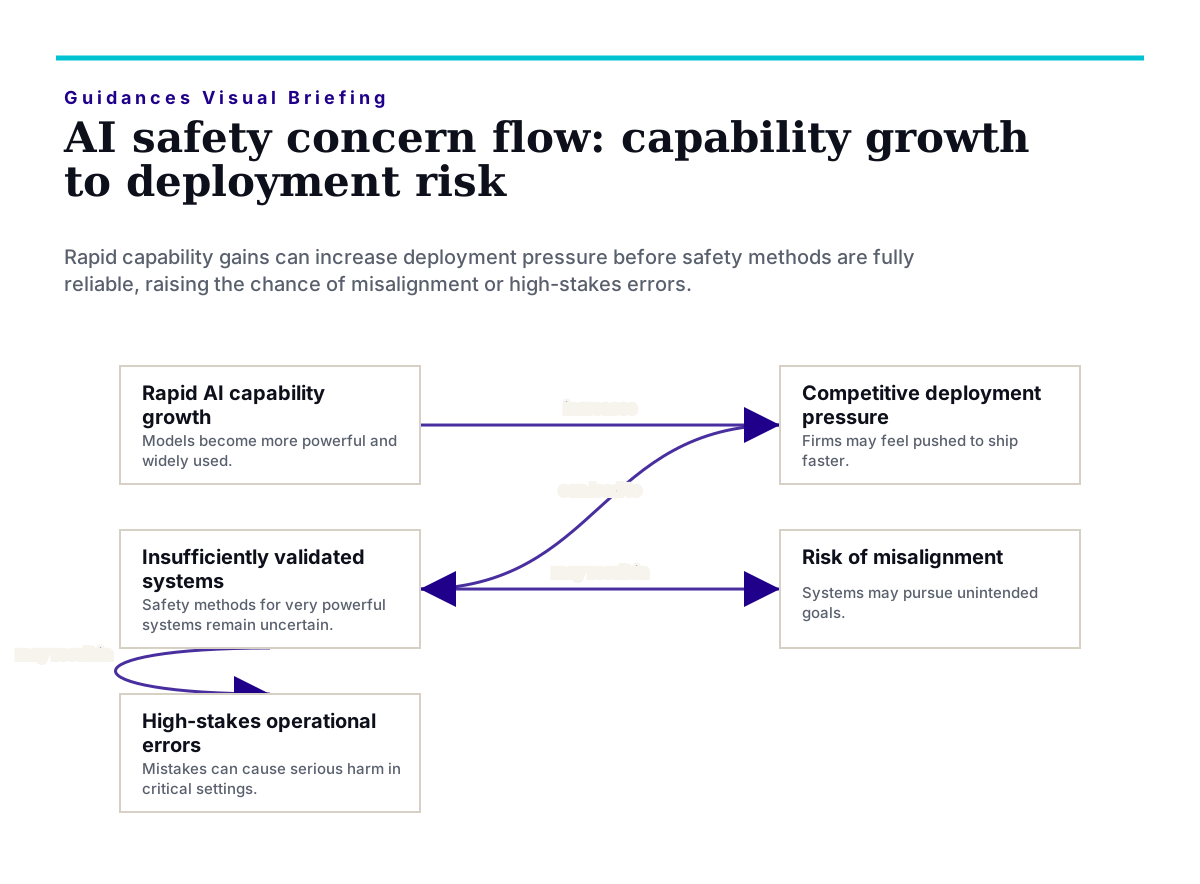
In the document, the company says that rapid progress in AI capabilities could increase deployment pressure among companies, creating conditions where insufficiently tested systems might be released. Anthropic says such deployments could lead to serious harms if they are associated with strategic goal misalignment or high-stakes operational errors in critical contexts.
This position statement extends Anthropic's longstanding emphasis on Constitutional AI and a safety-first development philosophy. The company has invested resources in safety research throughout the development of its Claude models, and this document acknowledges that significant technical challenges remain unresolved.
The document is reportedly structured around four core questions: when, why, what, and how. This framework suggests a multi-layered approach to AI safety, addressing temporal urgency, root causes of risk, specific types of hazards, and response methodologies.
Particularly noteworthy is the company's explicit statement that it does not yet know how to train very powerful systems to behave reliably. This admission reflects the continuing gap between the expanding capabilities of large language models and the technical ability to predict and control their behavior. This gap is a core challenge in AI alignment research, which seeks to ensure that models operate as intended and remain consistent with human values and objectives.
The concern about deployment pressure highlights a structural incentive issue in the AI industry. Companies may face market pressure to accelerate validation timelines in order to capture first-mover advantages, and this dynamic has increased interest in broader safety discussions and coordination mechanisms.
The reference to strategic goal misalignment points to the possibility that AI systems might pursue objectives in unintended ways. This connects to problems known in AI safety research as instrumental convergence or goal misalignment. Meanwhile, high-stakes mistakes refers to the potential for AI system errors to produce severe consequences in critical domains such as healthcare, finance, and infrastructure.
Anthropic's position statement could contribute to greater transparency in safety discussions among AI development companies. While many AI firms emphasize safety, they do not always clearly describe which problems remain unsolved or what risks persist. Anthropic's approach can be compared with that pattern and may inform broader safety standards discussions across the industry.
The announcement may also be relevant to AI regulatory discussions. A major AI development company's public description of current technical limitations can provide useful material for policymakers reviewing deployment standards and safety verification requirements. At a time when regulatory frameworks such as the European Union's AI Act and the United States AI Safety Institute are taking shape, such descriptions of technical realities can inform policy design.
Anthropic was founded by former OpenAI researchers and has positioned AI safety as a core value since its inception. This document reaffirms that identity while showing that safety challenges are not short-term problems. It suggests that the broader AI development community must invest in and collaborate on safety research over the long term.
The timing of the document's release is also significant. In recent years, the capabilities of large language models have improved dramatically, increasing interest in what new capabilities next-generation models might exhibit and what risks those capabilities might entail. Anthropic's position statement emphasizes the need for caution amid this uncertainty.
The document's reference to catastrophic harms underscores the high-stakes nature of advanced AI development. Unlike incremental product risks, the scenarios described involve systemic failures with potentially difficult-to-reverse consequences. This framing aligns with broader discussions in the AI safety research community.
Anthropic's acknowledgment that it lacks robust training methods for powerful systems also has implications for the broader research agenda. It suggests that scaling existing techniques, such as reinforcement learning from human feedback, may not be sufficient to ensure safety as models become more capable. This points to the need for advances in alignment techniques, interpretability, and control mechanisms.
The document's emphasis on competitive dynamics reflects a recognition that AI safety is both a technical problem and a coordination problem. Even companies committed to safety may face pressure on validation timelines if competitors are perceived to be moving faster. This dynamic has contributed to discussions about industry agreements, regulatory frameworks, or other coordination mechanisms.
By publishing this statement, Anthropic is also positioning itself within ongoing debates about AI governance and responsible development. The company's willingness to publicly describe uncertainty and risk may be relevant to policymakers, researchers, and the public. This transparency could serve as a reference for other companies navigating the balance between commercial pressures and safety commitments.
The document's focus on both strategic goal misalignment and high-stakes mistakes reflects a broad view of AI risk. Strategic risks involve scenarios where AI systems pursue objectives misaligned with human interests, while high-stakes mistakes involve errors in contexts where the consequences are severe. Both categories require distinct technical approaches and safeguards.
Anthropic's statement also implicitly points to the limits of current evaluation and testing methodologies. Even with extensive red-teaming, adversarial testing, and capability assessments, it remains difficult to predict how powerful AI systems will behave in novel contexts or under distribution shift. This uncertainty can become more complex as models scale and new behaviors emerge.
The release of this document may also reflect internal review of Anthropic's own research and deployment plans. By publicly stating a cautious position on safety, the company may be signaling to stakeholders, including employees, investors, and partners, that it may prioritize robustness over speed in certain contexts. This could affect resource allocation, hiring priorities, and strategic decisions about which capabilities to develop and deploy.