What Happened
According to a CNBC report, Anthropic chief executive Dario Amodei and Google DeepMind chief executive Demis Hassabis used a closed-door working lunch at the G7 summit in Évian-les-Bains, France, to raise the idea of a U.S.-led international coalition on artificial intelligence. The meeting reportedly included heads of state and technology leaders, and President Donald Trump was among the attendees. The report says the executives argued for a form of international cooperation in which the United States would play a leading role in shaping AI rules and standards.
This was not a product launch, a funding event, or a quarterly earnings disclosure. It was a governance signal delivered at a highly visible diplomatic forum. The distinction matters: when senior AI executives appear alongside heads of state to discuss policy architecture, the conversation has moved beyond the conference circuit and into the diplomatic record.
The source material is a snippet, so the exact wording of the proposal, the reactions of other governments, and any formal follow-up remain unconfirmed. This analysis stays within what the snippet supports.
Why the Market Cares
AI competition has often been framed as a race for model capability. This episode suggests there is now another layer: who sets the rules. That matters for markets because policy can affect the cost structure and reach of AI deployment.
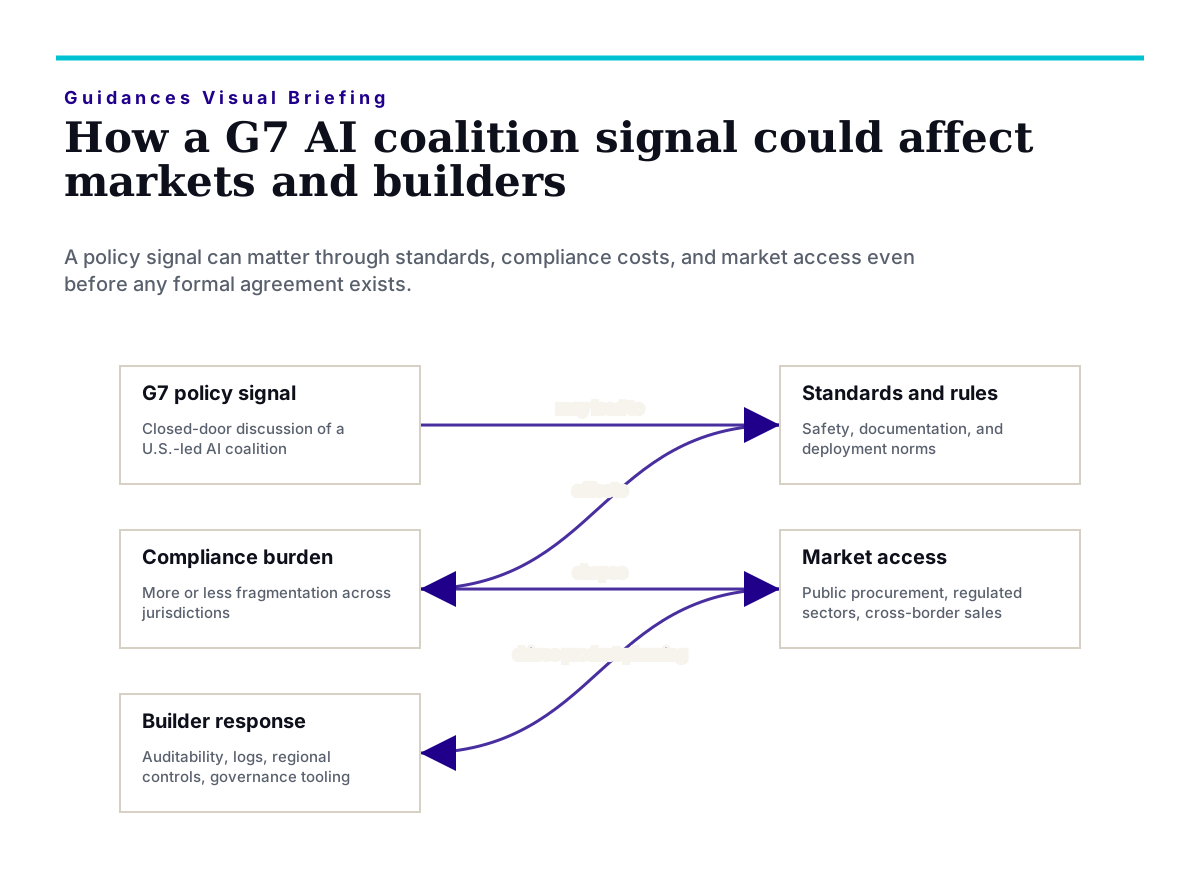
Compliance architecture influences costs. If international standards converge around a common framework, large AI platforms may be able to maintain a more consistent product design across jurisdictions. If standards diverge, the same platforms may need to manage multiple regulatory paths at once, which can increase operating complexity and affect launch timing and legal review processes.
Market access is also relevant. Public-sector contracts, regulated-industry deployments, and cross-border enterprise sales increasingly depend on whether a product meets recognized safety, transparency, and accountability standards. A U.S.-led coalition, if it produced widely adopted norms, could become a reference point for those requirements.
Alphabet, the parent company of Google DeepMind, has a market capitalization of $4.45T and annual revenue of $403.0B, with year-over-year revenue growth of +15.1%. Those figures are included as scale context only and do not imply any direct financial effect from the G7 discussion. Anthropic is privately held, so no listed-equity signal is directly observable from that side of the conversation.
Technology and Policy Linkage
The technology-policy connection here operates on several levels.
First, there is the standards layer. AI models are global products, but the rules governing their deployment remain jurisdiction-specific. The European Union has its AI Act. The United States uses executive orders and agency guidance. Other G7 members have their own frameworks at different stages of development. A coalition anchored by the United States would be an attempt to reduce that fragmentation, potentially aligning evaluation methods, safety documentation requirements, and deployment controls across participating governments.
Second, there is the infrastructure layer. AI deployment depends on chips, networking, power, cooling, and data-center capacity. Policy coordination can influence where those assets are built, how quickly they receive regulatory approval, and which customers are allowed to use them. Export controls on advanced semiconductors are already an example of how policy shapes AI infrastructure. A broader governance coalition could extend that logic into model deployment, data handling, and cross-border compute access.
Third, there is the competitive-order layer. The entity that defines the rules first often influences the market structure that follows. If U.S.-aligned standards become the de facto international baseline, companies already operating under U.S. regulatory frameworks may face lower incremental compliance costs when entering allied markets. That is a possible structural effect, not a guaranteed outcome, and it depends heavily on whether other G7 members and non-G7 AI powers accept the framework.
The available material does not support direct claims about specific semiconductor companies, cloud ETFs, or infrastructure funds. Those links remain unverified. The mechanism, however, is clear: policy coordination can affect the economics of AI capital expenditure and market access in ways that may later show up in earnings, capex guidance, and enterprise sales cycles.
Market Lens
Trigger: A CNBC report says Anthropic and Google DeepMind leaders raised the idea of a U.S.-led AI coalition during a closed-door G7 working lunch in France.
Mechanism: The trigger is a policy signal rather than an operating event. The market mechanism runs through compliance cost, deployment speed, and cross-border market access. Stronger international coordination could reduce fragmentation costs for large AI platforms, while weaker or stalled coordination could increase regulatory uncertainty and affect enterprise adoption and infrastructure investment timing.
Potentially affected sectors: Large AI platforms, cloud computing, semiconductor supply chains, data-center operators, power and cooling infrastructure, and enterprise software tied to AI deployment are among the sectors that could be relevant. Any direct ticker-level price effect is not confirmed by the provided snippet alone. Alphabet is the most directly observable public-market company connected to the event through Google DeepMind's participation, but the snippet does not support a claim of immediate operating or financial impact.
Time horizon: Medium term. A single closed-door meeting is unlikely to drive a major market repricing on its own. The more relevant horizon is the next policy document, summit communiqué, regulatory consultation, or company guidance on compliance and capital expenditure.
Next check: Watch for a G7 joint statement, U.S. AI policy follow-up actions, European regulatory responses, and any company disclosures that reference safety standards, deployment controls, or international governance frameworks. For public markets, a useful checkpoint is whether policy language begins to appear in earnings calls, capex plans, or enterprise sales commentary from major AI platform operators.
This section is market context only, not investment advice.
What to Watch Next
The central question is whether this proposal remains a diplomatic talking point or becomes a working policy agenda with defined scope, participating governments, and adoption or enforcement mechanisms.
If it becomes the latter, three details will matter most to market observers. First, scope: does the coalition address safety evaluation, data governance, export controls, public procurement, or all of the above? Second, alignment: do European and Asian regulators accept the U.S.-led framework, or does it produce a parallel standards track? Third, binding nature: are standards voluntary, tied to procurement eligibility, or linked to market-access conditions?
A secondary signal to watch is whether large AI companies begin to frame their public communications around international governance more explicitly. If governance language starts appearing in investor presentations, product documentation, and enterprise sales materials, it would suggest the policy layer is becoming part of go-to-market strategy rather than a background public-affairs issue.
For operators and founders, the relevant question is not whether AI regulation will exist, but whether it will become predictable enough to plan around. Predictable regulation, even if demanding, is generally easier to navigate than uncertain regulation for companies making long-horizon infrastructure and product investments.
Uncertainty and Constraints
Several important caveats apply to this analysis. The source is a snippet from a closed-door meeting, so the exact wording of the proposal, the reactions of other governments, and any formal commitments are unconfirmed. There is no published communiqué, draft framework, or official policy document in the available material.
Anthropic is a private company, which limits the ability to observe any market reaction directly. Alphabet's scale figures are provided as context, not as evidence of a specific financial effect from this event. The article does not assert any near-term earnings impact, price movement, or valuation change for any company.
This analysis is market context only. It is not investment advice, and it does not constitute a recommendation to buy, sell, or hold any security.