What Happened
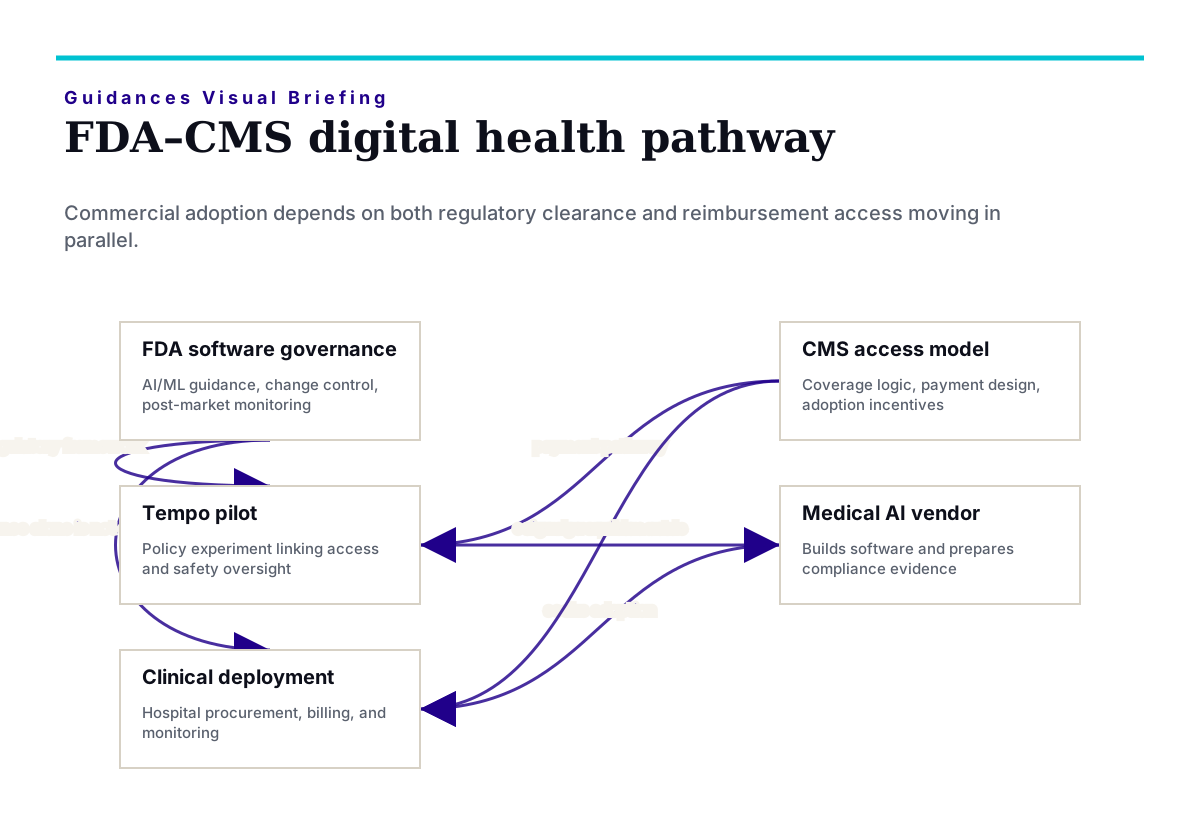
The FDA's Digital Health Center of Excellence — the agency's dedicated policy hub for software-based medical tools — carries ongoing guidance on AI and machine-learning software, and an April 2026 update to that page references the Tempo pilot. That pilot is connected to the Center for Medicare and Medicaid Innovation's access model, a CMS mechanism designed to promote uptake of certain digital health devices while maintaining safety oversight.
The source for this article is a search-snippet metadata record from the FDA's official page, collected in mid-June 2026. The underlying page text was not retrieved in full, and the publication date is not machine-verified. That means the precise scope, eligibility criteria, and legal force of the Tempo pilot cannot be confirmed from the available material alone. What can be confirmed is that the FDA is treating AI/ML software as a distinct governance category, and that a CMS-linked access model is part of the current policy landscape.
That combination — FDA software governance plus CMS access design — is the structural story. It is not about whether a specific product works. It is about whether the institutional plumbing that connects product approval to clinical deployment and payment is being assembled in a coherent way.
Why the Market Cares
Digital health has a commercialization problem that is separate from its technology problem. AI-enabled medical software can be developed and even cleared relatively quickly. The harder constraint is the path from clearance to widespread clinical use, which runs through hospital procurement committees, payer coverage decisions, billing code availability, and post-market monitoring requirements. Each of those gates can delay or block adoption even when the underlying product is technically sound.
The reason FDA and CMS coordination matters to market participants is that it can compress or extend that path. When the two agencies operate on separate timelines — FDA clearing a product while CMS has no coverage pathway — vendors face a gap between regulatory approval and commercial revenue. That gap is a known risk in digital health and a known operational challenge for founders. Conversely, when guidance and reimbursement logic develop together, the adoption curve can steepen.
For listed companies in healthcare IT, medical devices, and clinical workflow software, the policy environment is a material variable. It affects how quickly a product can be sold into hospital systems, whether payers will reimburse its use, and what documentation and monitoring infrastructure the vendor must maintain. None of that is speculative; it is the standard operating environment for any company selling software into regulated care settings.
The broader market exposure extends further. Cloud infrastructure providers, data platform vendors, and interoperability software companies all sit upstream of clinical AI deployment. If the regulatory and reimbursement environment becomes more legible, the total addressable market for those infrastructure layers becomes easier to size. If it remains fragmented, enterprise sales cycles stay long and unpredictable.
Technology and Policy Linkage
AI and machine-learning software presents a specific governance challenge that older device categories did not face at the same scale. A traditional medical device — a stent, an imaging machine — does not update itself after deployment. An AI model can be retrained, its input data can shift, and its performance on a new patient population may differ from its performance during the original validation study. That creates a post-market monitoring problem that static approval logic handles poorly.
The FDA has been working on this problem for several years, developing frameworks around predetermined change control plans and continuous performance monitoring. The Digital Health Center of Excellence is the institutional home for that work. Its emphasis on AI/ML software guidance reflects the agency's recognition that software-as-a-medical-device requires a different regulatory posture — one that is more iterative and more dependent on real-world evidence than the traditional 510(k) or PMA pathway.
On the CMS side, the CMMI access model is a different kind of instrument. CMMI exists to test payment and delivery models before they are adopted at scale. An access model focused on digital health devices is, in effect, a structured experiment in whether a particular reimbursement design can promote uptake without creating safety or cost problems. The Tempo pilot, referenced in the April 2026 update, appears to be one such experiment. Its outcome — whether it demonstrates that access can be expanded safely and cost-effectively — will likely inform how CMS approaches coverage for AI-enabled tools more broadly.
The policy linkage between FDA and CMS is therefore not just administrative. It is the mechanism by which a product that has passed regulatory review can or cannot become a billable, deployable clinical tool. For operators and founders, understanding that linkage is as important as understanding the technical requirements for clearance.
This article is market context only. It is not investment advice and not medical advice. The source does not support any clinical claim about the effectiveness or safety of specific products, and nothing here should be read as guidance on clinical decisions.
Market Lens
Trigger: The FDA's Digital Health Center of Excellence page references an April 2026 Tempo pilot update connected to CMS CMMI's access model, alongside ongoing AI/ML software guidance.
Mechanism: When FDA software governance and CMS reimbursement design develop in parallel, the commercial gap between product clearance and clinical deployment can narrow. That affects procurement timing, documentation requirements, and the speed at which pilots convert to repeatable revenue for digital health vendors.
Affected sectors: The most direct policy read-through applies to digital health software companies, medical AI platform vendors, remote monitoring device makers, healthcare IT firms, and hospital operations software providers. Indirect exposure reaches cloud and data infrastructure providers that support clinical AI workloads. Some of those sector links are supported by the policy context described here; others remain unverified until the full CMS and FDA documentation is reviewed.
Time horizon: Medium term. Policy pages and pilot references typically translate into commercial impact only after formal guidance, coverage determinations, or procurement rule changes follow. The April 2026 Tempo update is a directional signal, not a completed market event.
Next check: The most concrete verification points are the official Tempo pilot documentation from CMS CMMI — including eligibility criteria, evaluation metrics, and timeline — and any follow-on FDA guidance that specifies AI/ML software monitoring or change-control expectations. For companies, the relevant checkpoints are regulatory submissions, product documentation updates, and procurement announcements, not broad policy headlines. This analysis is market context only, not investment advice.
What to Watch Next
Four specific developments would convert this directional signal into a more concrete market read-through.
First, the official Tempo pilot documentation. The snippet confirms the pilot exists and is linked to CMS CMMI's access model, but the scope — which device categories qualify, what patient populations are included, what safety monitoring is required, and what the evaluation timeline looks like — is not available from the current source. That documentation, when published or updated, will determine whether the pilot is a narrow experiment or a template for broader digital health coverage.
Second, FDA follow-on guidance on AI/ML software. The agency has been developing frameworks for model change management, post-market performance monitoring, and real-world evidence standards. Any formal guidance document that specifies those requirements will directly affect the compliance cost and documentation burden for AI medical software developers. Watch for Federal Register notices, draft guidance publications, or updates to the Digital Health Center of Excellence page itself.
Third, CMS coverage determinations. An access model pilot is not the same as a coverage decision. The market will want to see whether Tempo or successor programs lead to formal national coverage determinations or local coverage decisions that make AI-enabled tools billable at scale. That is the step that converts policy intent into commercial revenue.
Fourth, company disclosures. In digital health, the most reliable signal that policy is translating into commercial reality is often found in earnings commentary, regulatory submission announcements, or procurement contract notices from companies operating in the space. Abstract policy signals become concrete when a vendor reports that a product has been included in a CMS-linked access pathway or that documentation requirements have changed in response to new FDA guidance.
Uncertainty and Constraints
The primary constraint on this analysis is source depth. The available material is a search-snippet metadata record from the FDA's official page, not the full underlying text. The publication date is not machine-verified. That means the exact wording, legal status, and operational scope of both the AI/ML guidance and the Tempo pilot reference cannot be confirmed